



Return to Normalcy
The industry shifts its gaze to leasing as the segment realizes gains and prompts dealers to update their processes.

Captive finance companies did all they could last year to revitalize a key metal-moving financial tool, and recent announcements and comments made by finance executives indicate that their drive to get leasing back to normal levels isn’t over. But are dealership F&I and sales departments ready?
The first indication that leasing has yet to reach its final destination was Toyota Financial Services’ announcement in January that it will launch a new wear-and-tear lease product later this quarter. Short on details, Justin Leach, spokesperson for TFS, said the hope is that the product will help Toyota dealers increase their lease penetration.
Other captive finance companies have indicated that they also are looking to increase lease penetrations this year. But they also note that dealer re-education will be key, as not every part of the country experienced leasing’s resurgence last year.
“In my part of the country, leasing has been out of the dealership for a while, so, to some extent, the knowledge of how to set up a lease on the sales floor in the Southeast isn’t there,” Craig Hewitt, a TD Auto Finance executive, said at the magazine’s annual conference last September.
Dealer Re-Education
Robbie Kanoff spent four and a half years selling leasing software for DealerTrack before he joined Country Hills Motors in Kansas City, Kan. And when he was pounding the pavement for the software provider, he saw firsthand how many dealers had forgotten how to deliver a lease. Part of the problem, he says, is many of the industry’s in-dealership lease experts were lost during the downturn. He also believes dealers avoid the transaction type because leasing doesn’t lend itself to the sale of higher grossing F&I products.
“Before I got in the car business, people did leasing and [dealer staff] understood it. But those people aren’t in the car business anymore,” Kanoff says. “And when you’d look at the F&I pay plan, [lease deals] don’t necessarily behoove the F&I manager to get proactive because they’re not going to get that credit-life penetration or the reserve you would get on a two-point spread.”
Executives at Ally Financial, the former captive of General Motors, have taken note. Last year, the company launched Ally Buyer’s Choice, a finance product that works like a lease by giving vehicle owners the option to sell their car back to the company after 48 months at a predetermined price. The company also rolled out a comprehensive lease class to retrain 7,700 dealer partners last year on a product it believes is the perfect option for economy-weary consumers.
“We took [lease training] to the next level to show [our dealers] how to qualify customers the right way and show them the right time to bring leasing into the discussion,” says Kathy Ruble, Ally’s director of alliance sales, performance and development. “The other piece is to give them the ability to manage their portfolio and really learn how to work that portfolio to their advantage.”[PAGEBREAK]
Leasing’s Return
In the third quarter of 2011, leasing accounted for 22.7 percent of new-vehicle financing. Melinda Zabritski, director of automotive credit for Experian Automotive, says leasing’s rebirth last year was a clear indication that the auto finance industry is healthy once again, but adds that she doesn’t expect the transaction type to regain the penetration levels it enjoyed in the ’90s. That decade’s confluence of overinflated residual values and aggressive marketing drove leasing to a 40 percent share of the new-vehicle market, which eventually saddled the industry with $10 billion in debt.
“If the end of 2011 is any indicator, we may see some slight growth in leasing [in 2012],” Zabritski says. “But I don’t expect to see leasing become 25 or 27 percent [of the market]. I would think it would be right around the upper 22 to 23 percent range.”
Some captives have launched leasing products for the high-risk tiers, and Zabritski says some finance companies also have expressed interest in used-vehicle leasing. The subsidy costs required to make subprime leases attractive, however, is one reason why leasing has primarily been directed at prime-credit customers.
“At Chrysler Financial, we did a lot of subprime leases and it was very bad business for us, “ TD Auto Finance’s Kelly Mankin said at the magazine’s conference last year. “It requires a whole lot of understanding of the credit to make it work.”
Finance companies are careful not to relive the ’90s, but insiders say captive sources won’t be afraid to get aggressive with leasing if it helps them drive market share. They add that the boom some regions of the country felt last year was more of a return to normalcy after leasing’s retrenchment four years ago at the height of the credit crisis.
F&I Taking to Leasing
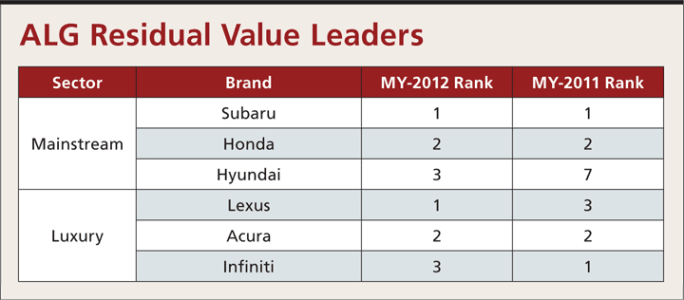
Dealers who operate in areas where leasing did make a comeback also are warming up to the transaction type. Heidi Williams, sales manager for Billings, Mont.-based Underriner Honda — part of the Underriner Motors dealer group owned by 2012 NADA Chairman William Underriner — experienced the resurgence firsthand. She says leasing currently accounts for 30 percent of the store’s new-car business, which she attributes to Honda’s high resale values and her employees presenting the option to every customer.

“Our personal goal is to try to get our business to 50 percent leasing because it brings the customer back to the market sooner,” she says. “And lease customers are statistically far more loyal to the brand, especially Honda.”
Williams admits her store isn’t selling as many service contracts as a result, but a menu of customized options tailored to lease customers has allowed the store to maintain a 60 percent product acceptance rate on lease deals. Talking about products early and often also has helped.
Meanwhile, F&I product providers — particularly noncaptive companies — have devised new product strategies to help F&I managers sell product on lease deals. Bundling products such as appearance and windshield protection and offering shorter terms on those packages was one way providers responded. Some providers also introduced programs that allowed dealers to preload product. And by offering complimentary coverage, the hope is that the F&I office can upsell the product or be able to focus on the higher grossing products.
Ryan Campbell, F&I manager at Indiana’s Toyota of Warsaw and Rice Ford Lincoln, prefers retail financing to leasing, but he also knows how important leasing is to restocking his two stores with pre-owned inventory. He also knows that pre-owned vehicles, especially late-model cars with lower mileage, present an easier path to selling a service contract. That’s why he’s looking forward to what captives have in store in 2012.
“When I was selling cars, I liked lease deals because it meant that you were going to have a customer again [at lease end],” Campbell says. “But it’s not my favorite. However, the way the used-car market has been for the last couple years should illustrate to us why we need to be maintaining healthy lease portfolios.”
More Auto Finance

Interest Rates Further Squeeze Auto Consumers
Last month’s hike and a potential second increase this month add to a growing list of inflation woes that could continue to dent overall car sales.
Read More →
Mind Your Process
Consistent steps taken in various aspects of the F&I office can make valuable differences over time, similar to an outline for a best-selling book.
Read More →
Top Five Credit Application Fraud Flags
Compliance audits regularly reveal bad habits that can lead to fraud charges and should have been stamped out decades ago.
Read More →
More Auto Loans for the Taking in August
Riskier categories were on the uptick for the month as lenders loosened access in several areas while balancing out the exposure in another, Cox Automotive reported.
Read More →
July Was Hot for Auto Borrowers
Credit proved readily available for many, but most loans left buyers in negative territory, Cox Automotive said.
Read More →
Dealer Lender Preferences Revealed
When lenders provide consistent, fast service, their overall satisfaction scores with dealers greatly improve, according to JD Power research.
Read More →
Auto Refi Savings Surge
Consumers with 84-month auto loan terms who refinanced saved the most on monthly payments, according to a new report by auto refinancing provider Caribou.
Read More →
Subaru Enters Lending Business
The automaker follows other brands in adding captive financing in the U.S., and says the move will strengthen its position here.
Read More →
Positive Equity Reaches Record High
Mainstream vehicle owners who bought a car seven years ago are likely to have positive equity when trading in for a new vehicle, according to second-quarter Edmunds data.
Read More →
Dealerships Are Paying the Price for Extended Car Loans
Growing negative-equity scenarios mean such lengthy terms should be addressed in a forward-looking way to make them work for the dealer and the consumer down the road.
Read More →