

F&I
Consistency at Scale: Driving F&I Performance
With 75 rooftops across the Sunshine State, Morgan Auto Group has proven to Floridians that it knows a thing or two about driving performance in a competitive market. But it didn’t start at the top.


 MENU
MENU SEARCH
Finance has historically been the last step in the car-buying process, but it doesn’t have to be. The customer’s journey starts long before they arrive at the dealership, and so should F&I’s involvement.
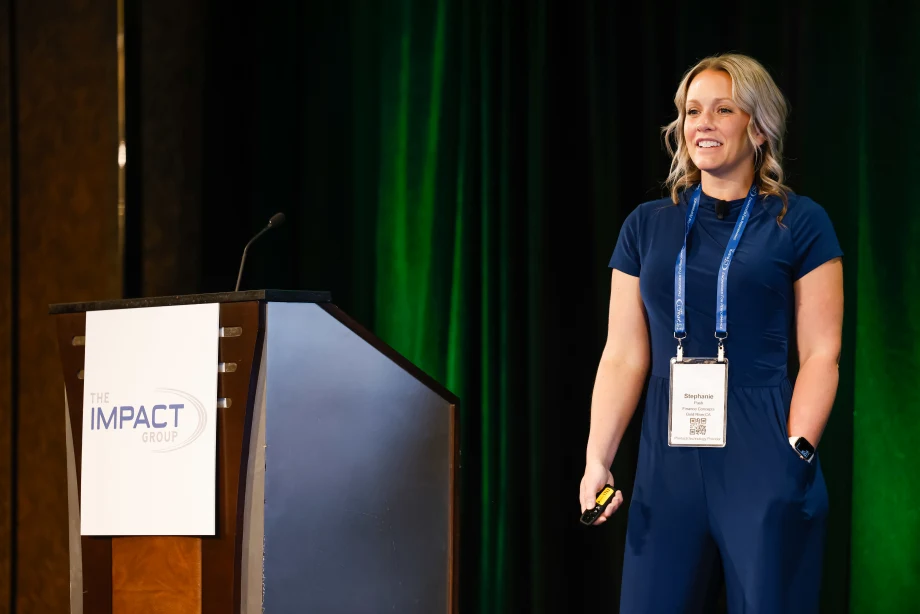
Pash spent 16 years in automotive retail before transitioning to training and development.
Expo Ease
From initial awareness to driving away with a brand-new or used car, an automotive customer’s journey is shaped by a multitude of touchpoints. In the modern era, most of those touchpoints are digital. And while inventory is usually easy to access, there is one area of the business that is often left out of the conversation, according to industry professional Stephanie Pash: finance and insurance.
Pash is a production development manager for Finance Concepts, a Portfolio company. But she didn’t start at the top. Like a lot of people in the car business, she stumbled into sales, realized the opportunity set before her and never looked back.
“A world opened up that my brain had never even comprehended,” she said of her career, which started at a rare combined Toyota-Mercedes dealership in Washington state. “This industry provides beautiful lives for people who want them.”
Eventually, Pash moved from sales to the finance desk, and it was there that she found her niche: mastering the digital side of the business. She saw the need for a point person for the vendors and systems in the dealership where she worked, and she pitched the idea to her general manager at the time.
Then, with a mere $20 a month investment on the part of the dealership, Pash launched a sponsored advertisement for the store that she said sent leads through the roof to the point that it had to hire several people to handle the volume. From there, she grew her knowledge base through Google Analytics and Facebook Blueprint certifications.
It wasn’t long before she noticed that a vital piece of the puzzle was missing from the digital systems: finance. So she took steps to get the finance department involved and said the profit center saw a noticeable improvement in workflows and customer journeys.
At this year’s Ethical F&I Managers Conference, Pash laid out four ways that dealerships can audit themselves for missed F&I opportunities.
Third-party platforms or anywhere your dealership’s vehicles are listed should have the finance department looped in, Pash said. The platforms often offer financing options and display rates that the dealership set. If F&I isn’t involved in the decision-making process, that could negatively impact the department.
As Pash said, “You can’t have other people doing F&I’s job.”
Some questions the dealership should explore include:
“It’s your profit. It’s your department,” she said. “And this is influencing it. You deserve to be at the table to talk about this.”
Customers obviously don’t want to waste time once they get to the dealership. If they’re locked in on a price they received online, where no F&I products were offered, that puts the F&I department in a reactive position, trying to establish value with a resistant customer. But if the platform is optimized for customers to choose protection products before they get to the store, it sets everyone up for a smoother, profitable process.
A dealership’s website is where it has the most control of what is shown to a customer, Pash said. It should be a hub of information for everything the customer needs, because if they can’t find it on the website, they’re going to look somewhere else. It’s the dealership’s chance to establish value early and begin to build trust with the customer.
To audit the website, it must be viewed from the eyes of a customer, and that includes the mobile and tablet experience. Things to look out for on mobile include:
Pash also recommended helpful items to have on the dealership website, like F&I product explanations, video content highlighting the benefits of protection options, and real customer scenarios.
Dealership content is the key to start building trust at digital touchpoints before a customer gets to the dealership.
“If you put the right amount of effort into your content, it can be used in so many different ways,” Pash said. “A one-time effort can be utilized across so many different platforms to keep a consistent and visible message across all of your third-party websites.”
Content includes videos, photos and team member profiles. Pash said video is the fastest way to humanize your team, but it doesn’t have to be a high-budget production. The more human and relatable the content is, the more the customer will appreciate it.
Video subject ideas include:
Pash also emphasized the importance of saving and using good customer reviews on the dealership’s website and Google business profile. Team member profiles are an ideal place to include positive reviews and other feedback.
The finance team must be active every day in the dealership’s customer relationship management software, Pash said. It helps them see who is coming in that day and what, if any, steps can be taken before the customer arrives at the dealership to make the process as smooth as possible.
Pash gave as an example the placing of courtesy phone calls to customers who are coming from out of town. If F&I doesn’t know they’re coming, the team loses the chance to intercept missed protections if the customer is armed with a check or cash.
Pash listed some ways that your dealership’s CRM could be costing it F&I gross:
Pash ended her presentation by urging finance managers to take ownership of their own results.
“The most successful finance departments aren’t waiting to be included,” she said. “They’re making sure that they are.”
Loading data...
F&I
With 75 rooftops across the Sunshine State, Morgan Auto Group has proven to Floridians that it knows a thing or two about driving performance in a competitive market. But it didn’t start at the top.







Industry
More auto dealerships are offering mobile servicing for today’s convenience-minded consumers to boost business and stand out from competition, though it may not fit every store.
Industry
Since finance-and-insurance was added to the auto dealership, most stores’ F&I teams have been separated from sales like a car’s trunk is separated from the engine. It doesn’t have to – and shouldn’t – be that way.
F&I
Finance has historically been the last step in the car-buying process, but it doesn’t have to be. The customer’s journey starts long before they arrive at the dealership, and so should F&I’s involvement.
Digital
Digital retailing has not made the F&I manager obsolete. If anything, it has revealed how valuable the role can become when technology is used correctly.
F&I
How can auto dealerships help F&I managers fulfill their vital role in the most effective ways? Industry expert Rick McCormick shares his insights on the best ways to train these professionals and help them maintain good habits.
Industry
2026 NADA Chairman Rob Cochran knows a thing or two about leadership after decades in the business. He brings an emphasis on stewardship to his new role at the head of the country’s major auto retail trade group.
F&I
It may be human nature to back off when a customer seems to say no to a product or service. But experts say F&I managers should operate as though the answer will be the opposite.
F&I
A high profit per-vehicle retail can create a false sense of strength that masks underlying problems, while a low one may not reveal an operation that's actually efficient and well-balanced.
Industry
As America turns 250, explore how the automotive industry shaped jobs, culture, innovation, and mobility from Detroit assembly lines to today’s EV era.