F&I
Consistency at Scale: Driving F&I Performance
With 75 rooftops across the Sunshine State, Morgan Auto Group has proven to Floridians that it knows a thing or two about driving performance in a competitive market. But it didn’t start at the top.


 MENU
MENU SEARCH
How can auto dealerships help F&I managers fulfill their vital role in the most effective ways? Industry expert Rick McCormick shares his insights on the best ways to train these professionals and help them maintain good habits.
McCormick said that F&I training should be transformational, changing behavior and not just providing information.
Reahard & Associates
Rick McCormick, national director of training for Reahard & Associates, has been in the automotive retail business for more than 25 years, and he started out as a finance manager.
From the finance-and-insurance office of a Georgia dealership that sold Chevrolet, Chrysler and Jeep models, he took his hard-won expertise and started training others to do the same specialized sales, joining nationally known F&I training firm Reahard & Associates 20 years ago.
McCormick both trains F&I managers in the ins and out of sales and speaks at industry conferences on the subject, including Bobit Business Media’s annual Agent Summit.
He recently shared with F&I and Showroom some of his deep knowledge on how to approach F&I manager training and how to make it stick over time. Below are his answers to questions about the behind-the-scenes process:
Q:How often do adult learners need to be retrained before bad habits return?
A: In F&I, bad habits tend to return more quickly than in most other dealership roles due to the high volume of customers in a short period, lender constraints, and general compliance fatigue. Without ongoing reinforcement, shortcuts often reappear the moment a customer raises an objection.
F&I managers, regardless of experience level, should attend a three‑day certification class to establish a consistent process and build a strong foundation for future growth.
From there, we strongly recommend a training regimen that continually reinforces that foundation and includes:
The goal isn’t constant retraining. It’s consistent reinforcement.
Q:How do F&I managers evaluate if they're slipping into bad habits?
A: Most F&I managers don’t recognize they’re slipping until it begins to show up in their numbers. Reduced performance is often the first red flag, but there are several telltale signs that habits are slipping, long before the results fully reveal it.
Common indicators of bad habits returning are:
When results begin to decline, it usually means skills have dulled, attitude needs a reset, and old habits have resurfaced. Customers then seem tougher, not because they are but because the F&I manager is presenting based on their own needs rather than the customer’s.
Just like an athlete experiencing a slump, the slump is not the problem. It’s the symptom of bad habits returning.
Q:How do you evaluate whether training is taking or being embraced?
A: Training is only effective when behavior changes. Real change requires following a consistent process that builds value around the customer’s needs. When overcoming resistance becomes comfortable, natural and focused on the customer, not the F&I manager, you know the training is being embraced and applied.
The key indicator is consistent improvement, not temporary spikes.
To ensure training is taking, monitor:
A short-term spike followed by gradual regression typically indicates the manager was trained but received no ongoing reinforcement. Without reinforcement, habits fade, shortcuts return, and performance declines.
Q:Should different generations be trained differently?
A: Yes, but not because of age. Training should be adjusted based on experience level, learning expectations and skill gaps, not generational labels. A 60‑year‑old who is new to F&I is still new to F&I. Automotive or sales experience is certainly helpful, but it does not replace the specialized skills required in the F&I office.
Selling a vehicle is selling a tangible product that customers want. In F&I, we are presenting intangible protection products that customers often don’t initially believe they need. These require different skill sets, communication strategies, and levels of emotional intelligence.
F&I development falls into four key quadrants: mindset, skill set, execution and practice. Any of these areas can become a development focus for any experience level.
A new F&I manager may need more skill-set training, while an experienced F&I professional may be shortcutting the process that once made them successful. Anyone, regardless of age, can fall into prejudging customers or inconsistent execution.
The goal is to identify which quadrant is limiting performance, and then focus training efforts there.
Q:When and how should F&I training be done—and how long should it last?
A: As mentioned earlier, the training process is just as important as the deal process. Every F&I professional should attend a foundational class to begin their development journey. This should be non-negotiable because it establishes the baseline skills and mindset needed for long-term success.
A true F&I professional must train continuously throughout their entire career. This ongoing development includes:
F&I professionals are no different from other high-level professionals. Continuing education, coaching and skill refinement ensure that knowledge is strengthened, value is clearly communicated, and customers consistently receive the help they need.
Whether it’s uncovering needs, reviewing options, building value or overcoming objections, F&I professionals don’t practice until they get the process right. They practice until they can’t get it wrong.
Q: Is online training OK for some trainees? Should more experienced trainees get in‑person training, or vice versa?
A: Online training is highly effective for building knowledge across every part of the F&I process. It provides structured instruction on product knowledge, objection handling, compliance, and the overall deal flow. Since training must be a daily activity, online learning works well because it can be completed consistently and integrated into a regular routine, just like brushing your teeth. It should be comprehensive, covering all areas to ensure consistent growth.
Online training paired with in‑store, hands‑on coaching is one of the most powerful combinations for changing behavior and reinforcing a consistent process with every customer.
Contrary to popular belief, the more experience an F&I professional has, the more valuable live interaction becomes. Experienced managers often develop shortcuts or fall into pattern-based habits. Live training helps refine skills, correct drift, and elevate performance beyond basic competency.
Everyone, regardless of experience level, should be continuously engaged in both online training and live, in-person coaching to build a well-rounded, skill-strengthening development process.
Q: What are the most common training mistakes dealerships make with F&I managers, and how would you rectify those?
Dealerships that expect and require continuous training and make it an integral part of the job create F&I professionals who feel supported, valued and invested in. As a result, they are more likely to stay with a dealership that continually invests in their development.
One of the most effective accountability tools today is video review. Reviewing recorded transactions enables managers and leaders to identify training opportunities, confirm that the process is being followed, and ensure that sales tools are used properly. In a world where everything is recorded, reviewing performance shouldn’t be the exception. It should be the standard for professionals.
Video reviews also create transparency in the improvement process and help F&I managers strengthen their ability to truly help every customer.
Dealerships must instill the expectation of continuous improvement and then implement a structure that guarantees it happens. This includes establishing a consistent training schedule; creating a defined process for ongoing skill development; ensuring training efforts are visible and measurable; and incorporating accountability into daily operations
Today, success isn’t just about achieving customer satisfaction. It’s about creating customer delight. To achieve that, dealerships must design a long-term training program that keeps every F&I professional growing, adapting and expanding their skill set.
Once the training structure is established, accountability must follow. That means tracking each manager’s effort, not just their results; tracking improvement over time, not just monthly numbers; and ensuring training and customer experience are part of the pay plan.
Customer retention is everything in this business, and the most powerful retention tool in a dealership is a truly exceptional customer experience. That requires both sales and F&I processes to be engaging, educational and informative.
Q: Is there anything you'd add to keep in mind on training best practices?
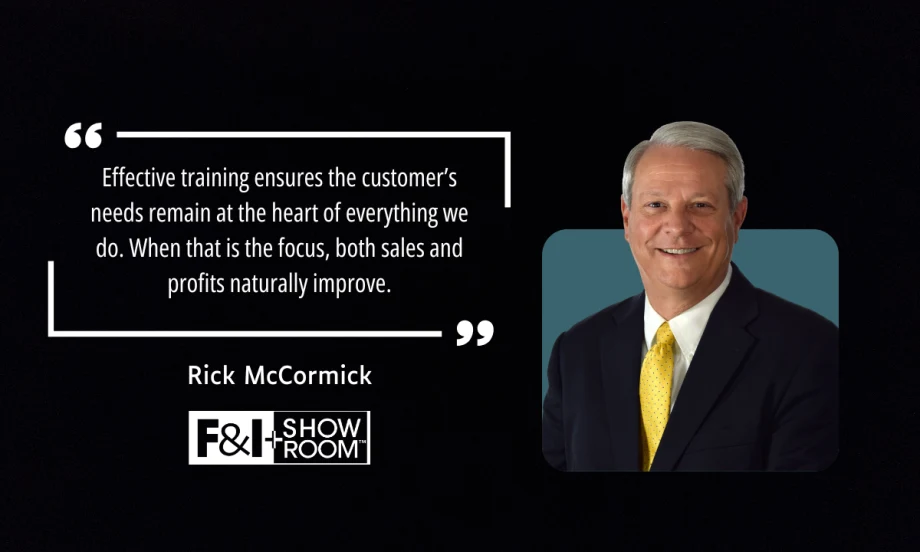
Training should be transformational. It should change behavior, not just provide information. Buying a vehicle should be enjoyable and centered on the buyer's needs, not the seller's goals. Effective training ensures the customer’s needs remain at the heart of everything we do. When that is the focus, both sales and profits naturally improve.
In the F&I office, customers won’t pay attention to a sales pitch they don’t want to hear. However, they will invest thousands of dollars in an F&I professional’s knowledge, expertise and guidance. The real skill lies in helping customers clearly understand why F&I products matter and how they specifically benefit. That’s what builds credibility, value and trust.
High-performing F&I departments aren’t created from a single great class. They are built through ongoing, intentional training and coaching focused on continuously improving our ability to help customers. Consistency, reinforcement and a customer-first mindset are what separate good departments from exceptional ones.
Loading data...
F&I
With 75 rooftops across the Sunshine State, Morgan Auto Group has proven to Floridians that it knows a thing or two about driving performance in a competitive market. But it didn’t start at the top.







Industry
More auto dealerships are offering mobile servicing for today’s convenience-minded consumers to boost business and stand out from competition, though it may not fit every store.
Industry
Since finance-and-insurance was added to the auto dealership, most stores’ F&I teams have been separated from sales like a car’s trunk is separated from the engine. It doesn’t have to – and shouldn’t – be that way.
F&I
Finance has historically been the last step in the car-buying process, but it doesn’t have to be. The customer’s journey starts long before they arrive at the dealership, and so should F&I’s involvement.
Digital
Digital retailing has not made the F&I manager obsolete. If anything, it has revealed how valuable the role can become when technology is used correctly.
F&I
How can auto dealerships help F&I managers fulfill their vital role in the most effective ways? Industry expert Rick McCormick shares his insights on the best ways to train these professionals and help them maintain good habits.
Industry
2026 NADA Chairman Rob Cochran knows a thing or two about leadership after decades in the business. He brings an emphasis on stewardship to his new role at the head of the country’s major auto retail trade group.
F&I
It may be human nature to back off when a customer seems to say no to a product or service. But experts say F&I managers should operate as though the answer will be the opposite.
F&I
A high profit per-vehicle retail can create a false sense of strength that masks underlying problems, while a low one may not reveal an operation that's actually efficient and well-balanced.
Industry
As America turns 250, explore how the automotive industry shaped jobs, culture, innovation, and mobility from Detroit assembly lines to today’s EV era.