



Cut in Gas Prices Fuels $300 Decline in Wholesale Prices
Wholesale prices continued to fall in May and into June, with cumaltive market prices declining $300 from April, the NADA Used Car Guide reported yesterday.
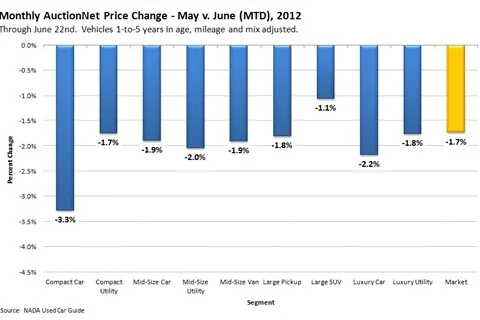
McCLEAN, Va. — Wholesale prices continued on their downward course in May, as cumulative market prices declined by $300, or 1.7 percent, compared to the prior month, according to the National Automobile Dealers Association’s Used Car Guide.
The steep cut in gasoline prices over the last two months — which the U.S. Energy Information Administration (EIA) puts at 50 cents from early April through the third week of June — combined with the drop-off in seasonal demand normally seen following the end of spring continues to place significant downward pressure on compact car prices, and, as a result, the segment’s 3.3 percent fall was the biggest of any segment.
Prices for the remaining segments all fell within a half a point or less of the market average, with the exception being the large SUV segment, which had prices slide by a more moderate 1.1 percent.
Compared to last June, market prices were at a 1.5 percent disadvantage, which isn’t a surprise since used prices remained elevated into July of last year because of new-vehicle substitute demand stemming from Japan’s natural disasters. “We can expect to see this inverted relationship in prices remain in effect until at least until August, which is when market prices took a dive in 2011,” Jonathan Banks, executive automotive analyst for the NADA Used Car Guide, wrote.
“Overall, the NADA expects to see current trends stay true to their present direction, which means that the usual slackening of demand experienced over the summer will be the main driver behind softening used prices near-term,” he continued. “That being said, the quick descent of gasoline prices will continue to see compact car prices roughed up more than otherwise but will also help cushion the fall of truck prices; the relatively minor fall in large SUV prices for the month is evidence of this.”
Banks added that the slight reduction in the number of rental fleet units going through the lanes over the last few weeks has helped to alleviate some of the downward pressure on fleet-heavy segments. “I think this observation and the fact that we’re half way through the year transition nicely into a summary of auction volume changes year to date,” he wrote.
“Considering NADA’s prediction that used supply will continue to fall until well into 2013 before starting to pick back up again, it should come as no surprise that auction volume is down yet again this year.”
Volume for vehicles up to 10 model years in age is down by 4 percent compared to the same period last year, and even more dramatically, volume for vehicles five years in age or younger is down by more than three times that amount, or 13 percent.
“As you would expect from movement of this type, volume for only one segment — compact utilities at plus 6 percent — has increased year to date, while at the opposite end of the spectrum, large pickup, large SUV, and mid-size utility volume has tumbled by 24-to-25 percent,” Banks wrote.
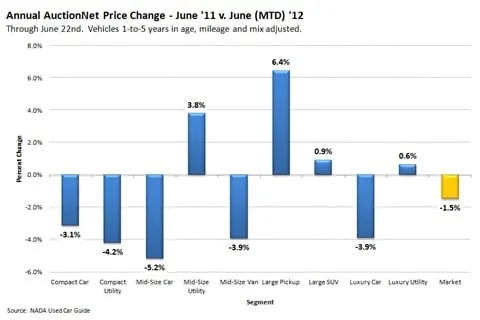
Based on the ongoing decline in supply at auction and the fact that values in June are a slight 1.5 percent below last year’s inflated level, it’s evident that the uptick in used-vehicle trade-ins accompanying the growth in new vehicle sales has done little to change the current balance of supply and demand.
More Auto Finance

Interest Rates Further Squeeze Auto Consumers
Last month’s hike and a potential second increase this month add to a growing list of inflation woes that could continue to dent overall car sales.
Read More →
Mind Your Process
Consistent steps taken in various aspects of the F&I office can make valuable differences over time, similar to an outline for a best-selling book.
Read More →
Top Five Credit Application Fraud Flags
Compliance audits regularly reveal bad habits that can lead to fraud charges and should have been stamped out decades ago.
Read More →
More Auto Loans for the Taking in August
Riskier categories were on the uptick for the month as lenders loosened access in several areas while balancing out the exposure in another, Cox Automotive reported.
Read More →
July Was Hot for Auto Borrowers
Credit proved readily available for many, but most loans left buyers in negative territory, Cox Automotive said.
Read More →
Dealer Lender Preferences Revealed
When lenders provide consistent, fast service, their overall satisfaction scores with dealers greatly improve, according to JD Power research.
Read More →
Auto Refi Savings Surge
Consumers with 84-month auto loan terms who refinanced saved the most on monthly payments, according to a new report by auto refinancing provider Caribou.
Read More →
Subaru Enters Lending Business
The automaker follows other brands in adding captive financing in the U.S., and says the move will strengthen its position here.
Read More →
Positive Equity Reaches Record High
Mainstream vehicle owners who bought a car seven years ago are likely to have positive equity when trading in for a new vehicle, according to second-quarter Edmunds data.
Read More →
Dealerships Are Paying the Price for Extended Car Loans
Growing negative-equity scenarios mean such lengthy terms should be addressed in a forward-looking way to make them work for the dealer and the consumer down the road.
Read More →