



J.D. Power Study Finds Decline in Dealer Satisfaction With Lenders
Industry-wide declines in overall dealer satisfaction with lenders indicate a need for improved service from automotive finance sources, according to the J.D. Power and Associates 2009 Dealer Financing Satisfaction Study.
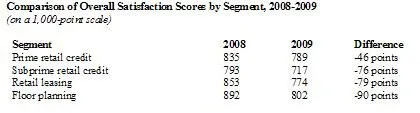
WESTLAKE VILLAGE, Calif. — Industry-wide declines in overall dealer satisfaction with lenders indicate a need for improved service from automotive finance sources, according to the J.D. Power and Associates 2009 Dealer Financing Satisfaction Study.
Despite the overall decline in dealer satisfaction with finance sources, BMW Financial Services and Mercedes-Benz Financial ranked among the top three in the prime retail credit, retail leasing and floor planning segments of the study.
In prime retail credit Mercedes-Benz Financial has an index score of 918, and performs well in provider offering and credit personnel. Alphera Financial Services (910) and BMW Financial Services (898) follow in the rankings.
For a sixth consecutive year, BMW Financial Services ranks highest in retail leasing satisfaction with a score of 909 and performs well in credit personnel, application/approval process and termination policy/service. Mercedes-Benz Financial follows closely with a score of 908, and Toyota Financial Services ranks third in the segment with 872.
With a score of 926, Mercedes-Benz Financial ranks highest in floor planning, followed by BMW Financial Services (921) and Volkswagen Credit (896).
The favorable scores of these lenders is in contrast to the study's finding that overall dealer satisfaction with lenders decreased from 2008 in four segments — prime retail credit, subprime retail credit, retail leasing and floor planning.
The service aspects of the retail financing experience account for more than two-thirds of dealer satisfaction. Meanwhile, offerings — including rates — account for less than one-third of overall satisfaction. This indicates an opportunity for lenders to differentiate themselves through service, even though external market forces are driving a more conservative lending approach.
“Current economic conditions have created something of a ‘perfect storm,’ as declines in new-vehicle sales, tightened lending and reduced inventory funds have combined to put extreme stress on dealer business,” said David Lo, director of financial services at J.D. Power and Associates. “However, the fundamental principles of service are unchanged. Lenders that focus on prompt application and funding turnaround times, have credit buyers that demonstrate willingness to work with their clients, and have sales representatives who are skilled in relationship management may position themselves to be a lender of choice.”
The study finds that higher levels of satisfaction may positively impact the amount of business a lender receives from a dealer. For example, among lenders in the prime retail credit segment whose satisfaction scores average 712 on a 1,000-point scale, 22 percent of dealers say they “definitely will” increase their business with that lender. In contrast, for lenders whose satisfaction scores average 886, 46 percent of dealers say they “definitely will” increase their business with that lender.
“High-performing lenders tend to close a higher proportion of deals,” said Lo. “This is critical right now, and — almost more importantly — may serve as a foundation for growth once the market stabilizes.”
More Auto Finance

July Was Hot for Auto Borrowers
Credit proved readily available for many, but most loans left buyers in negative territory, Cox Automotive said.
Read More →
Dealer Lender Preferences Revealed
When lenders provide consistent, fast service, their overall satisfaction scores with dealers greatly improve, according to JD Power research.
Read More →
Auto Refi Savings Surge
Consumers with 84-month auto loan terms who refinanced saved the most on monthly payments, according to a new report by auto refinancing provider Caribou.
Read More →
Subaru Enters Lending Business
The automaker follows other brands in adding captive financing in the U.S., and says the move will strengthen its position here.
Read More →
Positive Equity Reaches Record High
Mainstream vehicle owners who bought a car seven years ago are likely to have positive equity when trading in for a new vehicle, according to second-quarter Edmunds data.
Read More →
Dealerships Are Paying the Price for Extended Car Loans
Growing negative-equity scenarios mean such lengthy terms should be addressed in a forward-looking way to make them work for the dealer and the consumer down the road.
Read More →
Trade-Ins in Negative Equity Reach New Heights
As such trade-ins rise in frequency, so do monthly loan payment amounts and interest rates, according to second-quarter data compiled by Edmunds.
Read More →
Auto Credit Plentiful
June numbers show lenders are readily granting access, including to risky borrowers, as consumers leverage themselves to take on high prices.
Read More →
Automotive Consumers Sink Further in Debt
Most financing metrics hit records in the second quarter as more buyers locked themselves into long terms and high monthly payments.
Read More →
Porsche Financial Services Shifts Structure
After 36 years with Porsche, the Financial Services Chief Financial Officer Konrad Riedl is retiring, and the department is realigning its management structure.
Read More →