



Black Book Used Vehicle Retention Index Decreases in December
There were 4 months of typical seasonal decline in prices, resulting in a relatively flat seasonally adjusted index.

There were 4 months of typical seasonal decline in prices, resulting in a relatively flat seasonally adjusted index.
IMAGE: Black Book
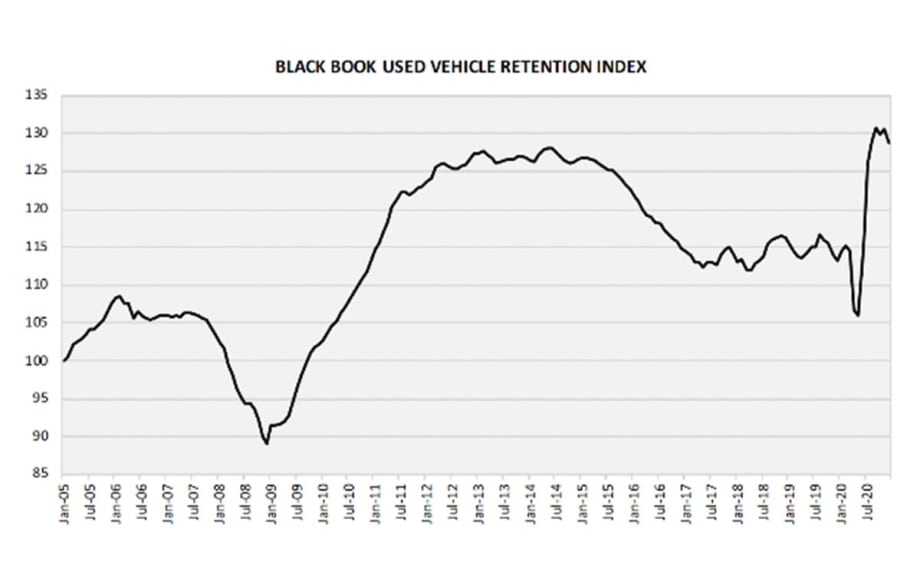
LAWRENCEVILLE, Ga. – Black Book, a division of Hearst that provides industry-leading used vehicle valuation and residual value forecast solutions, released its Used Vehicle Retention Index for December 2020 (128.8), a 1.8 point decline from November (130.6). Click here to obtain a copy of the latest index data.
“The seasonally adjusted Retention Index has remained relatively stable since August,” said Alex Yurchenko, SVP, Data Science. “Nevertheless, due two record-setting summer months, the year ended with a 15.5-point (or 13.7%) year-over-year change in the Index. In fact, only the Minivan Segment did not have a year-over-year increase in the Index.”
The Black Book Used Vehicle Retention Index is calculated using Black Book’s published Wholesale Average value on two- to six-year-old used vehicles, as percent of original typically-equipped MSRP. It is weighted based on registration volume and adjusted for seasonality, vehicle age, mileage, and condition. The Index offers an accurate, representative, and unbiased view of the strength of today’s used vehicle market values. The Index dates to January 2005, where Black Book published a benchmark index value of 100.0 for the market. During 2008, the index dropped by 14.1% while during 2016, the index fell by just 6.4%. During 2011, the index rose strongly from 113.3 to 123.0 by the end of the year as the economy picked up steam and used vehicle values rose higher. It continued to remain relatively stable, rising slightly until May of 2014 when it hit a peak of 128.1. During 2020, we saw the largest drops and increases in the Index due to supply and demand pressures during the COVID-19 pandemic. To obtain a copy of the latest Black Book Wholesale Value Index, please click here.
More Auto Finance

Mastering Credit Friction
In this video, Josh Krach explains how to turn credit friction into an advantage.
Read More →
April Less Affordable
Based on prices, reduced incentives and slower household income growth, consumers found it more challenging to buy new last month, Cox Automotive reported.
Read More →
Auto Lenders, Consumers on a Tightrope
April borrowing data shows that more consumers are bending over backward to buy vehicles, though subprime lending cooled off for the month.
Read More →
Toyota Financial Services President Replaced
Scott Cooke has served in various roles with Toyota Financial Services for over 20 years, including president and CEO, which he retires from on June 30.
Read More →
Permission or Approval: When to Notify Finance Sources
Credit card down payments, multiple vehicle purchases and even straw purchases can be completed without committing bank fraud, as long as you tell the bank first.
Read More →
At-Risk Auto Borrowers Drive Looser Credit Access
Cox Automotive’s index shows the subprime segment, long loan terms, negative-equity borrowers and down payment amounts all grew in February despite ever-higher vehicle prices.
Read More →
Auto Loan Forecast Bucks Market Trend
Auto loan originations rose over 6% year-over-year in the third quarter of 2025, but TransUnion predicts a slight decline in auto loan growth this year, making it an outlier in the company's overall lending forecast.
Read More →
Auto Credit More Plentiful
Growing access shows greater lender appetite for risk as consumers take on heavier debt burden in an inflated market.
Read More →
Auto Loans Long as Stretch Limos
More consumers, faced with ever-rising car prices, are adapting by agreeing to longer loan terms despite the cost of added interest payments.
Read More →
AutoPayPlus Launches RePayPlus
The reinsured biweekly payment program offers auto dealers with customer retention and reinsurance structure.
Read More →