



Black Book: Weekly Market Report
The market continued to make gains this past week, marking the fourth consecutive week of overall wholesale value increases.

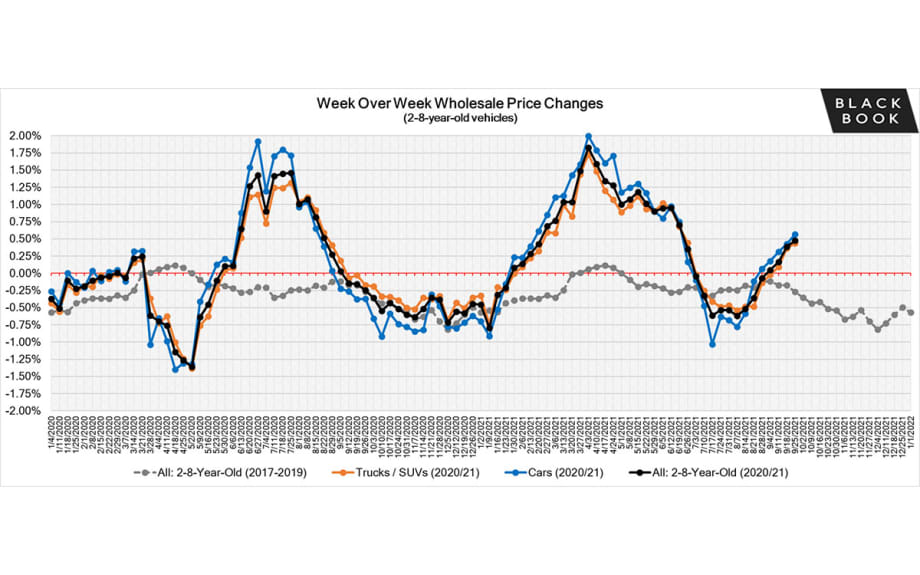
The market continued to make gains this past week, marking the fourth consecutive week of overall wholesale value increases.
Wholesale Prices, Week Ending September 25th
The market continued to make gains this past week, marking the fourth consecutive week of overall wholesale value increases. All segments reported increases, except for Sporty Cars. Sporty Cars typically begin to decline as the weather starts to cool so maybe one segment will be behaving “normally” this fall.
This Week Last Week 2017-2019 Average (Same Week)
Car segments +0.57% +0.43% -0.34%
Truck & SUV segments +0.43% +0.36% -0.22%
Market +0.48% +0.38% -0.27%
Car Segments
On a volume-weighted basis, the overall Car segment increased +0.57%. For reference, the previous week, cars increased by +0.43%.
Eight of the nine Car segments reported gains last week, with Sporty Car (-0.11%) being the only segment to decline. The segment has now reported declines for thirteen consecutive weeks.
Mid-Size (+0.86%) and Compact (+0.83%) Car segments reported the largest gains, but the Near Luxury (+0.66%) and Luxury (+0.70%) segments weren’t far behind in the rate of gains.
Truck / SUV Segments
The volume-weighted, overall Truck segment increased +0.43%, compared to previous week’s increase of +0.36%.
All thirteen truck segments reported gains last week.
Full-Size Trucks had a second consecutive week of increases, with the segment increasing +0.03% after the prior week’s increase of +0.10%.
Minivans (+0.75%) had another large week of gains, with the segment increasing for a seventh consecutive week. The segment has reported gains in thirty out of the last thirty-five weeks, for an average weekly change of +0.71%.
Weekly Wholesale Index
Calendar year 2020 ended with used wholesale prices at elevated levels. With economic patterns (including the automotive market) driven by the pandemic, normal seasonal patterns (e.g., 2019 calendar year) in the wholesale market were not observed for most of the year. We saw a similar picture in 2009, at the end of the Great Recession. Calendar year 2021 has not had typical seasonality patterns as the market has had rapid increases in wholesale values for the majority of the year. After reaching record heights at the end of June, wholesale prices began to decline at a rate higher than the typical seasonal decline through July and most of August. As we moved into the Fall season, wholesale prices began to show a positive movement once again and reached the highest point of the year last week.
The graph below looks at trends in wholesale prices of 2-6-year-old vehicles, indexed to the first week of the year.
Retail (Used and New) Insights
Toyota revealed the redesigned 2022 Tundra last week. This is the first major update to the Tundra since 2007. Look for the updated full-size pickup truck to hit showrooms later this year.
Starting with the 2022 C40, Volvo will be phasing out the use of leather in all their products. By 2030, when the entire Volvo line-up will be electrified, they will have completed the phase out of leather.
General Motors is restarting the production of the Canyon and Colorado this week, but seven of their North American plants responsible for crossovers will remain closed this week, due to the ongoing microchip shortage.
The Ford Bronco is getting a little more exciting for the 2022 model year, with the introduction of a Raptor trim.
IHS Markit updated their global production forecast. Due to the supply shortage, they are estimating a 6.2% reduction in output, roughly 5 million vehicles, for 2021 and an additional reduction of 9.3% for 2022.
Used Retail Prices
With the proliferation of ‘no-haggle pricing’ for used-vehicle retailing, asking prices accurately measure trends in the retail space. Retail demand slowed down at the end of last year, and thus resulted in declining retail asking prices for the last several weeks of 2020. As demand rebounded, retail prices have lagged slightly behind wholesale prices, but March had an accelerated growth in retail prices. In April and May, retail prices picked up speed as demand accelerated, fueled by stimulus payments, tax season, and shortages of new inventory. In June, retail prices continued to rise at a slower rate. After strong Spring and Summer months, retail listing prices seemed to stabilize at around 25% above where we started the year.This analysis is based on approximately two million vehicles listed for sale on US dealer lots. The graph below looks at 2-6-year-old vehicles.
Inventory
Used Retail
Current used retail listing volume is about 15% below the start of the year. Used inventory is now starting to decrease again due to a slowdown of trade-ins and lease returns.
Days-to-turn for used retail listings have been increasing, as retail demand softened over the last few weeks. The days-to-turn now sits just above 34 days, which is still lower than what is typically expected in a normal year.
Wholesale
As wholesale values continue to increase, so do the sales rates. Available inventory in the wholesale channel remains limited, leading to strong bidding, particularly on anything with a good condition report and low mileage.
After weeks of newer used units reporting considerable strength compared to the older used vehicles, the trend of the 0-2-year-old vehicles increasing by a larger amount has ended. The overall wholesale market for 2-8-year-old vehicles increased by +0.48% last week, and 0-2-year-old also increased +0.48%.
ADESA is updating their inspection process by adding OBD2 emissions codes on their condition reports.
More Auto Finance

Mastering Credit Friction
In this video, Josh Krach explains how to turn credit friction into an advantage.
Read More →
April Less Affordable
Based on prices, reduced incentives and slower household income growth, consumers found it more challenging to buy new last month, Cox Automotive reported.
Read More →
Auto Lenders, Consumers on a Tightrope
April borrowing data shows that more consumers are bending over backward to buy vehicles, though subprime lending cooled off for the month.
Read More →
Toyota Financial Services President Replaced
Scott Cooke has served in various roles with Toyota Financial Services for over 20 years, including president and CEO, which he retires from on June 30.
Read More →
Permission or Approval: When to Notify Finance Sources
Credit card down payments, multiple vehicle purchases and even straw purchases can be completed without committing bank fraud, as long as you tell the bank first.
Read More →
At-Risk Auto Borrowers Drive Looser Credit Access
Cox Automotive’s index shows the subprime segment, long loan terms, negative-equity borrowers and down payment amounts all grew in February despite ever-higher vehicle prices.
Read More →
Auto Loan Forecast Bucks Market Trend
Auto loan originations rose over 6% year-over-year in the third quarter of 2025, but TransUnion predicts a slight decline in auto loan growth this year, making it an outlier in the company's overall lending forecast.
Read More →
Auto Credit More Plentiful
Growing access shows greater lender appetite for risk as consumers take on heavier debt burden in an inflated market.
Read More →
Auto Loans Long as Stretch Limos
More consumers, faced with ever-rising car prices, are adapting by agreeing to longer loan terms despite the cost of added interest payments.
Read More →
AutoPayPlus Launches RePayPlus
The reinsured biweekly payment program offers auto dealers with customer retention and reinsurance structure.
Read More →