



Ask the Power Questions
The magazine’s resident F&I pro reveals the two magic words that, when mixed with solid power questions, can motivate your customers to buy.


©gettyimages.com/kzenon
Listening is the most important part of communication; specifically, listening with the intent to learn more about the other person. To do this, you need to ask the right questions at the right time.
I’d like to take you back, for a minute, to a memory — yours, not mine. Maybe it was a job interview, a discussion with another employee, or even a meeting concerning your performance. A question was posed that changed the entire atmosphere. You know the one. It made you, or the other person, stop and think. The response then opened a door or shifted events. What made the difference is the question.
See, great questions are the most effective method to having a productive conversation with your customer before any attempt to sell them anything. That is our needs discovery — the most important part of the F&I process. But before we can get to the questions, we need to create a safe environment. A safe environment encourages an open discussion by everyone involved.
In an environment in which there is no sales pressure, customers are asked great questions that encourage them to talk while the F&I manager listens to better understand their situation. Otherwise, customers will provide guarded responses and seek to move the process forward quickly.
So, what type of questions are we going to ask? There are three types of questions designed to help customers see the need for products, which will make their ownership experience more enjoyable. Let’s review.
1. Closed-Ended Questions: Closed-ended questions, which can be answered with a “Yes” or “No,” should be held to a minimum and only used when necessary. These questions do not provide you with any new information on which to base your next question. In fact, these questions tend to turn a conversation into an interrogation.
2. Open-Ended Questions: Open-ended questions cause customers to relax and expand upon their answers. More importantly, they provide you with the information you need to sell your products. These questions utilize words such as who, what, where, when, why, and how. Open-ended questions should be a creative effort to produce an in-depth answer by the customer and must be more than what I call a “one-fact” effort.
Your open-ended questions could include:
Who will be driving the car?
How long do you normally keep your vehicles?
How many miles a year do you drive?
Where do you normally park your car during the day or night?
We should utilize these great questions. However, these one-fact questions will not promote the open discussion we need to not only discover the necessary facts but also the motivations and feelings about why they are buying and how they will use this vehicle. To uncover those, we must utilize the third and most effective question type.
3. Power Questions: These are open-ended questions on steroids. Power questions prompt customers to describe what something might look like. Here are a few examples that will hopefully prompt you to create even more:
Icebreaker: What factor was the most impactful to help you reach your level of success in your line of work?
Needs discovery: What word best describes the vehicle you’re trading in today and why?
Service contract: What is the one technology feature on your car that excites you the most?
Environmental and tire protection: How would you describe a typical month of use with your vehicle?
Dent-and-ding: How would you describe a typical weekend for you and your family?
The great thing about power questions is they naturally lead to follow-up questions and more discussion. I have observed, either in person or on video, hundreds of F&I deliveries. The F&I managers who ask quality questions normally end up asking 20 to 30 questions as they progress through the required paperwork and before the menu is presented to the customer.
"There are two “magic words” that, when used as a part of a power question, engage the mind of the customer at a high level and create a picture in their mind that motivates them to buy."
They also have a tremendous amount of information and reasons why their customers need several of the products they offer. And they will have numerous opportunities to use the most powerful tool any F&I manager has: “You told me earlier …”
F&I managers who ask more closed-ended and one-fact questions can end up talking more than the customer. They also gain fewer reasons why their customers need their products.
Say the Magic Words
There are two “magic words” that, when used as a part of a power question, engage the mind of the customer at a high level and create a picture in their mind that motivates them to buy. The first word is “describe.” When you ask a customer to describe something, it immediately paints a picture in their mind that their response will vividly describe. Referring to that response in your interaction provides a powerful way to move them to consider the products you are discussing. In fact, consider the following word-track:
“Earlier, you described a typical weekend for your family as being a non-stop schedule of soccer games that usually involves several other child passengers. That’s why the environmental protection is critical for you, so all of that activity will not permanently damage the interior of your vehicle and hurt its trade value later.”
When you refer to the scenario they described, it is much more powerful than any scenario you come up with. That’s power selling with power questions.
The second magic word is “one.” When you ask a customer to single out one piece of information, their mind immediately starts a process of sifting through information like going through a box of index cards. This brings a sense of urgency or importance to an area you want to highlight and brings the most important fact to the surface. In short, it makes them think. One of the struggles in our fast-paced environment is to get customers to slow down and think about the ramifications of the major purchase they are making.
"Ask your next customer, “What is the one technology feature on this new car that excites you the most?” This sets up a discussion about the high level of technology inside the vehicle and the urgency to protect against the high cost of repairing a possible failure of that technology or replacing it."
Ask your next customer, “What is the one technology feature on this new car that excites you the most?” This sets up a discussion about the high level of technology inside the vehicle and the urgency to protect against the high cost of repairing a possible failure of that technology or replacing it. It also makes you aware of the level of engagement each customer has with the technology on their vehicle and the level of effort you might need to use to enable them to realize how much more advanced the vehicle is compared to their trade-in.
Power questions create an open dialogue with the customer and the conversation that follows is based on his or her situation. That is a conversation your customers will be interested in and one that will enable them to see themselves using the products offered. Power questions provide at least seven benefits to our efforts:
Increased levels of engagement
Greater trust and openness in less time
Forces the customer to think
Creates conversations and eliminates the presentation
Moves customers to take ownership of their own conclusions
Naturally leads to more questions, both by you and the customer
Creates a helping environment as opposed to a selling environment
Every F&I manager asks their customers questions. However, if an intentional effort is made to develop questions that provide the deeper interaction needed to make our invisible products visible to the customer, we will see better results. The questions we ask need to be updated regularly so we can provide the most effective customer-focused process. Few things will have more of an impact on your ultimate success in F&I.
Rick McCormick is the national account development manager for Reahard & Associates Inc., an F&I training company providing classes, workshops, in-dealership and online training. Email him at rick.mccormick@bobit.com.
More F&I

AI: Facilitator, Not Fixer, in F&I
The dealerships that thrive in the years ahead will be those that embrace technology while continuing to invest in the people who make customer interactions count.
Read More →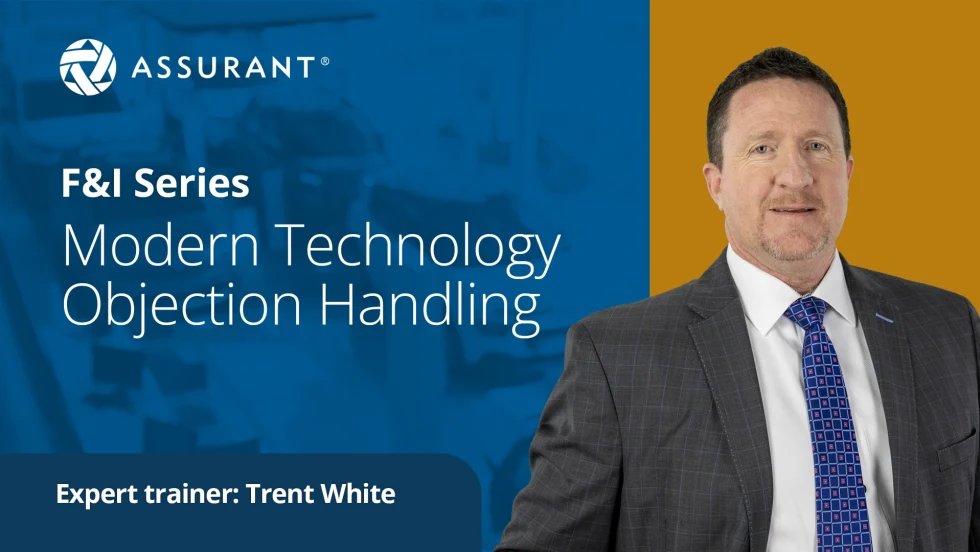
Modern Technology Objection Handling
In this video, Trent White shares how to confidently handle technology-based objections by helping customers understand the value of protection, even with modern vehicle technology.
Read More →
Consistency at Scale: Driving F&I Performance
With 75 rooftops across the Sunshine State, Morgan Auto Group has proven to Floridians that it knows a thing or two about driving performance in a competitive market. But it didn’t start at the top.
Read More →
Gitty Up on GAP
The foundational finance-and-insurance product hasn’t kept up with the latest conditions for auto dealers. Is the time ripe?
Read More →
How AI-Powered Coaching Is Transforming F&I Performance
See how AI-powered coaching can turn F&I customer conversations into actionable insights that support compliance, performance and profitability
Read More →
Sell Value, Build Trust
In this video, Trent White explains why selling on value, not fear, builds lasting customer trust, reduces cancellations, and drives long-term success.
Read More →
F&I Sales Give Dealers First-Half Lift
Product business shored up total profits to avoid an overall revenue tanking as product penetrations held steady, StoneEagle reported.
Read More →
Targeted Training Drives Results
Today’s technology, instead of threatening F&I managers, can actually make them better, according to an industry veteran who’s watched market setbacks roil the unprepared.
Read More →
Double the Change, Double the Chance
When an F&I manager gets a customer refusal, it’s a wise move to tweak more than one thing in the product offering.
Read More →
Just Do It
F&I managers need training, but instead of resisting application or expecting perfection, they should improve by simply acting on what they learn.
Read More →