
F&I
The F&I Manager's Report Card
The best managers take the time and attention to measure the behaviors behind the numbers.


 MENU
 SEARCH
The best managers take the time and attention to measure the behaviors behind the numbers.

If you graded your performance today, what would your report card show?
Pexels/RDNE Stock Project
In many dealerships, an finance-and-insurance manager's annual evaluation centers on a familiar set of results: profit per vehicle retailed, products per deal, product penetration, reserve, and total income. Those measures matter, but they only tell part of the story.
Sustainable F&I performance is built through disciplined behaviors repeated across hundreds of customer interactions. The strongest managers do not wait until year-end to discover where performance slipped. They review the process throughout the year, identify gaps early, and adjust while there is still time to improve.
If you graded your performance today, what would your report card show?
1. Customer experience
Ask: Did each customer receive a complete, consistent presentation? Could the customer explain the available ownership-protection options in their own words?
What do CSI results, reviews, complaints and cancellations indicate? Declining product penetration can signal a customer-engagement problem, but the manager should examine the full process before drawing that conclusion.
2. Process discipline
Track observable process measures: complete product-presentation rate, menu-utilization rate, discovery completion, objection-handling practice and documentation consistency. A simple A-to-F grade can start the conversation, but each grade should be supported by data, deal audits or observed behavior.
Performance often becomes inconsistent when established steps are skipped during busy periods. The solution is a process that remains practical under pressure, supported by coaching and accountability.
3. Product knowledge
Can you accurately explain available vehicle service contract coverage, GAP, tire-and-wheel, key-replacement, appearance and windshield-protection options? Can you explain important eligibility, limitations and differences without overstating coverage?
Product knowledge supports a clear, confident conversation, but accuracy matters more than memorization.
4. Compliance awareness
Review whether disclosures, menu practices and deal documentation are complete and consistent with dealership policy and applicable requirements. Use periodic deal-jacket reviews to identify gaps and route legal or compliance questions to qualified dealership resources.
5. Communication skills
When permitted by dealership policy, review or role-play customer conversations. Look for interruption, rushed explanations, jargon, excessive detail and scripted delivery.
Today's customers often arrive with extensive information. The manager's value comes from making the conversation clear, relevant, and easy to navigate.
6. Continuous improvement
Document completed training, coaching sessions, role-play practice and the specific behavior each activity is intended to improve. Training hours alone are not the outcome; the better test is whether new learning appears consistently in customer interactions and operating results.
At year-end, combine financial results with product performance, customer outcomes, process execution and observable professional behaviors. The exact weighting should reflect the dealership's priorities and be agreed upon before the evaluation period.
A balanced scorecard may include: financial performance, such as PVR and product income; product performance, such as vehicle service contracts, GAP and ancillary penetration; customer outcomes, such as customer satisfaction index, reviews, complaints and cancellations; process execution, such as discovery completion, menu utilization and documentation consistency; and professional behaviors, such as completion of required compliance activities, follow-through on coaching plans, collaboration and accountability for agreed actions.
The goal is not simply to identify the highest producer. It is to recognize the manager who produces strong, sustainable results while supporting customers, the dealership, and a consistent process.
There is no universal product-penetration target for every store.
Cash deals should be measured separately because they present a different conversation and opportunity.
Unexplained waiting can erode the customer experience before the F&I conversation begins.
Useful supporting measures may include complete-presentation rate, menu-utilization rate, discovery completion, PPD by deal type, product penetration by eligible transaction, cancellations and chargebacks, documentation exceptions, customer complaints, follow-up completion and progress against coaching actions.
Improving F&I performance does not require waiting for an annual review. It requires clear standards, consistent measurement, and coaching that turns performance insights into repeatable
Loading data...
F&I
The best managers take the time and attention to measure the behaviors behind the numbers.







F&I
With 75 rooftops across the Sunshine State, Morgan Auto Group has proven to Floridians that it knows a thing or two about driving performance in a competitive market. But it didn’t start at the top.
Industry
More auto dealerships are offering mobile servicing for today’s convenience-minded consumers to boost business and stand out from competition, though it may not fit every store.
Industry
Since finance-and-insurance was added to the auto dealership, most stores’ F&I teams have been separated from sales like a car’s trunk is separated from the engine. It doesn’t have to – and shouldn’t – be that way.
F&I
Finance has historically been the last step in the car-buying process, but it doesn’t have to be. The customer’s journey starts long before they arrive at the dealership, and so should F&I’s involvement.
Digital
Digital retailing has not made the F&I manager obsolete. If anything, it has revealed how valuable the role can become when technology is used correctly.
F&I
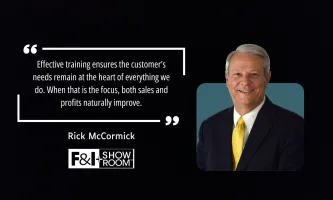
How can auto dealerships help F&I managers fulfill their vital role in the most effective ways? Industry expert Rick McCormick shares his insights on the best ways to train these professionals and help them maintain good habits.
Industry
2026 NADA Chairman Rob Cochran knows a thing or two about leadership after decades in the business. He brings an emphasis on stewardship to his new role at the head of the country’s major auto retail trade group.
F&I
It may be human nature to back off when a customer seems to say no to a product or service. But experts say F&I managers should operate as though the answer will be the opposite.
F&I
A high profit per-vehicle retail can create a false sense of strength that masks underlying problems, while a low one may not reveal an operation that's actually efficient and well-balanced.
Industry
As America turns 250, explore how the automotive industry shaped jobs, culture, innovation, and mobility from Detroit assembly lines to today’s EV era.