



Credit, Capacity, Collate and Compliance
There were the three Cs of consumer credit, but today's credit crisis has probably tacked on two more Cs. Compliance expert makes the argument for a sixth "C."

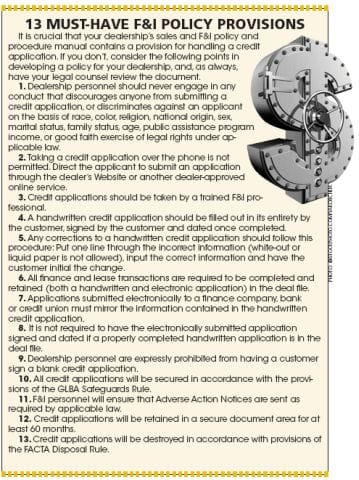
Everyone knows the 3 C’s of consumer credit — credit, capacity, and collateral. Recently, I read a great article about the 5 C’s of credit. It added character and conditions to the list. I would argue that there is another C to be considered — compliance.
Being a compliance consultant for the last four years has provided me with the opportunity to review thousands of credit applications. Considering the fact that we are all operating under the same set of rules, I’m amazed at the variety of compliance issues I find. It’s just a simple form, so why all the issues?
When you consider how many laws come into play, the way applications are taken, and who is involved in the process, it’s easy to see why the credit application process can create a whole heap of litigation exposure and business risk.
First, let’s start with the laws that come into play when attempting to finance a customer. There’s the Equal Credit Opportunity Act (ECOA)’s Regulation B, the Fair Credit Reporting Act (FCRA), the Fair and Accurate Transactions Act (FACTA), the Gramm-Leach-Bliley Act (GLBA) and its Safeguards Rule, federal and state consumer protection laws, state community property laws, marital property laws, and state banking laws.
You also have to consider the variety of ways a customer’s credit-related information can be collected these days, including e-mail from third-party lead sources, manufacturer Websites, dealer Websites, online Internet services, facsimile, phone, mail, and, of course, in-person walk-ins.
And finally, consider the different employees within a dealership that could be involved with the process. There’s the general managers, sales managers, salespeople, business development and Internet sales personnel, administrative personnel, F&I directors, and F&I managers.
In this article, I’ll take a look at the credit application process and make some suggestions on how you can minimize your exposure and risk. I’ll also provide a checklist that can help you develop your own credit application policies and procedures.
[PAGEBREAK]
Keep Credit Apps Current
Let’s start with the credit application form. I recommend the credit application you use be designed in accordance with the model credit applications offered in the appendix of the ECOA’s Regulation B.
These types of applications provide all the necessary disclosures, and they can help guide you through the application process to ensure compliance. These forms are also state specific, so make sure the application you are using has the required disclosures for your state.
If you need these forms, check with your local or state dealer associations, captive sales finance companies, and companies such as Reynolds and Reynolds. These are recommended because they are all regularly reviewed for compliance.
Multi-part forms are also recommended so the customer can get a copy of the application. Depending on your process, you can also print and use blank electronic applications such as those offered by DealerTrack, RouteOne, CUDL, Honda/Acura Interactive, BMW Autobond, and Credit Acceptance Corporation.
Safeguards for Credit App Submissions
The Internet has certainly become a critical tool for attracting consumers these days.
Informally, I’ve been asking BDC managers and F&I
managers what percentage of leads include a credit application. Based on the
responses, I would estimate that only one-out-of-five leads will include an
application.
Depending on the size of your dealership, that could mean between one to 200 applications a month. This is an acceptable and very secure method of completing a credit application outside of the dealership.
Taking an application over the phone is not a recommended practice and most dealers will direct customer’s to their own Websites to submit an application.
What if your dealership does not have a credit application format on its Website? Dealer- Track has a service that allows you to send the customer a link to a credit application on DealerTrack’s site. DealerTrack will then forward the application by email to a designated person at the dealership.
No matter how many applications you receive electronically, you need to address several potential compliance risks. As part of your GLBA Safeguards risk assessment, you should review where the e-mails containing a customer’s non-public information are being printed. Is it within a secure document area?
[PAGEBREAK]
One of the most frequent questions I get is, “Who should complete the credit application?” The customer is my standard answer. I recommend that customers be required to complete a handwritten application when they come to the dealership. This ensures they’ve read all of the required Reg. B and state disclosures. I say this because having the credit application in the customer’s own handwriting safeguards the dealership against accusations that information was altered.
I understand it is sometimes impractical to have the customer complete the form. However, under those circumstances, it is recommended that you have the customer put their initials next to their demographic information, such as time on the job, income, and mortgage or rent payment. Those are the main credit determinates, and the ones most likely to be challenged.
What about F&I managers who complete the onscreen electronic credit application while interviewing the applicant? If this is your process, which I don’t recommend, remember to at least have the customer initial their personal information.
Limiting Your Exposure
I would also strongly advise against involving salespeople in the credit application process, as they are not trained F&I professionals. However, if your selling process is to run credit before the first pencil quote, you are better off using a separate form to capture “five-liner” information and the customer’s consent to run credit.
Additionally, the statement of consent should not be in microprint. It should be in the same font as the other printed information on the form, and no less than a 10-point font. The consent statement should also mirror the one printed on your credit application.
There are also several potential problems with only capturing “five-liner” information on a formal credit application. First, your finance sources may object to the limited amount of information on the application. Your customer may also claim that he or she was asked to sign a blank form, which would be filled out later by your dealership.
Second, contract forms have clauses that hold customers accountable for the information provided on the credit application. Leaving anything blank could then compromise your rights as a dealer. Additionally, a fully completed application will help support the process your dealership has in place for identifying, detecting and mitigating identity theft.
Third, salespeople should also be instructed not to discuss or evaluate a customer’s credit before the credit application is completed. It’s OK to ask qualifying questions during the sales process, but sales personnel should never discourage anyone from submitting a credit application. Your dealership should have policies that frown on discrimination against an applicant based on race, color, religion, national origin, sex, marital status, family status, age, or use of a public assistance program.
[PAGEBREAK]
Completing Sections A and B
Now let’s look at the proper way to complete a credit application. We’ll use a standard LAW Credit Application form as an example. The very top section has this statement “IMPORTANT: READ THESE DIRECTIONS BEFORE COMPLETING THIS APPLICATION.” Be honest, how many times have you started taking a credit application by asking the customer to read this section? Next, the customer is asked to check one of the three following boxes:
• If you are applying for individual credit in your own name and relying on your own income or assets and not the income or assets of another person as the basis for repayment of the credit requested, complete Sections A and C.
• If you are married and live in a community property state, complete all sections, including Section B.
• If this is an application for joint credit with another person, complete all sections providing information in Section B.
Let’s assume the customer checked off the first box, which means we move to Section A. This section is pretty self-explanatory. This is where an applicant is asked if he or she is “married, unmarried or separated.” You can further clarify that the designation “unmarried” includes single, divorced and widowed persons.
It’s also a good idea to make sure the applicant lists a previous address and employer, as this could help reveal a potential identity theft issue if the information on the credit application doesn’t match the customer’s credit report.
From there we move to the income section. This can be one of the most problematic sections on the credit application, as income can be overstated, altered, left blank, or completed after the fact. There can also be differences between the handwritten application and the electronically submitted application.
Remember, falsifying income is considered bank fraud. However, if it’s necessary to correct the customer’s stated income, simply put one line through the incorrect amount, and write the correct amount. Also make sure to have the customer initial the change.
You should never leave the income section blank. Disclose some amount and make a proper correction when you have the correct information. If you are using a handwritten application as a worksheet for an electronically submitted application, make sure the information on both sheets are the same. There should never be any differences in the two documents.
And finally, showing an hourly wage rate does not accurately disclose a customer’s monthly income, as most applications don’t disclose how many hours the applicant works. The same guidelines for Section A of the credit application should be followed when filling out the co-applicant information under Section B.
[PAGEBREAK]
Providing Asset and Debt Information
When it comes to filling out Section C, at a minimum, you should indicate whether the applicant owns or rents. You should also indicate the amount of his or her mortgage or rent payment. Remember, the more information you can get, the easier it’ll be for you to determine the best source for financing.
Application formats may vary, but in most cases you will be required to submit a description and valuation of the collateral included in the credit offering. Once again, this is a very important compliance issue. Overstating the value of the collateral is also considered bank fraud. Most finance companies, banks and credit unions will require a book-out sheet to support the valuation of the collateral. But even if they don’t, it doesn’t mean you’re off the hook.
Also remember that virtually all finance sources have processes in place to verify the date and method of the down payment, actual equipment on the vehicle, and any issues related to straw purchases. Any discrepancies could require the dealership to repurchase the contract.
There are a variety of other disclosures required by each state
that you should be familiar with, especially if you are operating within a
state with community property or marital property laws. Just make sure you can
properly explain those disclosures.
Completing the Process
Your obligations aren’t over when the application is completed, as there are other requirements you must uphold.
First, how many of you (excluding California, which requires it by law) give the customer a copy of the signed and dated credit application? The verbiage on the credit application does say, “Puchaser Acknowledges Receipt of Copy of This Credit Statement.”
Second, dealers need to have a process for notifying applicants of credit turndowns, or other adverse actions as required under the ECOA, the FCRA and various state laws. It would be impossible to include all the requirements in this article, but I would recommend you read the NADA’s “A Dealer Guide to Adverse Action Notices.” This 18-page booklet was written by the attorneys at Hudson Cook LLP, and it provides a comprehensive review of your responsibilities regarding Adverse Action Notices.
The last step in this process is the retention of your customers’ credit applications. By law, credit applications are required to be retained for 25 months. However, a provision of the FACTA gave consumers the right to sue creditors for completing a credit check without their consent for up to 60 months. Therefore, keep those approved, rejected and dead deal applications for 60 months. When it is time to destroy a credit application, it has to be done according to the Disposal Rule, another provision of the FACTA.
There is a lot more information that pertains to the subject of credit applications, but hopefully this will help you remember the sixth C of consumer credit.
Joe Bartolone is an associate with gvo3 & Associates, a nationally recognized sales and F&I compliance consulting company. He can be reached at joe.bartolone@bobit.com.
More Compliance

Variations on a Theme – Lease Packing
Dealers must be careful they don’t run afoul of the law when it comes to such deceptive practices, as there are many cases pointing to the potential bad ends of such deals.
Read More →
Your 10-Point Compliance Checklist
Identify areas of concern and opportunities for training by updating, installing and enforcing a compliance checklist that requires specific actions for sales, F&I and accounting.
Read More →
A Continuing Antediluvian Dealer Fraud: Payment Packing
The longtime illegal practice, which can take many forms, can get a dealer and its employees in deep trouble. It’s a good idea to determine if anyone in your stores is doing it and to weed it out if so.
Read More →
Line 1 Is Not a Junk Drawer
Rolling products into the cash price — even if the bank told you to — misrepresents the vehicle’s value and runs afoul of four federal laws.
Read More →
Dueling Banjos in the Car Biz
Reports and accounts at variance show auto dealers’ trust profiles have risen in many consumers’ minds but that there remains a need for greater transparency by some.
Read More →
NADA and the Miracle on 34th Street
Automotive dealers should follow the National Automobile Dealers Association's consumer-friendly guidelines in order to minimize their legal risks.
Read More →
Another Look at a Recent Data Breach
Get caught up on the most pressing legal and regulatory matters facing dealers and F&I professionals, including data security, shotgun purchases, and inconsistent payment quotes.
Read More →


The Best Thing a Dealer Can Do to Avoid Legal Problems
Citing the issue is a strategy borrowed from the legal field itself.
Read More →