



Execs Dissect Challengers to F&I
Cash, leasing and adoption of technology stole the show during this year’s Executive Panel.
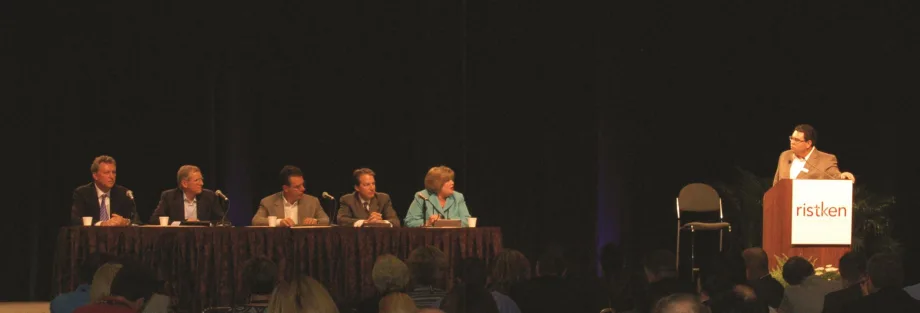
F&I is still navigating through some post-recession market challenges. That reality took center stage during the executive panel session at the magazine’s annual conference, as did the need to expedite adoption of technology.
“The industry is being dragged along kicking and screaming, but technology is actually enhancing the process,” said Charlie Robinson, president of Resource Automotive.
Moderated by F&I and Showroom’s Gregory Arroyo, the panel also included Stephen Amos, president of GSFSGroup; Bob Corbin, president of IAS; Dave Duncan, president of Safe-Guard Products LLC; and Kelly Price, president of National Automotive Experts.
It was a productive panel. The group tackled e-contracting, the apparent increase in cash deals earlier this year, leasing’s resurgence, the used-car market and the improving health of auto finance.
Reality Check
Amos said that despite gains in dealer adoption of electronic rating and contracting capabilities, usage isn’t where it needs to be. “We’re spending the money on it to be more accurate and user friendly,” said Amos, adding that e-contracting represents a cost, not a revenue stream for providers.
As for whether e-commerce and other technologies can drive F&I into the virtual world, Price said: “I think it’s going to be pretty hard to replace a qualified, educated and informed individual.”
Arroyo asked how the industry was responding to the pickup in cash deals and leasing’s resurgence. Panelists said that F&I offices were forced to focus on shorter terms and lower priced products. IAS’s Corbin said his dealers had begun bundling high-value, low-cost products, and Price added that preloading product — offering 12 months of complimentary coverage — was another response to those trends.
Short Supply
The resurgence in the secondary market also was addressed. The industry continues to face a used-vehicle supply problem amidst a great deal of pent-up demand. “We’re scrapping 12 million units and selling 12 million units, so auto dealers have an extreme challenge,” Robinson said. “The biggest obstacle is getting inventory; never mind getting the right inventory.”
On the upside, auto finance guidelines are loosening. Sources are not only buying deeper, they’re accepting deals with higher loan-to-value ratios. “If we’re comparing the F&I market to 2006 and 2007, it is more challenging,” Duncan said. “But compared to the spring of 2009, we’re in a lot better shape. F&I product advances are becoming less of an issue.”
More Auto Finance

Interest Rates Further Squeeze Auto Consumers
Last month’s hike and a potential second increase this month add to a growing list of inflation woes that could continue to dent overall car sales.
Read More →
Mind Your Process
Consistent steps taken in various aspects of the F&I office can make valuable differences over time, similar to an outline for a best-selling book.
Read More →
Top Five Credit Application Fraud Flags
Compliance audits regularly reveal bad habits that can lead to fraud charges and should have been stamped out decades ago.
Read More →
More Auto Loans for the Taking in August
Riskier categories were on the uptick for the month as lenders loosened access in several areas while balancing out the exposure in another, Cox Automotive reported.
Read More →
July Was Hot for Auto Borrowers
Credit proved readily available for many, but most loans left buyers in negative territory, Cox Automotive said.
Read More →
Dealer Lender Preferences Revealed
When lenders provide consistent, fast service, their overall satisfaction scores with dealers greatly improve, according to JD Power research.
Read More →
Auto Refi Savings Surge
Consumers with 84-month auto loan terms who refinanced saved the most on monthly payments, according to a new report by auto refinancing provider Caribou.
Read More →
Subaru Enters Lending Business
The automaker follows other brands in adding captive financing in the U.S., and says the move will strengthen its position here.
Read More →
Positive Equity Reaches Record High
Mainstream vehicle owners who bought a car seven years ago are likely to have positive equity when trading in for a new vehicle, according to second-quarter Edmunds data.
Read More →
Dealerships Are Paying the Price for Extended Car Loans
Growing negative-equity scenarios mean such lengthy terms should be addressed in a forward-looking way to make them work for the dealer and the consumer down the road.
Read More →