



Sexual Harassment: 4 Pillars of Effective Training
Make anti-harassment training stick by creating a program that addresses leadership and accountability, clear policies, compliance training, and reporting and investigation.


Dealers subject themselves to unnecessary risk when they fail to properly design and relentlessly enforce an anti-sexual harassment training. Photo by Magnus Hagdorn via Flickr
In our last article, we explored the subject of anti-harassment training from the dealership employee perspective. But we didn’t address the critical question every dealer eventually must answer: When is a joke a joke, and when does it cross the line?
When determining the difference between a joke and the basis for a harassment claim, there isn’t one universally definitive answer. Instead, each organization needs to implement its own system that empowers leadership to swiftly and thoroughly process claims and make determinations on a case-by-case basis. Such a system is critical to any environment in which employees feel respected, protected, and engaged at work.
With all that in mind, let’s discuss the four pillars of an effective anti-harassment training program.
Pillar 1: Leadership and Accountability
The standards set forth by the federal Equal Opportunity Employment Commission were designed to make sure that people accountable for their organizations are actually invested in the anti-harassment process. That means leadership understands that it’s going to take staff time and resources to make the program happen. That level of buy-in from the executive leadership team or your board of directors is what sets the tone for the overall program being successful within the organization.
In order to assess the efficacy of your program, it’s a good idea at the outset to conduct a risk assessment into where your organization currently stands, so that you can measure changes as your program matures.
Once you have that risk assessment and buy-in from the top, it’s important to not only inform everyone within your organization of your program, but to motivate them to participate. This is not an employee-only problem: Supervisors may engage in quid pro quo, for instance. Make sure to educate everyone, and apply the program equally, across all levels of your organization.
Finally, be committed to taking action based on what your initiative reveals. If results indicate that employees are not engaging with your policies, not completing training, or not following prescribed conduct, you need to be ready to address the issue and follow through with prompt, consistent, and proportionate disciplinary measures.
With an automated compliance system, you can develop specialized video messages from your executive leadership team and send out reminders to everyone within your organization that ending harassment is a priority for your organization.
Pillar 2: Clear Policies
Every dealership and dealer group should adopt an unequivocal, zero-tolerance statement about harassment. Be sure to write the policy in clear language that everyone can understand, regardless of job function, experience, or reading level. Avoid dealer jargon if at all possible.
Make sure to include assurances that immediate and proportionate corrective action will be taken when harassment is determined to have occurred. Also include a clear description of the reporting system, as well as an appropriate confidentiality statement.
If any manager at your organization has the ability to intake a report and forward it to the necessary resource, ensure that all managers know how their specific roles fit into the overall initiative. By educating your workforce about the way your system operates, you’re also keeping people accountable to address harassment wherever and however they experience, witness, or hear about it.
How automation makes it possible: by giving all employees access to the same information. Our platform, for instance, provides compliance managers with a central location to upload, edit, and disseminate relevant policy documents.
Pillar 3: Compliance Training
Training is a great opportunity to bring your initiative to life and supplement dry policy language with tailored education and real-world examples of harassment. Your organization’s training should be supported by leadership: they need to believe in what they’re educating their workforce on, and believe in their policy and be ready to follow through with it.
Training needs to be regularly repeated and reinforced. Typically, we see this in a recurring cadence, usually annually. Moreover, some states have requirements that managers specifically undergo training every two years.
The training should be actively engaging to participants. Don’t merely give your workforce a video to passively watch. Instead, provide participants with questions to answer, activities to complete, and other interactive elements.
The training needs to describe the unacceptable behavior and provide examples of what that might look like. Think back to our original question. Your organization’s training can provide examples of where that line between jokes and harassment really lies. This can be immensely valuable for your employees to understand what their role is in their compliance obligations.
The training also should clarify what consequences employees face for failing to conform to proper workplace behavior. Employees tend to take harassment more seriously if they know their job could be on the line if they’re caught engaging in it.
Last, organizations should design training specific to managers and supervisors. Of course, training should be applied equally across your organization, but managers and supervisors who have claim intake responsibility need to be aware of their roles as leaders.
How automation makes it possible: through customizable training controls. With an automated system, you can administer training tailored to individuals’ unique roles, departments, and learning styles. An automated platform also makes it easy to break training up into smaller segments and deliver it in a way that doesn’t interfere with employees’ day-to-day work, but actually supplements that work.
Pillar 4: Reporting and Investigation
When you think of your organization’s harassment reporting process, think “exceptionally available.” That means creating a supportive, safe reporting environment that provides multiple channels for report intake. For instance, if someone is uncomfortable going to their supervisor — common in a quid pro quo situation — they need to understand they have the opportunity to report to any manager at the organization.
Your process should incorporate timely responses and an investigation that:
Is run by well-trained, objective, and neutral investigators.
Is properly documented.
Includes mechanisms to determine if retaliation has occurred
Gives leadership the authority to impose appropriate sanctions when retaliation is uncovered.
Does not presume guilt or punish unless and until a complete investigation determines that harassment has occurred.
Finally, people who report harassment should be confident that the organization is taking claims seriously dedicating full resources to the investigation — regardless of the outcome of the investigation. Always make sure to tie a bow on the process by circling back to the person who reported the claim and informing them of what steps have been taken.
Again, automation makes this possible, this time by giving employees another avenue to report harassment. An automated intake system allows employees to file a complaint in private, on their terms. Compliance managers can make the process anonymous or require the reporter to disclose their identity as part of that intake process. Regardless, the more avenues you have for intake, the better.
Kynzie Sims is an attorney and certified compliance and ethics professional who serves as legal content product manager for Compli.
More F&I
Modern Technology Objection Handling
In this video, Trent White shares how to confidently handle technology-based objections by helping customers understand the value of protection, even with modern vehicle technology.
Read More →
Consistency at Scale: Driving F&I Performance
With 75 rooftops across the Sunshine State, Morgan Auto Group has proven to Floridians that it knows a thing or two about driving performance in a competitive market. But it didn’t start at the top.
Read More →
Gitty Up on GAP
The foundational finance-and-insurance product hasn’t kept up with the latest conditions for auto dealers. Is the time ripe?
Read More →
How AI-Powered Coaching Is Transforming F&I Performance
See how AI-powered coaching can turn F&I customer conversations into actionable insights that support compliance, performance and profitability
Read More →
Sell Value, Build Trust
In this video, Trent White explains why selling on value, not fear, builds lasting customer trust, reduces cancellations, and drives long-term success.
Read More →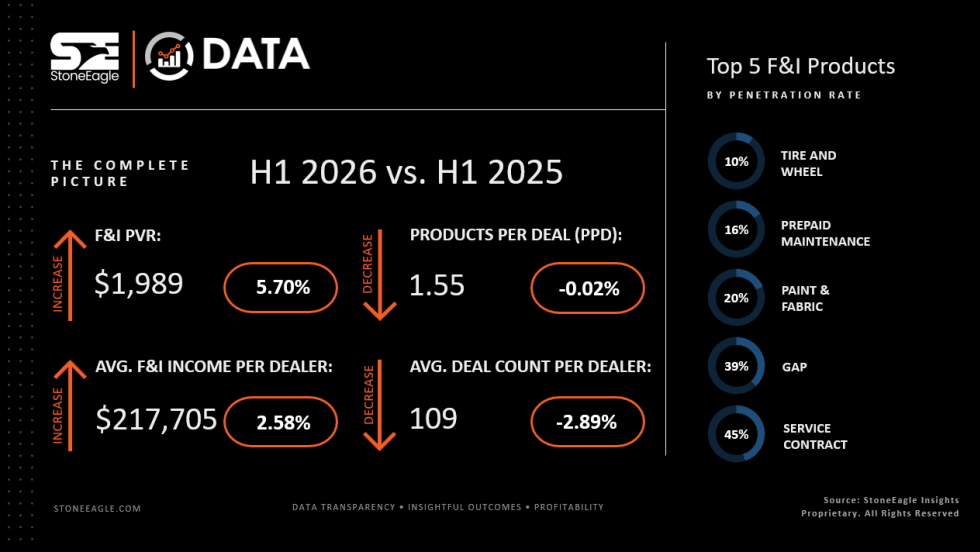
F&I Sales Give Dealers First-Half Lift
Product business shored up total profits to avoid an overall revenue tanking as product penetrations held steady, StoneEagle reported.
Read More →
Targeted Training Drives Results
Today’s technology, instead of threatening F&I managers, can actually make them better, according to an industry veteran who’s watched market setbacks roil the unprepared.
Read More →
Double the Change, Double the Chance
When an F&I manager gets a customer refusal, it’s a wise move to tweak more than one thing in the product offering.
Read More →
Just Do It
F&I managers need training, but instead of resisting application or expecting perfection, they should improve by simply acting on what they learn.
Read More →
Dealer Lender Preferences Revealed
When lenders provide consistent, fast service, their overall satisfaction scores with dealers greatly improve, according to JD Power research.
Read More →