



The Facts of Leasing
Leasing isn’t slowing down. In fact, it’s spreading to the pre-owned market. Dealership expert breaks down the keys to making leasing a viable option for showroom customers.

Courtesy of iStock.
Leasing has definitely made headlines this year, as it continues to trend up in both new- and used-vehicle markets. So is your dealership taking advantage? More importantly, with used-car lease volume surging 43% over the last two years, is your pre-owned department prepared to do the same?
According to Experian Automotive, leasing accounted for 31% of all new vehicles financed in the second quarter, a 13% year-over-year increase. As for used leasing, the transaction type increased its share of the market from 3.3% in the third quarter of 2015 to 3.7%. Yes, it’s still a small portion of the market, but it’s growing and will continue to do so.
What’s driving the uptick in used leasing is the flood of late-model, off-lease vehicles that hit the market earlier this year. According to the NADA Used Car Guide, a record 3.1 million off-lease vehicles were expected to return to the market this year, an 800,000-unit increase over 2015.
This used-vehicle surplus has resulted in more competitive pricing in the market, as well as an increase in dealership reliance on used-vehicle leasing to keep front-end margins high in a competitive environment. And with the subprime auto finance market steadily expanding over the last couple of years, finance sources even went so far as to offer lease options to less-than-prime customers. This helped spur the increase in used-vehicle leasing and falls right in line with an EFG Companies survey on why consumers lease.
Lease Driver
So why do consumers lease? Well, according to the 1,000 consumers EFG Companies surveyed, the answer is “money.” Consumers want to spend less of it on the purchase and maintenance of a vehicle, making leasing an excellent option for dealerships that know how to sell it. However, that same study also revealed a lack of consumer interest in leasing, with only 23% of respondents indicating they were currently in a lease.
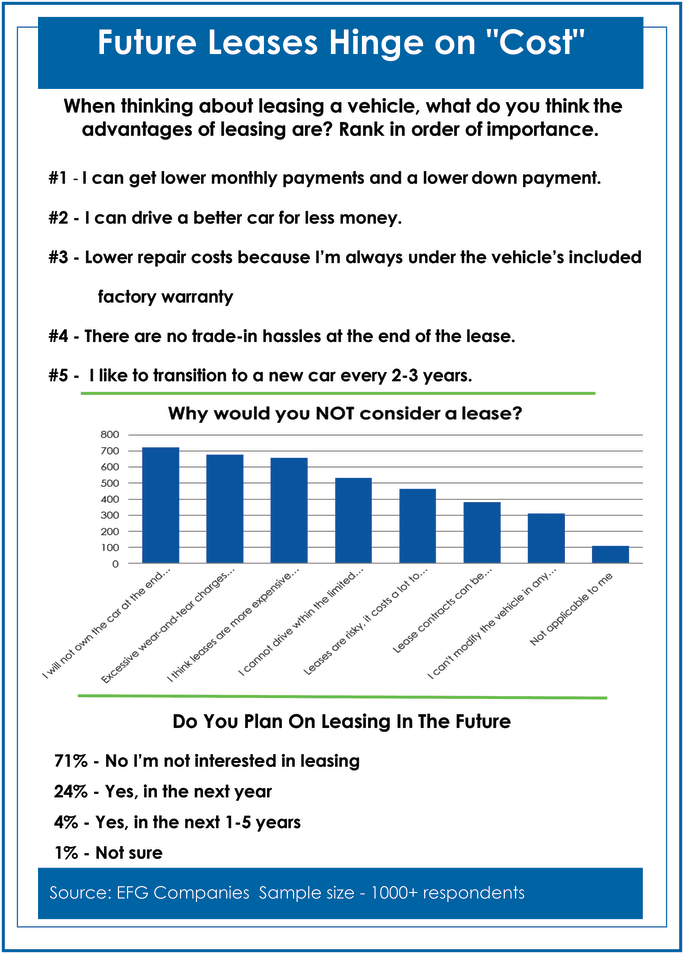
The study also revealed that 74% of respondents had never leased a vehicle. The key for dealerships looking to take advantage of leasing will be overcoming the objections of the 71% of respondents who stated they were not interested in leasing in the future.
So what will turn those customers around? Well, survey respondents ranked lower monthly payments and a lower down payment as the top advantages of leasing a vehicle, followed by driving a better car for less money, and lower repair costs due to the factory warranty. What sales personnel will have to overcome are the following Top 3 customer objections to leasing:
1. Not owning the vehicle at the end of the lease
2. Excessive wear-and-tear charges
3. A perception that leases are more expensive
Dealerships trained on educating consumers on the benefits of leasing have had massive success flipping customers to leases by addressing customer perceptions. The key here is dealers must consider leasing a viable revenue driver to put the right focus on it.
Pushing Leasing
A good baseline goal for nonluxury brand dealerships is to maintain a 30% lease penetration for lasting success. To do that, dealership personnel must focus more time and effort on qualifying consumers for leases and discussing the benefits of leasing. That means, just like when selling a car, your sales team needs to understand their customers’ needs.
As seen from EFG’s survey results, no matter the leasing climate, there will always be people who prefer to buy. That’s why it’s important to ask the right qualifying questions before positioning a lease. Questions could include:
How often do you trade in your vehicles?
When was the last time you paid off a vehicle and kept it for a while?
How many miles do you drive per year?
Do you trade your vehicles or sell them outright?
When was the last time you were happy with the amount offered for your trade-in vehicle?
The goal here is to help customers decide what matters to them, as the decision to lease or buy depends entirely on their lifestyle and what they feel comfortable with. If they have a predictable lifestyle, drive a low average number of miles per year, properly maintain their vehicle, and want to make the trade-in portion of the buying process easy, then leasing may be a good option. Top selling points for a lease include:
Only paying for vehicle use
Consumers are protected from market risks that affect their vehicle’s value
Lower monthly payments without a 72-plus month loan
Expectation Management
Lastly, everyone knows that all vehicles depreciate in value as soon as they are driven off the lot. However, few consumers make the connection that their vehicle, whether it’s leased or purchased, depreciates at the same rate. The only difference lies in what they pay for. Most customers don’t learn about this expense until it’s too late — when it’s trade-in time and the dealership offers them less than what they expected or needed.
Offering consumers a lease is a great way to manage their expectations come trade-in time. Not only does it manage the depreciation expense, it makes the trade-in process easy.
While these tips may seem basic, too many dealerships think their inventory just isn’t “lease material.” So they don’t focus on it and end up losing out on this significant revenue opportunity. With the uptick we’ve seen in used-vehicle leasing, I think it’s safe to say there’s very little out there that isn’t lease material. The more emphasis we place on this area of dealership profitability, the better able dealerships will be to capitalize on greater profit opportunities.
John Stephens serves as executive vice president of dealer services for EFG Companies. Email him at john.stephens@bobit.com
More F&I

AI: Facilitator, Not Fixer, in F&I
The dealerships that thrive in the years ahead will be those that embrace technology while continuing to invest in the people who make customer interactions count.
Read More →
Modern Technology Objection Handling
In this video, Trent White shares how to confidently handle technology-based objections by helping customers understand the value of protection, even with modern vehicle technology.
Read More →
Consistency at Scale: Driving F&I Performance
With 75 rooftops across the Sunshine State, Morgan Auto Group has proven to Floridians that it knows a thing or two about driving performance in a competitive market. But it didn’t start at the top.
Read More →
Gitty Up on GAP
The foundational finance-and-insurance product hasn’t kept up with the latest conditions for auto dealers. Is the time ripe?
Read More →
How AI-Powered Coaching Is Transforming F&I Performance
See how AI-powered coaching can turn F&I customer conversations into actionable insights that support compliance, performance and profitability
Read More →
Sell Value, Build Trust
In this video, Trent White explains why selling on value, not fear, builds lasting customer trust, reduces cancellations, and drives long-term success.
Read More →
F&I Sales Give Dealers First-Half Lift
Product business shored up total profits to avoid an overall revenue tanking as product penetrations held steady, StoneEagle reported.
Read More →
Targeted Training Drives Results
Today’s technology, instead of threatening F&I managers, can actually make them better, according to an industry veteran who’s watched market setbacks roil the unprepared.
Read More →
Double the Change, Double the Chance
When an F&I manager gets a customer refusal, it’s a wise move to tweak more than one thing in the product offering.
Read More →
Just Do It
F&I managers need training, but instead of resisting application or expecting perfection, they should improve by simply acting on what they learn.
Read More →