



Tracking the 2008 Credit Crisis
By the end of 2008, more than $7 billion worth of automotive loans were 60 days delinquent. Experian market analyst tracks the single-most challenging year for auto finance and provides her take on the road ahead.
Marked by slumping vehicle sales, deteriorating credit quality, increases in delinquencies, and a lack of funding availability, 2008 was the single-most challenging year for the automotive finance industry. This month’s quarterly trend report traces when things went wrong and peers into the challenges ahead for automotive dealers and their F&I departments.
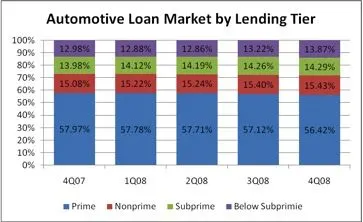
Distribution of Automotive Loans by Lending Tier
Providing a snapshot of the challenges faced last year is the shift in credit quality among all open automotive loans from the first to fourth quarter. Throughout 2008, the percentage of consumers considered prime steadily decreased. By the end of 2008, 56.42 percent of consumers with automotive loans were considered prime. Although still representing more than half of the market, this sector experienced a year-over-year decrease of 2.7 percent.
All of the high-risk tiers experienced year-over-year growth. The most significant increase was in the below subprime tier, which grew 6.85 percent from the fourth quarter 2007.
60 Days Past Due Delinquency Rate
Delinquency increases are one of the leading causes of consumer credit shifts. It is also one of the most significant data points on which lenders focus, as it guides credit programs available to dealers.
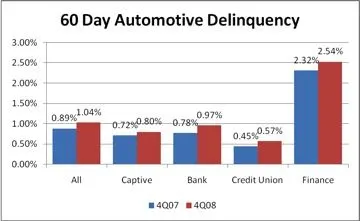
By the end of 2008, more than $7 billion worth of automotive loans were 60 days delinquent. While delinquency trends are cyclical and tend to increase throughout the year, the greatest quarterly increase occurred between the third and fourth quarters. During that period, the industry realized an end-of-year jump of 8.28 percent. In a year-over-year comparison, the 60-day delinquency rate rose 16.92 percent to 1.04 percent.
While having the lowest 60-day delinquency rate, credit unions experienced the greatest increases. The segment experienced a 28.22 percent year-over-year increase, bringing its 60-day delinquency rate to 0.57 percent.
The second-lowest delinquency rate was held by captive lenders, which ended the year with 0.8 percent of all loans reported 60 days delinquent. This was an increase of 11.98 percent from the fourth quarter 2007.
Banks, which typically have risk portfolios similar to credit unions, experienced the second-highest increase from the fourth quarter 2007 (24.79 percent), resulting in a 60-day delinquency rate of 0.97 percent.
Finance companies recorded the highest 60-day delinquency rate among all segments. These lenders typically have loan portfolios with significantly more high-risk consumers, which is why their 60-day delinquency rate stood at 2.54 percent. Despite this high rate of delinquency, the segment did record the lowest annual increase in delinquency rate at 9.37 percent.
Credit Scores by Vehicle Type
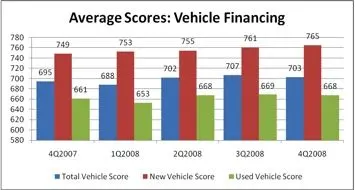
While delinquency rates increased and credit quality decreased across the entire automotive loan market, loans originated in 2008 had higher credit scores. The average credit score for all vehicles financed in the fourth quarter increased 15 points from the beginning of the year, and eight points on a year-over-year basis.
New-vehicle financing saw average scores increase 12 points from the beginning of the year and 16 points on a year-over-year basis. Used-vehicle financing experienced an increase in credit scores of 15 points from the beginning of the year and seven points on a year-over-year basis. However, the segment saw little change in scores in the second half of 2008.
[PAGEBREAK]
Average Amount Financed
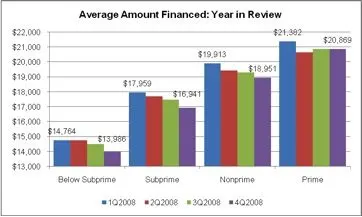
As credit improves, so does the average loan amount financed. On average, consumer finance amounts stood at $19,671 in the fourth quarter, a decrease of $409 from the first quarter of the year.
Below subprime, subprime and nonprime loans all saw steady decreases in the average amount financed throughout the year. The most significant decrease was in the subprime risk tier, which fell $1,018 to an average loan amount of $16,941. Nonprime consumer loans fell $962 to an average loan amount of $18,951. Below subprime loans had the lowest amount financed of $13,986, a decrease of $778. Prime financing decreased $513 to an average loan amount of $20,869.
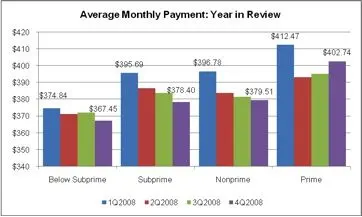
Average Monthly Payments
Average monthly payments on vehicles financed in 2008 also decreased throughout the year. Subprime loans ended the year with an average payment of $378.40, a decrease of $17 from first quarter 2008. Nonprime loans experienced a $17 decrease, ending the year with an average payment of $379.51.
The lowest monthly payments, $367.45, were found among below subprime loans. Compared to the first quarter, payments for this segment were $7 lower by the year-end quarter. Prime consumers had the highest monthly payments of all risk tiers at $402.74. However, monthly payments for this tier fell $10 from the first quarter of the year.
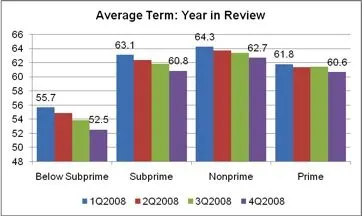
Average Term
While all risk tiers had an average loan term of 60 months in the fourth quarter 2008, each risk group saw decreases in monthly terms throughout 2008. Below subprime financing had an average loan term of 52.5 months in the fourth quarter, a decrease of 3.2 months from the first quarter 2008. Ending the year with an average term of 60.8 months, the subprime risk segment dropped 2.3 months from the first quarter — the second highest reduction of the year. Nonprime consumers had the longest terms at 62.7 months, which was a reduction of 1.6 months from the first quarter. Prime consumer loans saw a reduction of 1.2 months, ending the year with an average loan term of 60.6 months.
Overall
As credit quality shifted and delinquencies increased throughout 2008, lending programs changed significantly, resulting in an overall tightening of the automotive credit market. This was seen with increased credit scores on vehicle financing, along with reduced loan amounts and considerably lower terms.
Because of these shifts, the requirements of the F&I desk have definitely changed. While lenders continue to evolve their loan programs, dealers will continue to face challenges in obtaining financing for their consumers. While financing is still available for high-risk consumers, dealers need to be more aware of their lenders’ changing programs, as well as finding lenders still originating across a wide credit spectrum.
Melinda Zabritski is the director of automotive credit for Experian Automotive. She can be reached at melinda.zabritski@bobit.com.
More Auto Finance

Interest Rates Further Squeeze Auto Consumers
Last month’s hike and a potential second increase this month add to a growing list of inflation woes that could continue to dent overall car sales.
Read More →
Mind Your Process
Consistent steps taken in various aspects of the F&I office can make valuable differences over time, similar to an outline for a best-selling book.
Read More →
Top Five Credit Application Fraud Flags
Compliance audits regularly reveal bad habits that can lead to fraud charges and should have been stamped out decades ago.
Read More →
More Auto Loans for the Taking in August
Riskier categories were on the uptick for the month as lenders loosened access in several areas while balancing out the exposure in another, Cox Automotive reported.
Read More →
July Was Hot for Auto Borrowers
Credit proved readily available for many, but most loans left buyers in negative territory, Cox Automotive said.
Read More →
Dealer Lender Preferences Revealed
When lenders provide consistent, fast service, their overall satisfaction scores with dealers greatly improve, according to JD Power research.
Read More →
Auto Refi Savings Surge
Consumers with 84-month auto loan terms who refinanced saved the most on monthly payments, according to a new report by auto refinancing provider Caribou.
Read More →
Subaru Enters Lending Business
The automaker follows other brands in adding captive financing in the U.S., and says the move will strengthen its position here.
Read More →
Positive Equity Reaches Record High
Mainstream vehicle owners who bought a car seven years ago are likely to have positive equity when trading in for a new vehicle, according to second-quarter Edmunds data.
Read More →
Dealerships Are Paying the Price for Extended Car Loans
Growing negative-equity scenarios mean such lengthy terms should be addressed in a forward-looking way to make them work for the dealer and the consumer down the road.
Read More →