



AG Coalition: CFPB Has 'No Authority to Overrule' High Court’s ECOA Interpretation
A coalition of 14 attorneys general warned CFPB Acting Director Mick Mulvaney against taking any action to reinterpret ECOA as not providing for disparate impact liability — signaling that the fight over dealer participation might not be over.

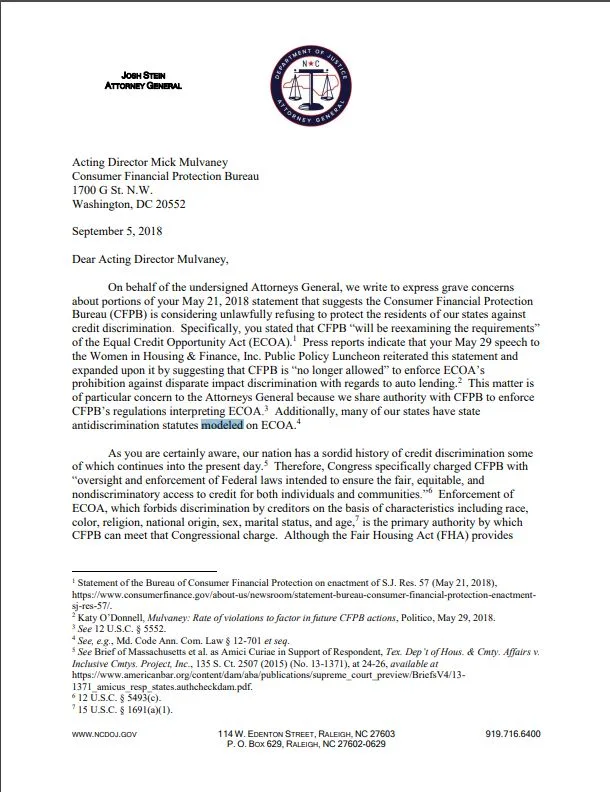
WASHINGTON, D.C. — A coalition of 14 state attorneys general called on the Consumer Financial Protection Bureau to continue protecting the rights of consumers against credit discrimination under the Equal Credit Opportunity Act (ECOA) — a sign that the fight over dealer participation might not be over.
In a letter issued to Acting Director Mick Mulvaney, the state regulators expressed concerns about part of a statement Mulvaney issued the day President Trump signed into law the resolution disapproving the bureau’s dealer participation guidance. They charge that the May 21 statement suggests that the bureau is considering “unlawfully refusing to protect residents of our states against credit discrimination.”
“Specifically, you stated that the CFPB ‘will be reexamining the requirements of the [ECOA],’” the letter states, in part. “Press reports indicate that your May 29 speech to the Women in Housing & Finance Inc. Public Policy Luncheon reiterated this statement and expanded upon it by suggesting that the CFPB is ‘no longer allowed’ to enforce ECOA’s prohibition against disparate impact discrimination with regards to auto lending.”
Of particular concern to the attorneys general, their letter notes, is the fact that state regulators share authority with the CFPB to enforce the CFPB’s regulations interpreting ECOA, and that “many of our states have stated antidiscrimination statutes modeled on ECOA.”
In Mulvaney’s May 21 statement, the acting director references “a recent Supreme Court decision” he said distinguishes “between antidiscrimination statutes that refer to the consequences of actions and those that refer only to the intent of the actor.”
“… In light the fact that bureau is required by statute to enforce federal consumer financial laws consistently, the bureau will be reexamining the requirements of the ECOA,” Mulvaney added.
In June 2015, the Supreme Court upheld the use of disparate impact in a Texas housing case involving the Texas Department of Housing and Community Affairs and The Inclusive Communities Project. The suit, filed in 2008, alleged that the Texas housing department caused segregated housing by allocating too many low-income housing tax credits to black inner-city neighborhoods and too few to predominantly white neighborhoods.
The complaint claimed that the department’s policies had a disproportionately adverse effect on minorities. Under the disparate impact legal theory, those policies could be in violation of the Fair Housing Act, even if their effects were unintentional. In its 5-4 ruling, the Supreme Court held that disparate impact claims “are cognizable under the Fair Housing Act.”
“A disparate impact claim relying on a statistical disparity must fail if the plaintiff cannot point to a defendant’s policy or policies causing that disparity,” retiring Justice Anthony Kennedy wrote in the court’s opinion. “Courts should avoid interpreting disparate impact liability to be so expansive as to inject racial considerations into every housing decision. These limitations are also necessary to protect defendants against abusive disparate impact claims.”
At the time, industry trade groups said that although the Supreme Court upheld the use of disparate impact, it did significantly narrow how the legal theory can be used. “Several important distinctions exist between the [FHA] and the ECOA, the statute under which the CFPB has authority to oversee auto lenders,” Chris Stinebert, president and CEO of the American Financial Services Association (AFSA), said at the time. “Specifically, the ECOA does not contain ‘effects’ language contained in other antidiscrimination statutes. The Supreme Court determined that the language contained in the FHA is equivalent to language found in other civil statutes that recognize disparate impact.”
Under the FHA, it is unlawful to “refuse to sell or rent … or otherwise make available or deny, a dwelling to a person because of race.” The ECOA, however, doesn’t include that phrase “otherwise make available,” which, according to Justice Kennedy, refers to the consequences of an action rather than an individual’s intent. The industry took that to mean the high court would have to go beyond its decision on the Texas housing case and find a new textual foundation for allowing disparate impact claims under the ECOA.
That interpretation is what the coalition believes Mulvaney’s May 21 statement referenced; their letter stating that his statement “relies on the observation that ‘a recent Supreme Court decision distinguishing between antidiscrimination statutes that refer to the consequences of actions and those that refer only to the intent of the actor.”
“But the majority in Inclusive Communities held that the ‘discrimination against’ provision of the FHA, which mirrors the language of ECOA, fell within the former type of statute,” the coalition’s letter states, in part. “Indeed, numerous courts have continued to recognize the validity of disparate impact claims under ECOA since the Supreme Court’s ruling in Inclusive Communities. As CFPB has no authority to overrule the Supreme Court’s interpretation of unambiguous text, any action to reinterpret ECOA not to provide for disparate impact liability could be set aside by a court as arbitrary, capricious, and otherwise not in accordance with the law.
“For the reasons stated above, we trust that CFPB’s reexamination will determine that ECOA provides for disparate impact liability,” the letter continues. “But the attorneys general will not hesitate to uphold the law if CFPB acts in manner contrary to law with respect to interpreting ECOA or to fulfilling its Congressional charge to ensure nondiscriminatory lending to the residents of our states.”
The letter is signed by attorneys general from North Carolina, California, the District of Columbia, Illinois, Maine, Maryland, Massachusetts, Minnesota, New Jersey, New York, Oregon, Rhode Island, Vermont, and Virginia.
More F&I

AI: Facilitator, Not Fixer, in F&I
The dealerships that thrive in the years ahead will be those that embrace technology while continuing to invest in the people who make customer interactions count.
Read More →
Modern Technology Objection Handling
In this video, Trent White shares how to confidently handle technology-based objections by helping customers understand the value of protection, even with modern vehicle technology.
Read More →
Consistency at Scale: Driving F&I Performance
With 75 rooftops across the Sunshine State, Morgan Auto Group has proven to Floridians that it knows a thing or two about driving performance in a competitive market. But it didn’t start at the top.
Read More →
Gitty Up on GAP
The foundational finance-and-insurance product hasn’t kept up with the latest conditions for auto dealers. Is the time ripe?
Read More →
How AI-Powered Coaching Is Transforming F&I Performance
See how AI-powered coaching can turn F&I customer conversations into actionable insights that support compliance, performance and profitability
Read More →
Sell Value, Build Trust
In this video, Trent White explains why selling on value, not fear, builds lasting customer trust, reduces cancellations, and drives long-term success.
Read More →
F&I Sales Give Dealers First-Half Lift
Product business shored up total profits to avoid an overall revenue tanking as product penetrations held steady, StoneEagle reported.
Read More →
Targeted Training Drives Results
Today’s technology, instead of threatening F&I managers, can actually make them better, according to an industry veteran who’s watched market setbacks roil the unprepared.
Read More →
Double the Change, Double the Chance
When an F&I manager gets a customer refusal, it’s a wise move to tweak more than one thing in the product offering.
Read More →
Just Do It
F&I managers need training, but instead of resisting application or expecting perfection, they should improve by simply acting on what they learn.
Read More →