



Auto Dealerships Initiated Nearly $50 Billion in Subprime New-Vehicle Loans in 2006
Facing some of the pressures that have contributed to heightened risks for subprime home mortgage lenders, automotive dealerships initiated nearly $50 billion in subprime new-vehicle loans in 2006, according to real-time retail transaction data from the Power Information Network (PIN), a division of J.D. Power and Associates.
Westlake Village, Calif.— Facing some of the pressures that have contributed to heightened risks for subprime home mortgage lenders, automotive dealerships initiated nearly $50 billion in subprime new-vehicle loans in 2006, according to real-time retail transaction data from the Power Information Network (PIN), a division of J.D. Power and Associates.
About 1.85 million of the 9.6 million customers in 2006 who leased or financed a new vehicle through the dealership — either with a bank, independent finance company, credit union or the automakers’ captive financing services — were in the subprime category, according to PIN. Indirect loans and leases accounted for 74 percent of all new-vehicle financing in 2006.
PIN defines the subprime market as customers with a Fair Isaac Corporation (FICO) Classic Auto score below 650. Subprime customers have longer loan terms (61 months compared with 56 months), lower down payments as a percentage of the price (11.6 percent compared with 17.4 percent), higher loan to value ratios (108.6 percent compared with 96.8 percent) and higher retail turn rates (72 days compared with 62 days) than prime credit customers.
“While it is unlikely that subprime auto lenders are exposed to the same level of risk as subprime home mortgage lenders because auto lenders do not have variable rates, the potential still exists for increased charge-offs on this paper,” said David McKay, senior director of auto finance and insurance at J.D. Power and Associates. “The economics that drove subprime consumers to default on their home loans — rising interest expense for credit cards and home loans, higher energy costs, lower home values and wage stagnation — will pressure these consumers to pay for their vehicle loans. Any tightening of the subprime market would leave the lenders and the automakers that have heavy portfolios of subprime customers exposed to increased losses and vehicle sales in the future business.”
Current intense pressure on the automakers and retailers to meet sales and market-share objectives has generated a number of industry-wide trends that seem to encourage subprime business, McKay said. Automakers and dealers are tailoring financing terms to meet the financial limitations of their customers. For example, loan terms have been increasing industry-wide — up from an average of 62 months in 2004 to 64 months in 2006 — while down payments, as a percent of transaction price, have declined from 19.3 percent to 16.3 percent over the same period.
McKay said the automakers with the largest share of the compact car, pickup and sports car sales are most at risk because these segments have the highest mix of subprime business.
Subprime business accounts for more than a quarter (25.5 percent) of all loans and leases in the compact car segment, the highest penetration of any segment in the industry. The pickup (22.5 percent) and sports car segments (19.6 percent) are second and third. In contrast, the full-size car and luxury car segments have the least exposure to subprime, with 7.5 percent and 11.5 percent, respectively, of their business in subprime
At the origin level, the domestic automakers have the most exposure to the subprime market, with 22.2 percent of their loans or leases falling in this category in 2006. Asian automakers’ subprime business in 2006 was 17.4 percent of total, while European subprime loans and leases were 11.3 percent of total.
“Since most of the business the European manufacturers conduct in the United States is in the luxury segments, one would expect their subprime business to be lower than that for the domestics or Asians,” McKay said.
The domestic subprime business was up 0.4 percentage points (2006 vs. 2004), while the Asians and Europeans were both down 0.8 percentage points.
More F&I

Modern Technology Objection Handling
In this video, Trent White shares how to confidently handle technology-based objections by helping customers understand the value of protection, even with modern vehicle technology.
Read More →
Consistency at Scale: Driving F&I Performance
With 75 rooftops across the Sunshine State, Morgan Auto Group has proven to Floridians that it knows a thing or two about driving performance in a competitive market. But it didn’t start at the top.
Read More →
Gitty Up on GAP
The foundational finance-and-insurance product hasn’t kept up with the latest conditions for auto dealers. Is the time ripe?
Read More →
How AI-Powered Coaching Is Transforming F&I Performance
See how AI-powered coaching can turn F&I customer conversations into actionable insights that support compliance, performance and profitability
Read More →
Sell Value, Build Trust
In this video, Trent White explains why selling on value, not fear, builds lasting customer trust, reduces cancellations, and drives long-term success.
Read More →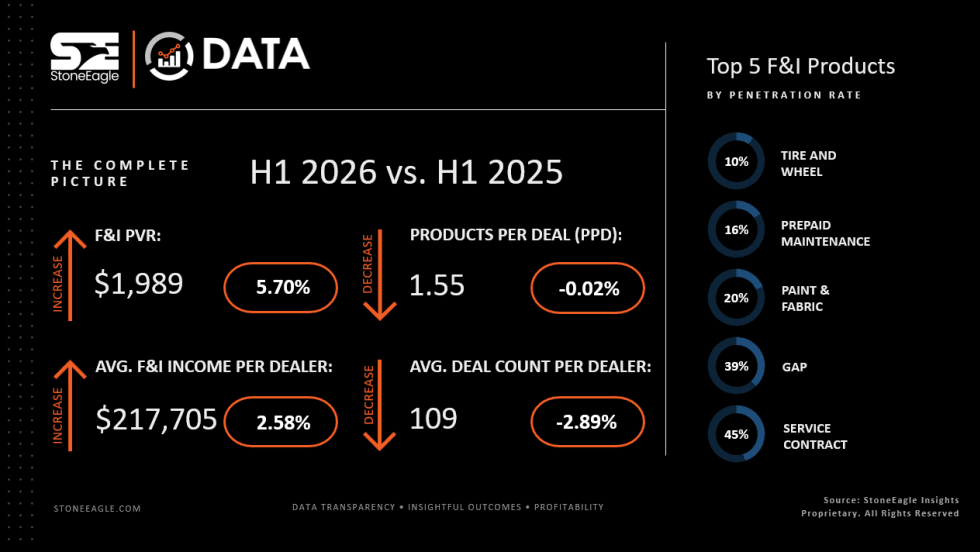
F&I Sales Give Dealers First-Half Lift
Product business shored up total profits to avoid an overall revenue tanking as product penetrations held steady, StoneEagle reported.
Read More →
Targeted Training Drives Results
Today’s technology, instead of threatening F&I managers, can actually make them better, according to an industry veteran who’s watched market setbacks roil the unprepared.
Read More →
Double the Change, Double the Chance
When an F&I manager gets a customer refusal, it’s a wise move to tweak more than one thing in the product offering.
Read More →
Just Do It
F&I managers need training, but instead of resisting application or expecting perfection, they should improve by simply acting on what they learn.
Read More →
Dealer Lender Preferences Revealed
When lenders provide consistent, fast service, their overall satisfaction scores with dealers greatly improve, according to JD Power research.
Read More →