FI showroom red and grey logo
MenuMENU
SearchSEARCH

Automakers Spending 12.5 Percent More to Sell Cars, Says Edmunds.com

Edmunds.com estimated today that the average automotive manufacturer incentive in the U.S. was $2,714 per vehicle sold in January 2009, down $148, or 5.2 percent, from December 2008, and up $301, or a dramatic 12.5 percent, from January 2008.

by Staff
February 5, 2009
3 min to read


SANTA MONICA, Calif. -- Edmunds.com estimated today that the average automotive manufacturer incentive in the U.S. was $2,714 per vehicle sold in January 2009, down $148, or 5.2 percent, from December 2008, and up $301, or a dramatic 12.5 percent, from January 2008.

"Automakers need to clear out leftover inventory from the 2008 model year, and that effort is boosting the average incentive cost for the industry," noted Jesse Toprak, executive director of industry analysis for Edmunds.com. "

Ad Loading...

Last month, 27 percent of all new vehicles sold were from the 2008 model year, while in January 2008 only 12 percent of new vehicle sales were from the previous model year’s inventory."

According to Edmunds.com, combined incentives spending for domestic manufacturers averaged $3,438 per vehicle sold in January 2009, down from $3,709 in December 2008. From December 2008 to January 2009, European automakers increased incentives spending by $329 to $3,297 per vehicle sold; Japanese automakers increased incentives spending by $27 to $1,775 per vehicle sold; and Korean automakers increased incentives spending by $197 to $2,963 per vehicle sold.

True Cost of Incentives for the "Big Six" Automakers

Automaker          January 2009          December 2008           January 2008

Chrysler Group              $4,196                        $3,681                     $3,616

Ad Loading...

Ford                              $3,574                         $3,985                     $3,055

General Motors             $2,992                         $3,554                     $3,322

Honda                           $1,349                         $1,209                       $ 988

Nissan                           $2,270                         $2,167                     $2,129

Toyota                           $1,973                         $2,071*                   $1,031

Ad Loading...

Industry Average           $2,714                         $2,862                     $2,413

(*Denotes a monthly record for the indicated automaker.)

In January 2009, the industry's aggregate incentive spending is estimated to have totaled approximately $1.9 billion, down 22.4 percent from December 2008. Chrysler, Ford and General Motors spent an aggregate of $1.1 billion, or 57.5 percent of the total; Japanese manufacturers spent $532 million, or 26.8 percent; European manufacturers spent $203 million, or 10.3 percent; and Korean manufacturers spent $108 million, or 5.5 percent.

"Incentives will be quite high until 2008 inventory is gone, likely by the end of March," reported Edmunds' AutoObserver.com senior editor Michelle Krebs. "Between now and then, bargain-hunters have a great opportunity to pick up an especially good deal.”

Among vehicle segments, premium sport cars had the highest average incentives, $5,297 per vehicle sold, followed by premium luxury cars at $5,213. Subcompact cars had the lowest average incentives per vehicle sold, $501, followed by compact cars at $1,422. Analysis of incentives expenditures as a percentage of average sticker price for each segment shows large trucks averaged the highest, 13.7 percent, followed by large cars at 11.9 percent of sticker price. Subcompact cars averaged the lowest with 3.0 percent and sport cars followed with 4.8 percent of sticker price.

Ad Loading...

Comparing all brands, in January MINI spent virtually nothing followed by Scion at $74 per vehicle sold. At the other end of the spectrum, Lincoln spent the most, $5,594, followed by BMW at $4,965 per vehicle sold. Relative to their vehicle prices, Kia and Mercury spent the most, 16.9 percent and 14.9 percent of sticker price, respectively; while MINI spent virtually nothing and Scion spent 0.4 percent.


Topics:F&I

More F&I

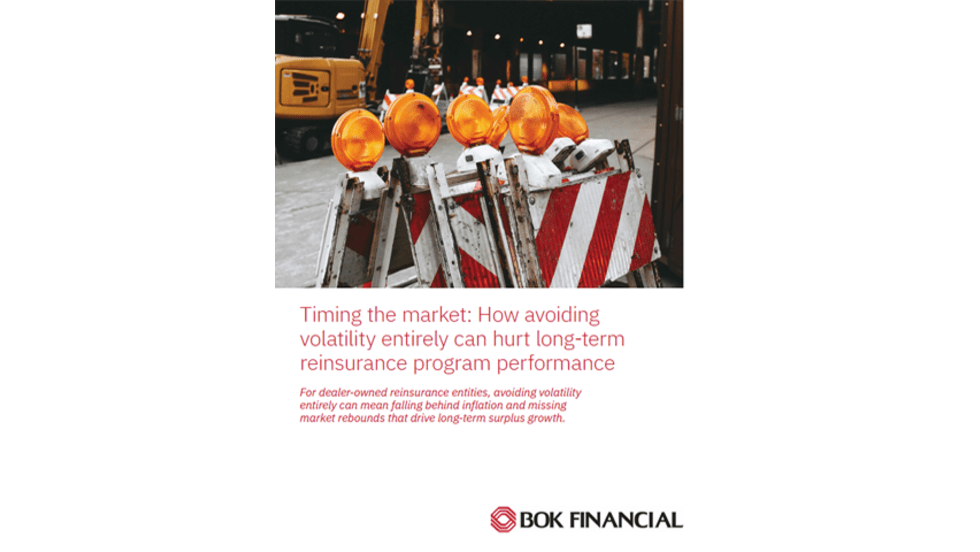
Cover image for a BOK Financial report titled “Timing the market: How avoiding volatility entirely can hurt long-term reinsurance program performance.” The image shows several road construction barricades with flashing amber warning lights lined up in a nighttime work zone. Beneath the image, red text explains that avoiding volatility can mean falling behind inflation and missing market rebounds that drive long-term surplus growth. The BOK Financial logo appears at the bottom right.
SponsoredMay 8, 2026

Timing the Market Can Hurt Long-Term Program Performance

For dealer-owned reinsurance entities, avoiding volatility entirely can mean falling behind inflation and missing market rebounds that drive long term surplus growth. Missing just a handful of strong market days can materially impact cumulative returns—an important reminder for long horizon trust and investment strategies.

Read More →
Ryan Ruff, The 90/10 Rule, Automotive Training Academy, Sales Series
F&IMay 6, 2026

The 90/10 Rule

In this video, Ryan Ruff explains the rule that elite sales professionals use to turn ordinary conversations into unforgettable customer experiences.

Read More →
Photo of essential oil diffuser on desk next to laptop
F&IMay 4, 2026

Your Office Is Talking

What’s the atmosphere saying about you to your customers? You can make minor adjustments and additions that transform your space into one that creates trust with the people on the other side of the desk.

Read More →
Ad Loading...
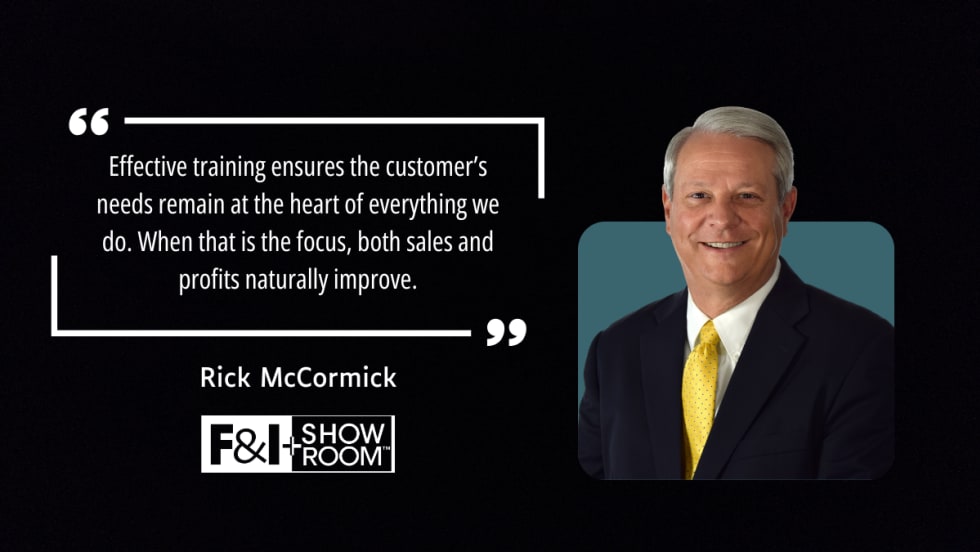
"Effective training ensures the customer’s needs remain at the heart of everything we do. When that is the focus, both sales and profits naturally improve." by Rick McCormick with F&I and Showroom logo and picture of Rick McCormick
F&IMay 1, 2026

F&I Training Fundamentals

How can auto dealerships help F&I managers fulfill their vital role in the most effective ways? Industry expert Rick McCormick shares his insights on the best ways to train these professionals and help them maintain good habits.

Read More →
Photo of car tire and the tread mark it left in snow
F&Iby Hannah MitchellApril 29, 2026

Not Just Any Tire Will Do

More consumers and businesses are opting for all-season options for various reasons as safety, sustainability and convenience push practical change.

Read More →
Photo of robot holding a laptop
F&Iby Hannah MitchellApril 27, 2026

How AI Will Drive the Next Wave of Innovation in Finance & Insurance

It’s time to take the next digital step to free F&I managers to handle the most challenging aspects of customer meetings.

Read More →
Ad Loading...
Photo of notepad and pen next to computer keyboard on desktop
F&IApril 13, 2026

Control in Sales Is an Illusion

Some of it should be given to the customer, but that doesn’t mean the F&I office relinquishes the process. In fact, a different approach both builds trust and boosts sales.

Read More →
Photo of external keyboard on office deak next to window
F&IApril 7, 2026

The Limited Warranty Game

Bringing it in-house benefits the dealership and its customers.

Read More →
Woman in casual clothing sitting at a desk
F&Iby Rick McCormickMarch 31, 2026

Curb The Confusion

Talk to F&I customers like you’d talk to a friend, without industry lingo or sales-like questions, and use hard proof to show, not tell, them about a need.

Read More →
Ad Loading...
Photo of man's hand on laptop computer keyboard with blank screen
F&IMarch 16, 2026

There Is Always one More Product

Helping F&I customers understand complementary offerings is likely to lead to more sales, based on the success of a high-performing practitioner of the philosophy.

Read More →