



Black Book: Weekly Market Updates
The May Retention Index showed another increase and broke yet another record, reaching 159.6 points, a 7.1 point (or 4.7%) increase from April (152.4).

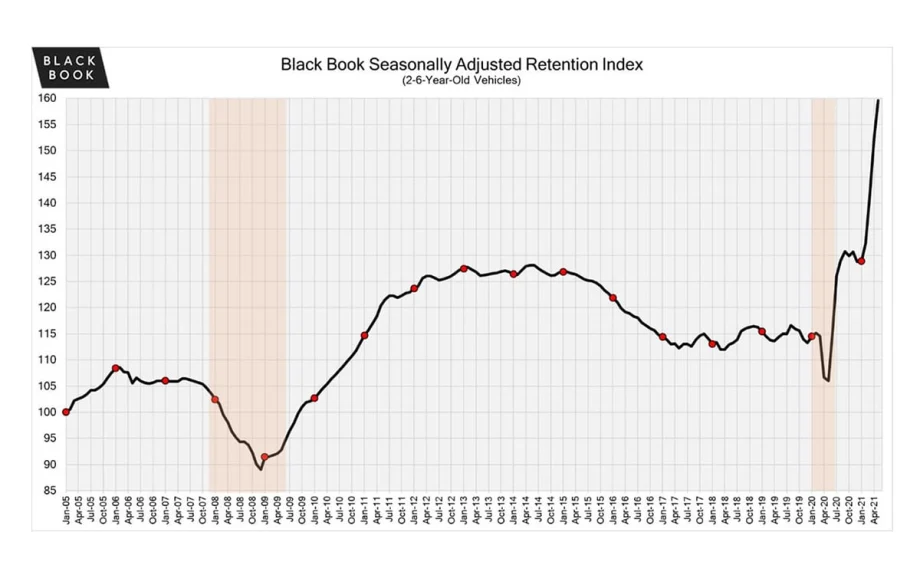
The May Retention Index showed another increase and broke yet another record, reaching 159.6 points, a 7.1 point (or 4.7%) increase from April (152.4).
Wholesale Prices, Week Ending June 12th
With so many newer used units selling at or above their respective new MSRP, the industry continues to question where the ceiling is, or if there is one? Unfortunately for buyers, the ceiling was not found this week; instead, it was another strong week for wholesale values, which makes it 20-consecutive weeks of gains.
Car Segments
On a volume-weighted basis, the overall Car segment continued its 20-week trend, increasing this week by 0.97%. For reference, the previous weeks increase was 0.80%.
The Mid-size and Compact car segments had the largest weekly gains at 1.15% and 1.14%, respectively.
Compact car segment has had greater gains than the overall car segment average for 13-consecutive weeks.
Only two segments had gains of less than half a percent, Premium Sporty and Prestige Luxury segments at +0.45% and +0.44%, respectively.
Truck Segments
On a volume-weighted basis, the overall Truck segment increased 0.94% this past week. For reference, the previous weeks increase was 1.02%.
All segments reported gains last week, with five of the thirteen segments gaining more than 1%.
Compact Van segment had the highest gains for the week at 1.59%, followed closely by Full-size Crossover/SUVs at +1.33%
Over the last 20-weeks, Sub-compact Crossover has had the highest cumulative total increase (of truck segments) at more than 30%
Newer Used Vehicles (0-2-year-old)
Driven by an extreme shortage of rental returns and limited inventory of new vehicles, the prices of newer used vehicles have been experiencing large weekly gains. While wholesale prices are exceeding MSRP in some cases, the rate of increase have started to slowed down in the last several weeks.
The table below shows the average weekly price changes for 0-2-year-old vehicles.
Weekly Wholesale Index
2020 ended with used wholesale prices at elevated levels. With economic patterns (including the automotive market) driven by the pandemic, normal seasonal patterns (e.g. 2019 calendar year) in the wholesale market were not observed for most of the year. We saw a similar picture in 2009, at the end of the Great Recession. It is now clear that 2021 will also not have typical seasonality patterns as the market is going through a rapid increase in wholesale values. The spring market arrived about 7 weeks earlier and with much stronger price increases compared to a typical pre-COVID year. The graph below looks at trends in wholesale prices of 2-6-year old vehicles, indexed to the first week of the year. Currently, wholesale prices are around 35% higher compared to the beginning of the year (adjusted for the mix).
Black Book’s May Wholesale Retention Index
The May Retention Index showed another increase and broke yet another record, reaching 159.6 points, a 7.1 point (or 4.7%) increase from April (152.4). The Index currently stands 50.6% above where it was the same time last year, during lowest point in automotive values due to COVID-19. Wholesale prices continued their ascent each week in May, although the rate of increase declined throughout the month. Demand for used and new vehicles remained strong even with dwindling new inventory. Available used inventory stabilized in May and started to build up at the end of the month, although we are still about 10% below where we started the year. This strong demand and low inventory together with low (and declining) incentive levels on new vehicles helped the retention index to increase for the fifth month in the row to a new record. This month, all segments besides Full-Size Vans showed increases, with Minivans having the largest gains again (almost 13%).
Retail (Used and New) Insights
Fiat’s CEO announced that the company is transitioning into a full-electric production line by 2030.
Lordstown Motors Corp announced that CEO Steve Burns and CFO Julio Rodriguez have resigned.
GM plans to build some MY21 pickups and SUVs, including the Yukon, without fuel-saving stop-start feature because of the chip shortage.
Toyota / Lexus recently added a premium parking app “Parkopedia” to their infotainment systems in North America.
Used Retail Prices
With the proliferation of ‘no-haggle pricing’ for used-vehicle retailing, asking prices accurately measure trends in the retail space. Retail demand slowed down at the end of last year, and thus resulted in declining retail asking prices over the last several weeks of 2020. As demand rebounded, retail prices have lagged slightly behind wholesale prices, but March had an accelerated growth in retail prices. In April and May, retail prices picked up speed as demand accelerated, fueled by stimulus payments, tax season, and shortages of new inventory. Currently, the prices are more than 22% above where we started the year.
This analysis is based on approximately two million vehicles listed for sale on US dealer lots. The graph below looks at 2-6-year-old vehicles.
Inventory
Used Retail
Current used retail listing volume is about 12% below the start of the year. The inventory levels have been slowly but consistently increasing over the last 7 weeks as we see some softening of demand.
Days-to-turn has continued to decrease since the middle of March as sourcing both new and used inventory continues to be a challenge; it now stands around 32 days, which as the graph below shows, is lower than we have seen in the recent past.
Wholesale
Although floor pricing remains strong and the availability of average and clean vehicles remains scarce, conversion rates have been consistently increasing since mid-May.
Despite the limited inventory on dealer lots, dealer lanes continue to have higher volume at auction, while manufacturers’ remarketing lanes are offering less and less in open sales channels. Many dealers are finding higher profit margins in the wholesale channel as opposed to their own retail lots. Dealers have found creative ways to diversify their source of inventory, and their innovation is paying off.
OEM remarketers are able to continue naming their price in the lanes for vehicles as a result of an extremely limited inventory pipeline. Even if a vehicle does not sell this week, it is expected to sell in the near future as there are limited opportunities for dealers to procure inventory.
More Auto Finance

Interest Rates Further Squeeze Auto Consumers
Last month’s hike and a potential second increase this month add to a growing list of inflation woes that could continue to dent overall car sales.
Read More →
Mind Your Process
Consistent steps taken in various aspects of the F&I office can make valuable differences over time, similar to an outline for a best-selling book.
Read More →
Top Five Credit Application Fraud Flags
Compliance audits regularly reveal bad habits that can lead to fraud charges and should have been stamped out decades ago.
Read More →
More Auto Loans for the Taking in August
Riskier categories were on the uptick for the month as lenders loosened access in several areas while balancing out the exposure in another, Cox Automotive reported.
Read More →
July Was Hot for Auto Borrowers
Credit proved readily available for many, but most loans left buyers in negative territory, Cox Automotive said.
Read More →
Dealer Lender Preferences Revealed
When lenders provide consistent, fast service, their overall satisfaction scores with dealers greatly improve, according to JD Power research.
Read More →
Auto Refi Savings Surge
Consumers with 84-month auto loan terms who refinanced saved the most on monthly payments, according to a new report by auto refinancing provider Caribou.
Read More →
Subaru Enters Lending Business
The automaker follows other brands in adding captive financing in the U.S., and says the move will strengthen its position here.
Read More →
Positive Equity Reaches Record High
Mainstream vehicle owners who bought a car seven years ago are likely to have positive equity when trading in for a new vehicle, according to second-quarter Edmunds data.
Read More →
Dealerships Are Paying the Price for Extended Car Loans
Growing negative-equity scenarios mean such lengthy terms should be addressed in a forward-looking way to make them work for the dealer and the consumer down the road.
Read More →