



Calif. Senate Panel OKs BHPH Legislation
Legislation aimed at setting new restrictions for the state’s buy here, pay here (BHPH) dealers cleared its first hurdle yesterday.
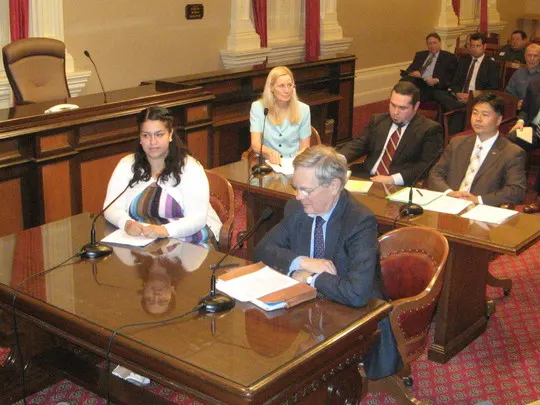
Picture are (from left) Jendry Ramos, a victim of a buy here, pay here dealer; Rosemary Shahan, president of Consumers for Auto Reliability and Safety; Mark Anderson, Ramos' attorney; Cliff Costa, legislative director for Sen. Ted W. Lieu; and Sen. Lieu.
SACRAMENTO, Calif. — Prompted by an investigative series published in the Los Angeles Times last fall, legislation aimed at setting new restrictions for the state’s buy here, pay here (BHPH) dealers cleared its first hurdle yesterday.
The Senate Banking and Financial Institutions Committee approved Senate Bill 956 by a five-to-two vote. The proposal, which was introduced by Sen. Ted Lieu (D-Torrance, Calif.) in January, is now headed to the Senate Judiciary Committee, where it will be heard on April 24.
If passed, the bill would set the strongest cap on auto loan interest rates in the nation at 17.25 percent. The legislation would also set mandatory grace periods for repossessions, and make it easier for vehicle owners to reinstate a repossessed vehicle. Dealers would also be required to use state-licensed repo companies.
The bill would also mandate that BHPH dealers register with the California Department of Corporations as a consumer lender.
“Some of California’s hardest working residents are being exploited simply because they desperately need a car to get to work or to drive their family to school or to the doctor,” Lieu told committee members yesterday. “Buy here, pay here dealers are pushing these types of unregulated loans to sell cars for far beyond market value.”
Lieu introduced his measure after a series of articles by Los Angeles Times reporter Ken Bensinger that sought to shed light on used-car lots and the customers who frequent them. The three-part series painted BHPH dealers in an unfavorable light, quoting customers who claimed they were taken advantage of by dealers. In one instance, a car owner claimed she was shown a 12 percent interest rate on the contract when the dealer knowingly charged her 20 percent.
Bensinger’s articles also played up the fact that some BHPH dealers charge rates as high as 30 percent, which is legal for most car finance transactions in California. “Strangely, Bensinger never indicated that rates that high are common,” Tom Hudson, a partner in the law firm of Hudson Cook LLP, wrote last February in F&I and Showroom’s Legal column. “But nothing gets in the way of a good story, right?”
A second bill aimed at regulating BHPH dealers also is making its way through the state legislature. Introduced in January by Assembly Member Mike Feuer (D-Los Angeles), the bill was referred to the Assembly Judiciary Committee on March 26. It would prohibit dealers from installing payment assurance devices, among other mandates.
Both bills drew swift condemnation from Kenneth Shilson, founder of the National Alliance of Buy Here, Pay Here Dealers (NABD). He described Feuer’s bill as “the most intrusive proposal I have ever seen.”
“They’re looking to regulate BHPH and disallow devices,” Shilson told F&I and Showroom in January. “That runs to the perception that the transaction is abusive and the device is an invasion of the consumer’s privacy. It’s not. Lenders have the right to their collateral.”
Shilson also was critical of Bensinger’s article. Calling it “totally one-sided,” Shilson said the newspaper series only focused on hard-luck stories from BHPH buyers and the high interest rates and multiple repossessions inherent to the segment. He added that the series gave little voice to dealers, noting that high interest rates reflect the risk each dealer takes on when financing “unbankable” customers.
The articles also caught the attention of the Consumer Financial Protection Bureau. Richard Cordray, the bureau’s new director, announced shortly after the articles were published that the CFPB was interested in finding out more about the BHPH industry. He claimed that the bureau’s interest in the topic came, in part, from Holly Petraeus, wife of CIA Director and retired General David Petraeus. She also heads up the CFPB’s Office of Servicemember Affairs and was critical of BHPH dealers surrounding military bases.
"We are looking at that space," Cordray said at a press conference in January. "We’re concerned about it."
More Auto Finance

Mind Your Process
Consistent steps taken in various aspects of the F&I office can make valuable differences over time, similar to an outline for a best-selling book.
Read More →
Top Five Credit Application Fraud Flags
Compliance audits regularly reveal bad habits that can lead to fraud charges and should have been stamped out decades ago.
Read More →
More Auto Loans for the Taking in August
Riskier categories were on the uptick for the month as lenders loosened access in several areas while balancing out the exposure in another, Cox Automotive reported.
Read More →
July Was Hot for Auto Borrowers
Credit proved readily available for many, but most loans left buyers in negative territory, Cox Automotive said.
Read More →
Dealer Lender Preferences Revealed
When lenders provide consistent, fast service, their overall satisfaction scores with dealers greatly improve, according to JD Power research.
Read More →
Auto Refi Savings Surge
Consumers with 84-month auto loan terms who refinanced saved the most on monthly payments, according to a new report by auto refinancing provider Caribou.
Read More →
Subaru Enters Lending Business
The automaker follows other brands in adding captive financing in the U.S., and says the move will strengthen its position here.
Read More →
Positive Equity Reaches Record High
Mainstream vehicle owners who bought a car seven years ago are likely to have positive equity when trading in for a new vehicle, according to second-quarter Edmunds data.
Read More →
Dealerships Are Paying the Price for Extended Car Loans
Growing negative-equity scenarios mean such lengthy terms should be addressed in a forward-looking way to make them work for the dealer and the consumer down the road.
Read More →
Trade-Ins in Negative Equity Reach New Heights
As such trade-ins rise in frequency, so do monthly loan payment amounts and interest rates, according to second-quarter data compiled by Edmunds.
Read More →