



Cox: September Sales to Decline 7.2% From Year-Ago Levels
Despite the expected volume decline, the firm put September’s seasonally adjusted annual sales rate at a healthy 17.1 million, down from last September’s 18.1 million SAAR. The company said higher interest rates and talks of tariffs may be having some pull-ahead impact in the market.
ATLANTA — September’s new-vehicle sales pace is expected to rise to 17.1 million units, according to Cox Automotive. If realized, the firm’s forecast would be an improvement over August’s 16.6 million sales rate. The gain, however, might be misleading, Cox’s Senior Economist Charlie Chesbrough said.
The firm noted that September’s total sales volume should decline nearly 60,000 units from last month nearly 100,000 units compared to September 2017, which benefit from a sales lift from replacement demand and delayed purchases following Hurricane Harvey in August 2017.
“Year-over-year comparisons are challenging in September, as the industry realized record sales levels last year,” said Chesbrough. “With one less selling day this September and due to seasonal adjustment factors, the sales pace will actually show an increase, despite significant volume declines.”
Vehicle sales reached an all-time high in September 2017 and bested the previous two Septembers by nearly 80,000 units. A large decline from last September’s unnaturally high level is expected, and recent storms and flooding in the Southeast will only contribute to weak volumes.
Including fleet sales, Cox Automotive’s September forecast puts new-vehicle sales at 1.41 million units, which would be down 100,000 units, or 7.2%, from September 2017. Compared to August, sales would be down 4.3%.
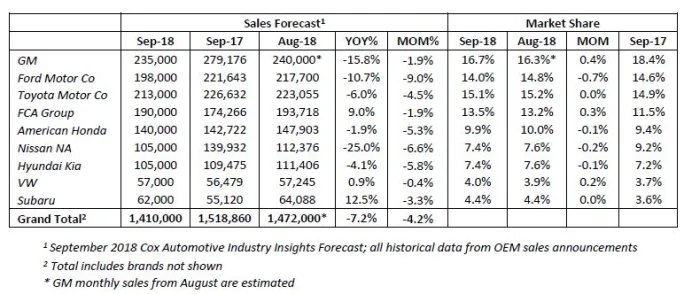
And despite the decline in sales volume, one less selling day this September vs. last September should cause the sales pace to rise, the company noted. It’s why the firm put September’s SAAR at 17.1 million, which would be down from last September’s record 18.1 million pace.
“A record SAAR in September is very unlikely,” the firm noted. “Sales will need to post 90,000 units above forecast to beat last year’s record,” the firm noted. “Without massive incentives and promotions, a record is not expected.”
The company added that talk of tariffs as well as rising interest rates may be having some pull-ahead impact in the market. “Auto buyers, concerned about the likelihood of higher vehicle prices over the course of the year may be buying sooner than they had originally planned, supporting the higher sales pace.
“Although the market and buying conditions are strong, risks are also rising. Additional interest rate hikes are expected, which will cause a buyer’s monthly payment to increase,” the firm noted. “And previous years of aggressive leasing is now creating a major headwind. Millions of gently-used, high-content vehicles have been returning to dealer lots. Off-lease vehicle volume is expected to peak in 2019, and many potential new-vehicle buyers will be drawn to this value alternative.”
Most manufacturers are expected to post sales declines. Jeep is expected to perform well, as demand for rugged crossovers fits well with their portfolio. Ford and GM are likely to see some larger declines as aging product in some segments, poor car sales, and tighter incentives hold them back.
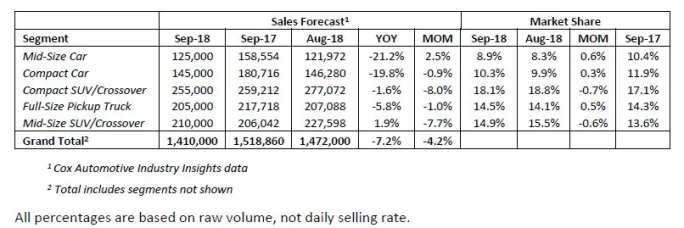
Most vehicle segments should see declining sales vs. last year. Car share may make a modest improvement as higher prices in the used market coupled with newer high-volume products from Honda and Toyota could support new sales.
Looking further ahead, Cox Automotive forecasts a slowing sales pace over the remaining months of the year as buying conditions deteriorate due to higher interest rates and elevated gasoline prices. Steel and aluminum tariffs may also be negatively contributing to sales activity, forcing automakers to hold incentive activity at more modest levels.
“Product costs are rising as a result of higher metal prices, and margins are being negatively impacted,” the firm added. “With less profit margin available, tighter and targeted incentive activity is required. Days supply is also in a relatively stable position, allowing for more pricing discipline.”
The growing volume of gently-used vehicles, which are selling at a 30% to 50% discount to their new versions, also pose a real threat to stronger new-vehicle sales volumes. Despite these headwinds, Cox noted that economic conditions for vehicle buyers remain favorable with strong consumer confidence level and decades-low unemployment rates.
The overall demand for transportation also remains high. Higher interest rates and new trade tariffs are also not chasing away buyers, the firm noted.
Cox’s forecast for full-year auto sale is 16.8 million units, which would be down from 2017’s 17.1 million-unit total.
More F&I

AI: Facilitator, Not Fixer, in F&I
The dealerships that thrive in the years ahead will be those that embrace technology while continuing to invest in the people who make customer interactions count.
Read More →
Modern Technology Objection Handling
In this video, Trent White shares how to confidently handle technology-based objections by helping customers understand the value of protection, even with modern vehicle technology.
Read More →
Consistency at Scale: Driving F&I Performance
With 75 rooftops across the Sunshine State, Morgan Auto Group has proven to Floridians that it knows a thing or two about driving performance in a competitive market. But it didn’t start at the top.
Read More →
Gitty Up on GAP
The foundational finance-and-insurance product hasn’t kept up with the latest conditions for auto dealers. Is the time ripe?
Read More →
How AI-Powered Coaching Is Transforming F&I Performance
See how AI-powered coaching can turn F&I customer conversations into actionable insights that support compliance, performance and profitability
Read More →
Sell Value, Build Trust
In this video, Trent White explains why selling on value, not fear, builds lasting customer trust, reduces cancellations, and drives long-term success.
Read More →
F&I Sales Give Dealers First-Half Lift
Product business shored up total profits to avoid an overall revenue tanking as product penetrations held steady, StoneEagle reported.
Read More →
Targeted Training Drives Results
Today’s technology, instead of threatening F&I managers, can actually make them better, according to an industry veteran who’s watched market setbacks roil the unprepared.
Read More →
Double the Change, Double the Chance
When an F&I manager gets a customer refusal, it’s a wise move to tweak more than one thing in the product offering.
Read More →
Just Do It
F&I managers need training, but instead of resisting application or expecting perfection, they should improve by simply acting on what they learn.
Read More →