



CUDL Credit Unions Break Into Top Five
A new report from Credit Union Direct Lending (CUDL) shows that the firm’s affiliated credit unions collectively represented the United States’ No. 5 source for auto loans in 2009.
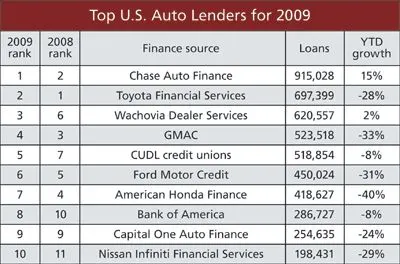
ONTARIO, Calif. — A new report from Credit Union Direct Lending (CUDL) shows that the firm’s affiliated credit unions collectively represented the United States’ No. 5 source for auto loans in 2009. Last year marked the second straight year of market share gain for the lending solutions provider, which currently represents more than 780 credit unions across the country.
Andrea Salgado, market research analyst for CUDL, presented the findings in a recent Webcast. She tempered the news by noting that numbers from recent months paint a somewhat different picture.
“We gained a lot of share from the captive [lenders],” Salgado said. “For the last six months of 2009, we saw that captives were once again reclaiming market share.”
The prior year’s No. 1 lender was Toyota Financial Services, which dropped into the No. 2 slot in 2009, trading places with Chase Auto Finance. Chase and Wachovia Dealer Services, which moved up three places to No. 3, were the only lenders in the Top 10 to grow their portfolios in 2009. CUDL credit unions gained market share despite shrinking in volume by 8 percent — a slight decrease compared to lenders such as American Honda Finance and GMAC, who remained on the list despite decreasing loan volume by 40 percent and 33 percent, respectively.
Delinquencies and charge-offs continue to haunt all sources of auto financing as part of the fallout from the recent economic downturn.
“Indirect [loan] delinquencies have been trending upward in 2009 but, fortunately, they’re still below the high that we experienced in the fourth quarter of 2008,” Salgado said. “Charge-offs have been trending upward as well, finishing the fourth quarter of 2009 at 1.45 percent.”
Salgado did not speculate as to when those numbers will improve, but it is widely believed that restricted lending to less-than-prime credit tiers will help to reverse those trends in the near future. The report found that, in 2009, CUDL-affiliated credit unions sent the lion’s share of their approvals to the prime lending tier — 81.2 percent of new-vehicle originations and 72.1 percent of used-vehicle loans were for customers with FICO scores of 680 or higher.
More Auto Finance

Interest Rates Further Squeeze Auto Consumers
Last month’s hike and a potential second increase this month add to a growing list of inflation woes that could continue to dent overall car sales.
Read More →
Mind Your Process
Consistent steps taken in various aspects of the F&I office can make valuable differences over time, similar to an outline for a best-selling book.
Read More →
Top Five Credit Application Fraud Flags
Compliance audits regularly reveal bad habits that can lead to fraud charges and should have been stamped out decades ago.
Read More →
More Auto Loans for the Taking in August
Riskier categories were on the uptick for the month as lenders loosened access in several areas while balancing out the exposure in another, Cox Automotive reported.
Read More →
July Was Hot for Auto Borrowers
Credit proved readily available for many, but most loans left buyers in negative territory, Cox Automotive said.
Read More →
Dealer Lender Preferences Revealed
When lenders provide consistent, fast service, their overall satisfaction scores with dealers greatly improve, according to JD Power research.
Read More →
Auto Refi Savings Surge
Consumers with 84-month auto loan terms who refinanced saved the most on monthly payments, according to a new report by auto refinancing provider Caribou.
Read More →
Subaru Enters Lending Business
The automaker follows other brands in adding captive financing in the U.S., and says the move will strengthen its position here.
Read More →
Positive Equity Reaches Record High
Mainstream vehicle owners who bought a car seven years ago are likely to have positive equity when trading in for a new vehicle, according to second-quarter Edmunds data.
Read More →
Dealerships Are Paying the Price for Extended Car Loans
Growing negative-equity scenarios mean such lengthy terms should be addressed in a forward-looking way to make them work for the dealer and the consumer down the road.
Read More →