



DealerSocket Report Offers Tips On How to Thrive in Slow-Growth Times
DealerSocket released its annual Dealership Action Report, which emphasized the importance of formal, technology-driven processes to thrive and increase profitability during slow periods.
SAN CLEMENTE, Calif. — DealerSocket released its Dealership Action Report (DAR) to the more than 700 attendees at the company’s annual User Summit in San Diego, Calif., last week.
With data from more than 6,500 dealerships, the insights of the company's inaugural DAR point to the importance of formal, technology-driven processes to thrive and increase profitability during periods of slowed sales growth
“The insights highlighted in the DAR will guide dealers to better ways of selling, servicing and retaining customers during periods of heightened competition as year-over-year unit sales growth wanes,” said Marylou Hastert, DealerSocket's director of product marketing. “With the same number of dealers fighting for fewer sales, it’s critical that dealerships focus on high-impact, data-driven processes to improve their margins.”
Approaches for responding to these market realities, according to DealerSocket, include using technology to turn current customers into loyal, profitable service customers, engaging new customers before competitors have the chance to, aligning operational focus on remarketing as a profit center, confirming appointments and nurturing digital leads.
Develop loyal, profitable service customers:According to the report, the ideal customer lifecycle at a dealership includes the new car purchase, providing maintenance on that vehicle on the service drive and, finally, a vehicle trade-in. Converting new-car sales customers into loyal service customers should be an area of focus as the average duration of ownership increases due to longer vehicle lifecycles, warranty terms and better parts, the study noted.
While 53% of the average dealership’s gross profit is generated from the service department, only 30% of sold customers bring their car in for service within the first year of ownership. That number plummets to 13% after three years and to 2% after five years, according to the report.
“Dealers must establish the value of their store’s service department early to protect their customers from the endless competitive options available to them,” said Hastert. “Third-party repair shops own about 75% of the market and are crushing dealerships in the service game.”
Introducing customers to the service manager and scheduling a first oil change before they drive off the lot can build a long-lasting, profitable relationship, according to the DAR. Some top performers offer cash-back bonuses on service purchases that can be applied to the purchase of future vehicles to improve customer retention.
Data from the report also showed that integrating the sales process within the service drive at a dealership nearly doubles the customer loyalty and retention rate.
Engage customers before competitors have a chance to: To engage customers before competitors have a chance to, the study noted that top-performing dealerships use data-mining software to scan customer data and identify potential customers who are in a favorable position to spend money at their stores.
Analysis of dealerships using DealerSocket’s RevenueRadar data-mining platform showed that leads identified through this technology are converted to sales nearly 90%of the time, and data mining, in general, generates, on average, 21 additional new-vehicle sales per month and more than $424,000 in gross profits per dealership, per year. Additionally, 84% of calls made to leads generated through RevenueRadar resulted in an appointment set compared to an average of 25% for other lead sources.
“Data-mining software is a gem that is really underutilized despite leading dealerships in the industry proving its value,” said Hastert. “Implementing this type of technology, understanding how to optimize its benefits, and investing resources into educating sellers about how to use it as a fourth lead source will give dealers an edge against the competition.”
Focus on remarketing as a profit center: Dealers taking advantage of anticipated used-car inventory for faster selling cycles and larger profits also have an edge, according to the DAR. DealerSocket underscored the importance of aligning an operational focus on used-vehicle acquisition and sales as a way to drive profitability.
“With more than 100 new or redesigned products hitting the market in 2015, product anticipation will diminish in 2016,” said Hastert. “The 800,000 lease maturities expected to come back to the market in 2016 will prove a fruitful revenue stream.”
The DAR report shows that the average total gross profit for used cars is 14% greater than for new cars across all lead sources. Additionally, data shows that used-car leads take fewer days to close and generally deliver an ROI between 500% and 700% compared to an average ROI for new cars of between 95% and 148%.
Confirm appointments: Dealerships with appointment-scheduling and confirmation processes improved show rates by as much as 15% over the average dealership. Some top performers achieved an appointment show rate as high as 80% just by emailing a “boarding pass” to confirm date, time and location.
Nurture digital leads: Digital leads generate an additional $812 in average total profit compared to leads acquired through traditional sources. The report also shows that when comparing a dealership’s cost per lead sold, the digital leads cost ten times less than traditional leads — with the cost per digital lead sold sitting at $150 compared to the cost of $1,581 per traditional lead sold.
To request a copy of the DealerSocket Dealership Action Report, call (844) 753-8148.
More F&I

AI: Facilitator, Not Fixer, in F&I
The dealerships that thrive in the years ahead will be those that embrace technology while continuing to invest in the people who make customer interactions count.
Read More →
Modern Technology Objection Handling
In this video, Trent White shares how to confidently handle technology-based objections by helping customers understand the value of protection, even with modern vehicle technology.
Read More →
Consistency at Scale: Driving F&I Performance
With 75 rooftops across the Sunshine State, Morgan Auto Group has proven to Floridians that it knows a thing or two about driving performance in a competitive market. But it didn’t start at the top.
Read More →
Gitty Up on GAP
The foundational finance-and-insurance product hasn’t kept up with the latest conditions for auto dealers. Is the time ripe?
Read More →
How AI-Powered Coaching Is Transforming F&I Performance
See how AI-powered coaching can turn F&I customer conversations into actionable insights that support compliance, performance and profitability
Read More →
Sell Value, Build Trust
In this video, Trent White explains why selling on value, not fear, builds lasting customer trust, reduces cancellations, and drives long-term success.
Read More →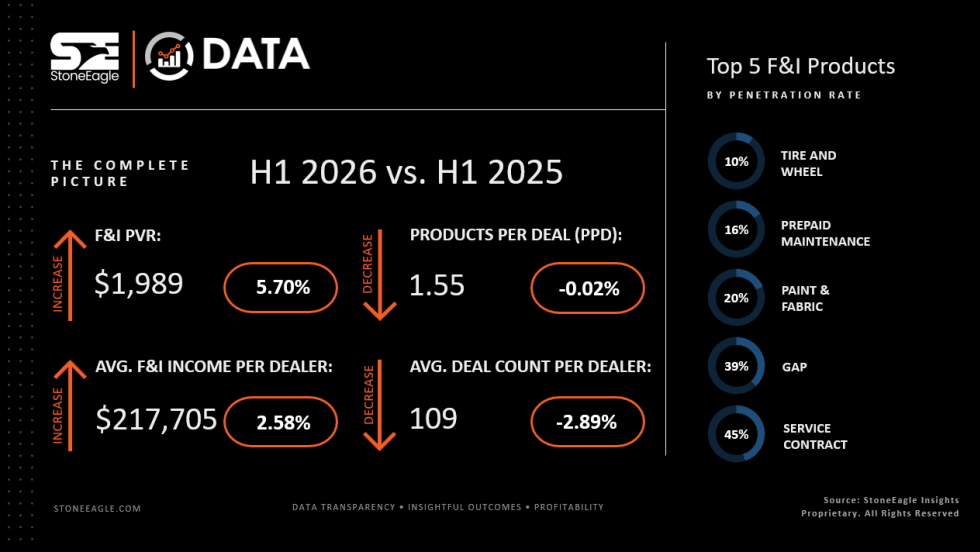
F&I Sales Give Dealers First-Half Lift
Product business shored up total profits to avoid an overall revenue tanking as product penetrations held steady, StoneEagle reported.
Read More →
Targeted Training Drives Results
Today’s technology, instead of threatening F&I managers, can actually make them better, according to an industry veteran who’s watched market setbacks roil the unprepared.
Read More →
Double the Change, Double the Chance
When an F&I manager gets a customer refusal, it’s a wise move to tweak more than one thing in the product offering.
Read More →
Just Do It
F&I managers need training, but instead of resisting application or expecting perfection, they should improve by simply acting on what they learn.
Read More →