



Edmunds: 100,000-Mile Cars More Valuable Than Shoppers Think
Thanks to a tight supply of late-model used vehicles, values don’t dramatically drop once the odometer crosses six figures, according to a new report from vehicle information site.
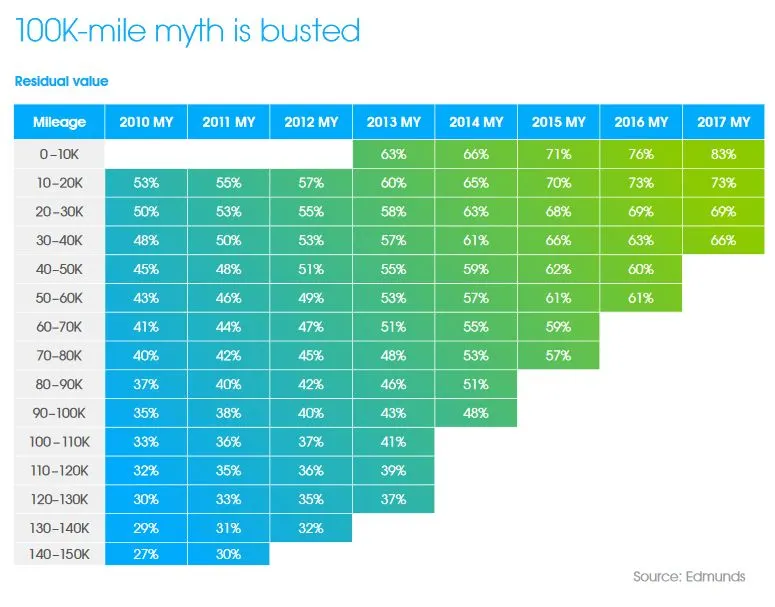
SANTA MONICA, Calif. — The tight supply of late-model used vehicles is squashing the long-held belief that a car’s best days are behind it once the odometer passes the 100,000-mile mark, at least according to Edmunds’ used-vehicle market report for the third quarter.
The site’s analysis of late-model used vehicles revealed that values decline only incrementally between 100,000 and 150,000 miles, and the rate of depreciation is similar to the decline that occurs between 50,000 and 100,000 miles.
“After about the first 40,000 miles, vehicles depreciate at a slow and steady pace. The most dramatic drop-off is actually during the first 20,000 miles,” Edmunds Senior Analyst Ivan Drury said. “The 100,000-mile myth is really just a psychological barrier that more and more car buyers are getting past.”
Drury noted that following the recession, many people were forced to hang on to their vehicles longer than they may have wanted because they couldn’t afford a new car. “People then saw for themselves how much vehicle quality has improved and realized that car with 125,000 or even 150,000 miles still has a lot of life left,” he added.
And according to Edmunds data, these older, higher-mileage vehicles are in high demand among car shoppers.
In the third quarter, for example, a 2013 model-year vehicle with between 10,000 and 20,000 miles on the odometer took, on average, the exact same amount of time to sell as one with between 90,000 and 100,000 miles. A 2010 model-year vehicle only sat on a dealer’s lot for an average of 34 days in the third quarter, while a 2013 model-year vehicle sat for 42 days and a 2016 model-year vehicle took an average of 51 days to sell.
Drury noted that even though the number of off-lease vehicles entering the used market is starting to level off, the average price of a used vehicle is still at a record high due to demand remaining strong at the lower end of the market. “While the oversupply of newer vehicles is good news for buyers who can afford them, there’s still a very large segment of the population who just want an affordable vehicle to get them from A to B, and those are becoming much harder to find,” Drury said.
The popularity of SUVs and trucks is also a driving force behind used-vehicle prices, creating a significant residual value gap between passenger cars and larger vehicles. For example, a used 2015 midsize SUV with 100,000 miles still holds 50% of its original value. In contrast, a midsize car with 100,000 miles retains only 42% of its value. The gap widens even further between older, low-mileage used SUVs and passenger cars.
Drury said it’s a good time for consumers who are hanging on to an older SUV and thinking about trading up for a new vehicle to pull the trigger. “You’ll have the chance to take advantage of record-level new vehicle incentives and year-end savings, as well as get top-dollar for your current vehicle.”
More Auto Finance

Interest Rates Further Squeeze Auto Consumers
Last month’s hike and a potential second increase this month add to a growing list of inflation woes that could continue to dent overall car sales.
Read More →
Mind Your Process
Consistent steps taken in various aspects of the F&I office can make valuable differences over time, similar to an outline for a best-selling book.
Read More →
Top Five Credit Application Fraud Flags
Compliance audits regularly reveal bad habits that can lead to fraud charges and should have been stamped out decades ago.
Read More →
More Auto Loans for the Taking in August
Riskier categories were on the uptick for the month as lenders loosened access in several areas while balancing out the exposure in another, Cox Automotive reported.
Read More →
July Was Hot for Auto Borrowers
Credit proved readily available for many, but most loans left buyers in negative territory, Cox Automotive said.
Read More →
Dealer Lender Preferences Revealed
When lenders provide consistent, fast service, their overall satisfaction scores with dealers greatly improve, according to JD Power research.
Read More →
Auto Refi Savings Surge
Consumers with 84-month auto loan terms who refinanced saved the most on monthly payments, according to a new report by auto refinancing provider Caribou.
Read More →
Subaru Enters Lending Business
The automaker follows other brands in adding captive financing in the U.S., and says the move will strengthen its position here.
Read More →
Positive Equity Reaches Record High
Mainstream vehicle owners who bought a car seven years ago are likely to have positive equity when trading in for a new vehicle, according to second-quarter Edmunds data.
Read More →
Dealerships Are Paying the Price for Extended Car Loans
Growing negative-equity scenarios mean such lengthy terms should be addressed in a forward-looking way to make them work for the dealer and the consumer down the road.
Read More →