



FDIC: Insured Bank and Thrift Earnings Fell to $5 Billion in 2Q
Commercial banks and savings institutions insured by the Federal Deposit Insurance Corporation (FDIC) reported net income of $5.0 billion in the second quarter of 2008, a decline of $31.8 billion (86.5 percent) from the $36.8 billion that the industry earned in the second quarter of 2007.
WASHINGTON — Commercial banks and savings institutions insured by the Federal Deposit Insurance Corporation (FDIC) reported net income of $5.0 billion in the second quarter of 2008, a decline of $31.8 billion (86.5 percent) from the $36.8 billion that the industry earned in the second quarter of 2007. With the exception of the fourth quarter of last year, the latest earnings were the lowest for the industry since the fourth quarter of 1991.
"By any yardstick, it was another rough quarter for bank earnings, but the results were not unexpected as the industry coped with financial market disruptions, the housing slump, worsening economic conditions and the overall downturn in the credit cycle," said FDIC Chairman Sheila C. Bair.
The FDIC's "problem list" grew to 117 institutions from 90 at the end of the first quarter. That is largest number on the list since the middle of 2003. Total assets of problem institutions increased from $26 billion to $78 billion, with $32 billion coming from IndyMac Bank, F.S.B., Pasadena, CA, which failed in July. "More banks will come on the list as credit problems worsen," Chairman Bair added. "Assets of problem institutions also will continue to rise."
In releasing the latest results, the FDIC cited higher provisions for loan losses as the primary reason for the drop in industry profits. The size of the earnings decline was mainly attributable to a few large institutions, but more than half of all insured institutions (56.4 percent) reported lower net income in the second quarter. In addition, the industry reported lower noninterest income than a year earlier, reflecting continuing weakness in market-sensitive revenues, such as income from trading and securitization activities. Expenses for goodwill impairment and other charges to intangible assets were significantly higher than a year earlier. Proceeds from sales of securities and other assets yielded a net loss in the second quarter, compared to a net gain a year ago.
Chairman Bair also announced that in early October the FDIC will consider a plan to replenish the agency's Deposit Insurance Fund (DIF), which experienced a large drop due to added loss reserves for IndyMac and other bank failures. The DIF restoration plan "likely will include an increase in the premium rates that banks pay into the fund," she said. "And we'll be proposing changes to the current assessment system that will shift a greater share of any assessment increase onto institutions that engage in high-risk behavior to encourage and reward safer behavior."
Financial results for the second quarter are contained in the FDIC's latest Quarterly Banking Profile, which was released today. Among the major findings:
Provisions for loan losses continue to be the main cause of falling earnings. Rising levels of troubled loans, particularly in real estate portfolios, led many institutions to increase their provisions for loan losses in the quarter. Loss provisions totaled $50.2 billion, more than four times the $11.4 billion the industry set aside in the second quarter of 2007. Almost a third of the industry's net operating revenue (net interest income plus total noninterest income) went to building up loan-loss reserves.
Noncurrent loans are still rising sharply. The amount of noncurrent loans and leases (90 days or more past due or in nonaccrual status) increased by $26.7 billion (20 percent) during the second quarter, following a $26.2 billion increase in the first quarter and a $27.0 billion increase in the fourth quarter of 2007. Almost 90 percent of the increase in noncurrent loans and leases in the last three quarters consisted of real estate loans, but noncurrent levels have been rising in all major loan categories. At the end of June, 2.04 percent of all loans and leases were noncurrent, the highest level for the industry since 1993.
Assets of insured institutions declined. Total assets of FDIC-insured institutions declined during the quarter for the first time since 2002. The $68.6 billion (0.5 percent) decline was caused by a reduction in trading assets at a few large banks. Assets in trading accounts, which increased by $135.2 billion in the first quarter, declined by $118.9 billion (11.8 percent) in the second quarter. In addition, the industry's holdings of one- to four-family residential mortgage loans fell by $61.4 billion (2.8 percent). Real estate construction and development loans declined for the first time since 1997, falling by $5.4 billion (0.9 percent).
The FDIC's Deposit Insurance Fund reserve ratio fell. Due to a significant increase in loss reserves, including reserves for failures that have occurred since June 30th, the DIF balance fell to $45.2 billion at the end of the second quarter, down from $52.8 billion at the end of the first quarter. While insured deposits rose only 0.5 percent during the quarter, the decline in the fund balance caused the reserve ratio to fall to 1.01 percent as of June 30th from 1.19 percent one quarter earlier. Because the reserve ratio is now below 1.15 percent, the Federal Deposit Insurance Reform Act of 2005 requires the FDIC to develop a restoration plan that will raise the reserve ratio to no less than 1.15 percent within five years.
The complete Quarterly Banking Profile is available on the FDIC Website.
More F&I

Modern Technology Objection Handling
In this video, Trent White shares how to confidently handle technology-based objections by helping customers understand the value of protection, even with modern vehicle technology.
Read More →
Consistency at Scale: Driving F&I Performance
With 75 rooftops across the Sunshine State, Morgan Auto Group has proven to Floridians that it knows a thing or two about driving performance in a competitive market. But it didn’t start at the top.
Read More →
Gitty Up on GAP
The foundational finance-and-insurance product hasn’t kept up with the latest conditions for auto dealers. Is the time ripe?
Read More →
How AI-Powered Coaching Is Transforming F&I Performance
See how AI-powered coaching can turn F&I customer conversations into actionable insights that support compliance, performance and profitability
Read More →
Sell Value, Build Trust
In this video, Trent White explains why selling on value, not fear, builds lasting customer trust, reduces cancellations, and drives long-term success.
Read More →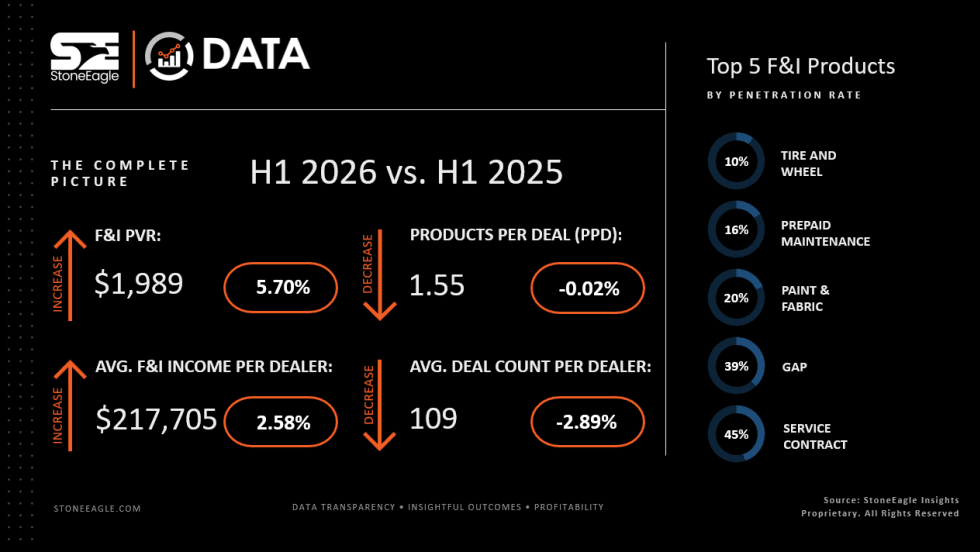
F&I Sales Give Dealers First-Half Lift
Product business shored up total profits to avoid an overall revenue tanking as product penetrations held steady, StoneEagle reported.
Read More →
Targeted Training Drives Results
Today’s technology, instead of threatening F&I managers, can actually make them better, according to an industry veteran who’s watched market setbacks roil the unprepared.
Read More →
Double the Change, Double the Chance
When an F&I manager gets a customer refusal, it’s a wise move to tweak more than one thing in the product offering.
Read More →
Just Do It
F&I managers need training, but instead of resisting application or expecting perfection, they should improve by simply acting on what they learn.
Read More →
Dealer Lender Preferences Revealed
When lenders provide consistent, fast service, their overall satisfaction scores with dealers greatly improve, according to JD Power research.
Read More →