



Fed Reserve Approves Second Rate Hike of 2018
For the seventh time since 2015, the Federal Reserve increased the Federal Funds Rate a quarter percentage. Cox Automotive economists say higher interest rates and tighter credit have already led to softening retail demand, noting that further rate increases will impact all corners of the car business.

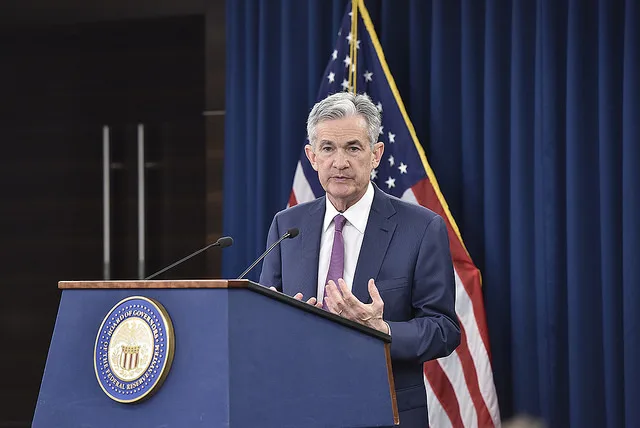
FOMC Chairman Powell answers a reporter's question at the June 13, 2018 press conference.
WASHINGTON, D.C. — With the labor market continuing to strengthen and economic activity rising at a solid rate, the Federal Reserve raised the Federal Funds Rate a quarter percentage point for the second time this year — putting the target for short-term rates in the 1.75 to 2% range.
The increase, the seventh since 2015, now has short-term rates up a full percentage point from last year. Cox Automotive Chief Economist Jonathan Smoke said recent rake hikes have impacted lending and borrowing across the U.S. economy, noting that average rates on automotive loans are up slightly more than a percentage point over last year and are now nearing seven-year highs.
“The 1% increase on the average auto loan we’ve already seen has increased the average monthly payment by $14. Throw in higher vehicle prices, and average payments are up over 4% from last year,” he said. “Higher rates are a problem for a consumer-driven economy as interest rates rise, debt service takes up a bigger chunk of income.”
Smoke added that data on personal income and consumption through April indicate that U.S. consumers have seen a 12% increase in interest payments year over year.
According to Experian Automotive, the average interest rate for new-vehicle financing in the first quarter climbed 31 basis points from the year-ago period to 5.17%, while the average rate for used-vehicle financing jumped 29 basis points to 9.18% over the same period.
The opening quarter of 2018 also saw the average amount financed and average monthly payment for a new vehicle rise to record highs of $31,455 and $523, respectively, with the firm noting that the “dream of owning a new vehicle is becoming more elusive to the average American.”
Kelley Blue Book put May’s average transaction price for a new light vehicle at $35,635, while Edmunds noted this month that May’s average transaction price for a used vehicle rose to a record high of $19,657.
In explaining the decision, Federal Reserve Chairman Jerome Powell said the main takeaway “is that the economy is doing very well.” He added that most people who want to find jobs are finding them, noting that unemployment and inflation remain low.
“Interest rates have been low for some years while the economy has been recovering from the financial crisis,” Powell said. “For the past few years, we have been gradually raising interest rates, and along the way, we have tried to explain the reasoning behind our decisions. In particular, we think that gradually returning interest rates to a more normal level as the economy strengthens is the best way the Fed can help sustain an environment in which American households and businesses can thrive.
“Today, we have taken another step in that process by raising our target range for the federal funds rate by a quarter of a percentage point,” he added. He also indicated that two more increases are likely this year.
According to Powell, economic growth appears to have picked up in the current quarter, largely reflecting a bounce-back in household spending. Business investments also continue to grow strongly, and the overall outlook for growth remains favorable, he added.
The median projection for the growth in the real gross domestic product is 2.8% this year, 2.4$ next year, and 2% in 2020.
In the labor market, job gains averaged 180,000 per month over the last three months, “well above the pace needed in the longer run to provide jobs for new entrants into the workforce,” Powell noted. He added that the unemployment rate declined over the past two months and stood at 3.8% in May — the lowest level in nearly two decades.
Additionally, the labor force participation rate has been roughly unchanged since late 2013, a positive sign, Powell said, “given that the aging of our population is putting downward pressure on the participation rate.”
“As you can see in our Summary of Economic Projections, the median of Committee participants’ projections for the unemployment rate stands at 3.6% in the fourth quarter of this year and runs at 3.5% over the next two years, a percentage point below the median estimate of its longer-run normal rate,” Powell said. “The median path is just a bit lower than that from March.”
The Fed chairman also noted that after many years of running below the Fed’s 2% longer-run objective, inflation is now closing in on that level. He added that overall consumer prices, as measured by the price index for personal consumption expenditures, increased 2% over the 12 months ending in April, noting that the core PCE index, which excludes the prices of energy and food and tends to be a better indicator of future inflation, rose 1.8% over the same period.
“As we expected, inflation moved up as the unusually low readings from last March dropped out of the calculation,” Powell said. “The recent inflation data have been encouraging, but after many years of inflations below our objective, we do not want to declare a victory. We want to ensure that inflation remains near our symmetric 2% longer-run goal on a sustained basis.”
The Federal Open Market Committee noted in its statement announcing its rate hike that it would be concerned if inflation were running persistently above or below its 2% objective. The committee’s median projection for inflation runs at 2.1% through 2020.
While the Federal Reserve’s decision was widely expected, higher rates and tighter credit — Experian noting that subprime lending fell to a record low in the first quarter — have already led to softening retail demand. And car buyers aren’t the only market participants affected.
“Manufactures and dealers are also impacted by higher interest rates. For OEM incentive spending, the cost of providing low-interest rate loans goes up,” said Cox Automotive Senior Economist Charlie Chesbrough. “For a $35K vehicle, providing [zero percent for 60 months] at 2.9% versus 3.9% is a difference of over $900.
“And for dealerships, the cost of acquiring and maintaining inventory — floor planning — also rises, which shaves a little deeper into already tight profit margins,” Chesbrough added. “For suppliers, their own operating costs – often borrowing to finance vehicle program fulfillment – goes up. The automobile industry is cash intensive. Rising interest rates impact all corners of the business.”
More F&I

AI: Facilitator, Not Fixer, in F&I
The dealerships that thrive in the years ahead will be those that embrace technology while continuing to invest in the people who make customer interactions count.
Read More →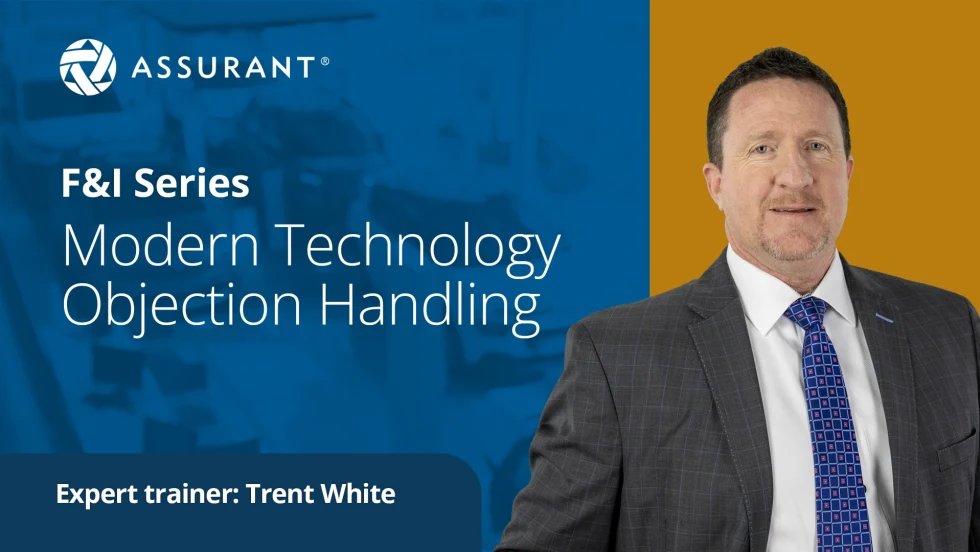
Modern Technology Objection Handling
In this video, Trent White shares how to confidently handle technology-based objections by helping customers understand the value of protection, even with modern vehicle technology.
Read More →
Consistency at Scale: Driving F&I Performance
With 75 rooftops across the Sunshine State, Morgan Auto Group has proven to Floridians that it knows a thing or two about driving performance in a competitive market. But it didn’t start at the top.
Read More →
Gitty Up on GAP
The foundational finance-and-insurance product hasn’t kept up with the latest conditions for auto dealers. Is the time ripe?
Read More →
How AI-Powered Coaching Is Transforming F&I Performance
See how AI-powered coaching can turn F&I customer conversations into actionable insights that support compliance, performance and profitability
Read More →
Sell Value, Build Trust
In this video, Trent White explains why selling on value, not fear, builds lasting customer trust, reduces cancellations, and drives long-term success.
Read More →
F&I Sales Give Dealers First-Half Lift
Product business shored up total profits to avoid an overall revenue tanking as product penetrations held steady, StoneEagle reported.
Read More →
Targeted Training Drives Results
Today’s technology, instead of threatening F&I managers, can actually make them better, according to an industry veteran who’s watched market setbacks roil the unprepared.
Read More →
Double the Change, Double the Chance
When an F&I manager gets a customer refusal, it’s a wise move to tweak more than one thing in the product offering.
Read More →
Just Do It
F&I managers need training, but instead of resisting application or expecting perfection, they should improve by simply acting on what they learn.
Read More →