



J.D. Power and Associates Reports: Credit Unions Turning Their Attention to the Indirect Lending Market With Competitive Rates and Longer Terms
Credit unions are becoming more aggressive in the indirect lending market, as credit aggregators are simplifying the process for dealers to finance auto loans through credit unions, according to the J.D. Power and Associates 2006 Consumer Financing Satisfaction Study(SM).
Westlake Village, Calif. — Credit unions are becoming more aggressive in the indirect lending market, as credit aggregators are simplifying the process for dealers to finance auto loans through credit unions, according to the J.D. Power and Associates 2006 Consumer Financing Satisfaction Study(SM).
Now in its 11th year, the study measures customer satisfaction with the new-vehicle financing process. Four factors are examined to determine customer satisfaction with automotive finance providers: provider offering, application/approval process, payment/billing process and customer contact experience.
The study finds that at a growing rate, credit unions are forming alliances with dealers to offer new-vehicle financing, representing nearly 10 percent of loans being issued in dealerships-up from nearly 7 percent in 2005 and 3 percent in 2004. Through the indirect lending channel, credit unions are providing more favorable rates, driven primarily by tax advantages gained from their non-profit status. They are also offering longer-term loans. These factors are particularly beneficial to consumers at a time of rising interest rates, as lower APRs and extended terms help to lower the cost of financing a vehicle.
"As the new-vehicle financing environment adjusts to increasing rates and compressed margins, credit unions are positioning themselves as strong competitors to the established captives, banks and independents, which is underscored by the fact that credit unions have historically provided excellent customer service through their very close, personal ties with their customers," said David Lo, senior research manager of automotive finance at J.D. Power and Associates. "From the dealer perspective, credit unions are currently competing primarily on their rates and terms. Captive providers still have a significant advantage in other offering related areas such as a more competitive reserve and overall compensation per deal."
Overall, finance provider satisfaction drops in 2006, primarily due to a broad-based shift in interest rates. Of particular note is the industry wide effect of the increasing Federal funds rate, which has caused all finance providers to increase their rates. The net effect of this increase is an industry wide decline in satisfaction.
Ford Credit ranks highest in the luxury lease segment for a second consecutive year, performing particularly well in provider offering. In the non-luxury lease segment, Ford Credit leads the rankings for a fifth consecutive year, receiving the highest ratings in provider offering and the application/approval process.
With strong performances in payment/billing and application/approval process, GMAC ranks highest in the luxury loan segment for a second consecutive year. GMAC also ranks highest in non-luxury loan satisfaction and receives the highest ratings from customers in three of the four factors that determine overall satisfaction: payment/billing, provider offering and application/approval process.
The study also finds that the use of e-contracting, which allows dealers to forego paper contracts by submitting an electronically signed document to capture customer signatures, has a positive impact on customer satisfaction. On average, customers whose contract was processed with e-contracting technology are more likely to say they are "delighted" with their overall application/approval process when compared to customers who were processed with traditional documentation. In particular, the largest difference in satisfaction is in the ease of filling out paperwork.
"Currently, only 3 percent of customers report that their contract was processed using e-contracting," said Lo. "While the current penetration is very small, this proportion is likely to increase soon. In our 2006 Dealer Financing Study, we found that 75 percent of dealers who currently use e-contracting expect the number of contracts processed with this technology to increase within the next 12 months."
More F&I
Plug Your Profit Leaks
By building in clear processes, your dealership can realize more profits in plugged leaks to maximize sales opportunities.
Managing Expectations
Learn how proactive communication, setting clear expectations, and providing solutions when plans change can strengthen customer trust and improve the overall service experience.

The F&I Manager's Report Card
The best managers take the time and attention to measure the behaviors behind the numbers.

AI: Facilitator, Not Fixer, in F&I
The dealerships that thrive in the years ahead will be those that embrace technology while continuing to invest in the people who make customer interactions count.

Modern Technology Objection Handling
In this video, Trent White shares how to confidently handle technology-based objections by helping customers understand the value of protection, even with modern vehicle technology.

Consistency at Scale: Driving F&I Performance
With 75 rooftops across the Sunshine State, Morgan Auto Group has proven to Floridians that it knows a thing or two about driving performance in a competitive market. But it didn’t start at the top.

Gitty Up on GAP
The foundational finance-and-insurance product hasn’t kept up with the latest conditions for auto dealers. Is the time ripe?

How AI-Powered Coaching Is Transforming F&I Performance
See how AI-powered coaching can turn F&I customer conversations into actionable insights that support compliance, performance and profitability

Sell Value, Build Trust
In this video, Trent White explains why selling on value, not fear, builds lasting customer trust, reduces cancellations, and drives long-term success.
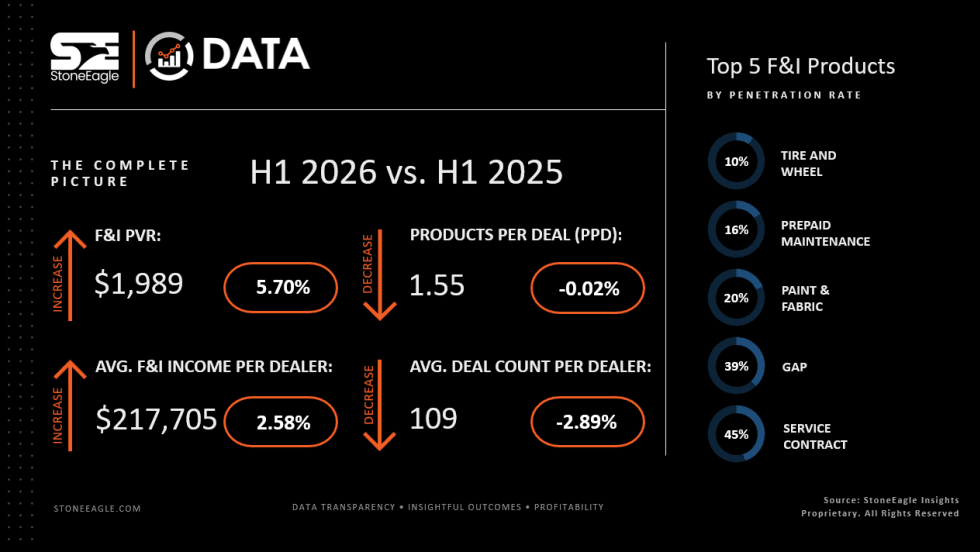
F&I Sales Give Dealers First-Half Lift
Product business shored up total profits to avoid an overall revenue tanking as product penetrations held steady, StoneEagle reported.