FI showroom red and grey logo
MenuMENU
SearchSEARCH

Large Cars and Trucks Sell with Comparably Sized Incentives While Compacts Wither on the Vine

by Staff
October 29, 2003
3 min to read


Edmunds.com, an online resource for automotive information, reported Oct. 29 that the average manufacturer incentive per vehicle sold in the United States was $2,622 in September 2003, up $596 or 29.4 percent from September 2002, but down 0.3 percent from August 2003.


“Looking forward, we expect continued stabilization in incentives spending since the new 2004 models – at least initially -- appeal to consumers without generous financial offers,” stated Dr. Jane Liu, executive director of data analysis for Edmunds.com.

Ad Loading...


Edmunds.com’s monthly True Cost of Incentives(SM) (TCI)(SM) report takes into account all of the manufacturers’ various United States incentives programs, including subvented interest rates and lease programs as well as cash rebates to consumers and dealers. To ensure the greatest possible accuracy, Edmunds.com said it bases its calculations on sales volume, including the mix of vehicle makes and models for each month, as well as on the proportion of vehicles for which each type of incentive was used.


Incentives spending for domestic Chrysler, Ford and General Motors nameplates decreased on a month-to-month basis for the first time in 2003, falling 1.9 percent to $3,618 per unit in September. General Motors reduced incentives spending by 5.3 percent to $3,812 per vehicle, and lost 0.9 percent market share. Chrysler reduced incentives spending by 3.6 percent to $3,078 per vehicle while its market share decreased by 0.4 percent.


Ford bucked the trend, increasing incentives spending by 5.3 percent to $3,655 per unit and seeing its market share increase by 3.2 percent, reaching 20.8 percent -- its highest level since September 2002.


In comparison, imports continue to spend far less on incentives: European automakers spent $1,753, Korean automakers spent $1,384, and Japanese automakers spent $965 per vehicle sold, according to Edmunds.com.


Among vehicle segments, large SUVs had the highest average incentives at $4,142, followed by large cars at $3,383 and large trucks at $3,255. Sports cars had the lowest average incentives at $1,327, followed by compact SUVs at $1,487 and compact cars at $1,790. Large trucks have gained the most market share since September 2002, up 2.0 percent to 14.8 percent, while compact cars have lost the most market share during that period, down 2.7 percent to 14.0 percent.

Ad Loading...


Industry average "days-to-turn," which measures how many days on average it takes to sell a vehicle after it hits the dealer’s lot, reached a record level of 75 days in September, compared to 62 days last September. Mitsubishi had the longest days-to-turn at 129, followed by Saturn at 122. The quickest inventory turnaround was for Lexus at 17 days, followed by Mini at 19 days.


About Edmunds.com True Cost of Incentives(SM)


Edmunds.com’s TCI(SM) is a monthly report that measures automobile manufacturers’ cost of incentives on vehicles sold in the United States.


These costs are reported on a per vehicle basis for the industry as a whole, for each manufacturer, for each make sold by each manufacturer and for each model of each make. TCI covers all aspects of manufacturers’ various incentives programs (except volume and similar bonus programs), including dealer cash, manufacturer rebates and consumer savings from subvented APR and lease programs (including subvented lease residual values used in manufacturer leasing programs).


Data for the industry, the manufacturers and the makes are derived using weighted averages and are based on actual monthly sales and financing activity.




Topics:F&I

More F&I

Photo of a three-seat vehicle back seat
F&Iby Hannah MitchellMay 22, 2026

F&I Reaches for the Sky

The increasingly important profit center continued making gains in the first quarter, according to StoneEagle data, ancillary products proving more popular as consumers hold onto their buys longer.

Read More →
Cover image for a BOK Financial report titled “Timing the market: How avoiding volatility entirely can hurt long-term reinsurance program performance.” The image shows several road construction barricades with flashing amber warning lights lined up in a nighttime work zone. Beneath the image, red text explains that avoiding volatility can mean falling behind inflation and missing market rebounds that drive long-term surplus growth. The BOK Financial logo appears at the bottom right.
SponsoredMay 8, 2026

Timing the Market Can Hurt Long-Term Program Performance

For dealer-owned reinsurance entities, avoiding volatility entirely can mean falling behind inflation and missing market rebounds that drive long term surplus growth. Missing just a handful of strong market days can materially impact cumulative returns—an important reminder for long horizon trust and investment strategies.

Read More →
Ryan Ruff, The 90/10 Rule, Automotive Training Academy, Sales Series
F&IMay 6, 2026

The 90/10 Rule

In this video, Ryan Ruff explains the rule that elite sales professionals use to turn ordinary conversations into unforgettable customer experiences.

Read More →
Ad Loading...
Photo of essential oil diffuser on desk next to laptop
F&IMay 4, 2026

Your Office Is Talking

What’s the atmosphere saying about you to your customers? You can make minor adjustments and additions that transform your space into one that creates trust with the people on the other side of the desk.

Read More →
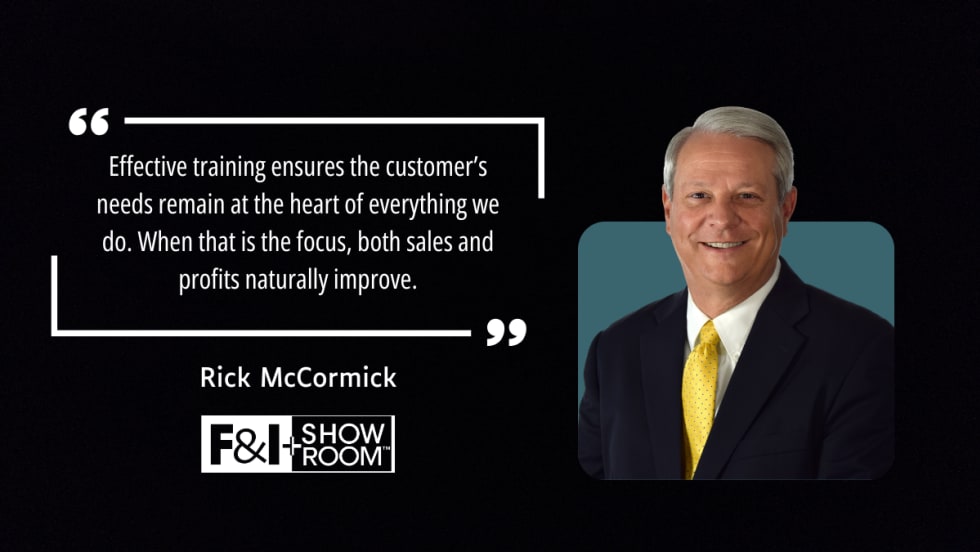
"Effective training ensures the customer’s needs remain at the heart of everything we do. When that is the focus, both sales and profits naturally improve." by Rick McCormick with F&I and Showroom logo and picture of Rick McCormick
F&IMay 1, 2026

F&I Training Fundamentals

How can auto dealerships help F&I managers fulfill their vital role in the most effective ways? Industry expert Rick McCormick shares his insights on the best ways to train these professionals and help them maintain good habits.

Read More →
Photo of car tire and the tread mark it left in snow
F&Iby Hannah MitchellApril 29, 2026

Not Just Any Tire Will Do

More consumers and businesses are opting for all-season options for various reasons as safety, sustainability and convenience push practical change.

Read More →
Ad Loading...
Photo of robot holding a laptop
F&Iby Hannah MitchellApril 27, 2026

How AI Will Drive the Next Wave of Innovation in Finance & Insurance

It’s time to take the next digital step to free F&I managers to handle the most challenging aspects of customer meetings.

Read More →
Photo of notepad and pen next to computer keyboard on desktop
F&IApril 13, 2026

Control in Sales Is an Illusion

Some of it should be given to the customer, but that doesn’t mean the F&I office relinquishes the process. In fact, a different approach both builds trust and boosts sales.

Read More →
Photo of external keyboard on office deak next to window
F&IApril 7, 2026

The Limited Warranty Game

Bringing it in-house benefits the dealership and its customers.

Read More →
Ad Loading...
Woman in casual clothing sitting at a desk
F&Iby Rick McCormickMarch 31, 2026

Curb The Confusion

Talk to F&I customers like you’d talk to a friend, without industry lingo or sales-like questions, and use hard proof to show, not tell, them about a need.

Read More →