



LexisNexis Risk Solutions Launches RiskView Optics and RiskView Spectrum: A New Era in Alternative Credit Scoring
New solutions allow credit risk professionals to gain a more complete view of consumer credit worthiness.

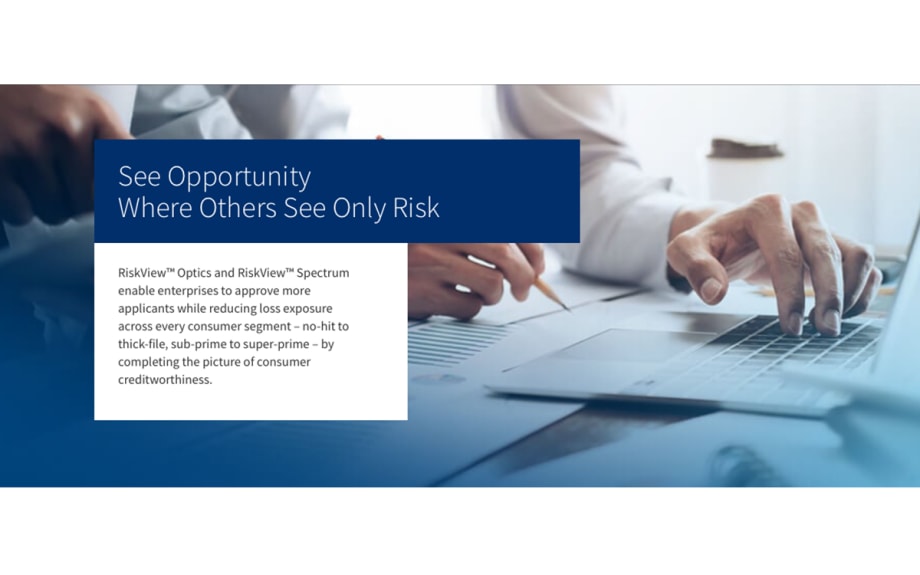
New solutions allow credit risk professionals to gain a more complete view of consumer credit worthiness.
LexisNexis® Risk Solutions unveiled LexisNexis® RiskView™ Optics and RiskView™ Spectrum, two alternative credit scores supported by a comprehensive view of consumer credit risk culminating from years of innovation and research. RiskView Optics and RiskView Spectrum are three-digit FCRA-compliant credit scores that provide a broader view into consumer credit worthiness to deliver a more predictive assessment for a higher percentage of new applicants. RiskView Optics delivers predictive credit scoring that combines non-credit life events and alternative credit inquiry data while RiskView Spectrum utilizes those insights in combination with traditional tradeline credit data.
With increasing competitive pressures, declining tolerance for financial losses and mounting regulatory and fair-lending scrutiny, credit risk professionals require access to more complete pictures of applicant creditworthiness, in order to minimize risk and better serve their customers.
These new tools can significantly boost financial inclusion by uncovering more creditworthy no-file consumers. RiskView Optics and RiskView Spectrum can score more than 90% of applicants who do not have a traditional credit score – often referred to as credit invisibles – with a high degree of predictive strength. The scores also allow creditors and lenders to issue more competitive offers to consumers. RiskView Optics and RiskView Spectrum find more near-prime and prime applicants whose credit worthiness are often under or overestimated by traditional credit scores alone to help creditors and lenders maximize application acceptance rates while reducing risk exposure.
For the first time in the credit risk industry, LexisNexis Risk Solutions is able to capture the three most essential pillars of consumer credit behavior in a single score:
Traditional tradeline credit data helps creditors and lenders better understand consumer creditworthiness
Alternative tradeline data builds a more expansive view of consumer credit responsibilities
Alternative non-tradeline credit data (life event, asset ownership, property records and others) fortifies understanding of consumer credit stability and ability to pay
"Many creditors and lenders are committed to the principles of financial inclusion and want to help consumers. With increasing competitive pressures, declining tolerance for financial losses and mounting regulatory and fair-lending scrutiny, credit risk professionals require access to more complete pictures of applicant creditworthiness, in order to minimize risk and better serve their customers," said Ankush Tewari, vice president of credit risk assessment at LexisNexis Risk Solutions. "Organizations need the broader risk visibility attainable through alternative credit data. The more insight, the greater the advantage. With our RiskView Optics and Spectrum solutions, lenders can make better credit decisions on nearly every U.S. consumer."
Visit RiskView Optics and RiskView Spectrum for more details on how creditors and lenders can better evaluate consumer risk. Attend a webinar on Mar 2, 2021 at 2:00 pm ET hosted by American Banker with Aite Group analyst Leslie Parrish and LexisNexis Risk Solutions senior director of credit risk strategy Kevin King: Surveying the Landscape of Alternative Data.
Originally posted on Auto Dealer Today
More Auto Finance

July Was Hot for Auto Borrowers
Credit proved readily available for many, but most loans left buyers in negative territory, Cox Automotive said.
Read More →
Dealer Lender Preferences Revealed
When lenders provide consistent, fast service, their overall satisfaction scores with dealers greatly improve, according to JD Power research.
Read More →
Auto Refi Savings Surge
Consumers with 84-month auto loan terms who refinanced saved the most on monthly payments, according to a new report by auto refinancing provider Caribou.
Read More →
Subaru Enters Lending Business
The automaker follows other brands in adding captive financing in the U.S., and says the move will strengthen its position here.
Read More →
Positive Equity Reaches Record High
Mainstream vehicle owners who bought a car seven years ago are likely to have positive equity when trading in for a new vehicle, according to second-quarter Edmunds data.
Read More →
Dealerships Are Paying the Price for Extended Car Loans
Growing negative-equity scenarios mean such lengthy terms should be addressed in a forward-looking way to make them work for the dealer and the consumer down the road.
Read More →
Trade-Ins in Negative Equity Reach New Heights
As such trade-ins rise in frequency, so do monthly loan payment amounts and interest rates, according to second-quarter data compiled by Edmunds.
Read More →
Auto Credit Plentiful
June numbers show lenders are readily granting access, including to risky borrowers, as consumers leverage themselves to take on high prices.
Read More →
Automotive Consumers Sink Further in Debt
Most financing metrics hit records in the second quarter as more buyers locked themselves into long terms and high monthly payments.
Read More →
Porsche Financial Services Shifts Structure
After 36 years with Porsche, the Financial Services Chief Financial Officer Konrad Riedl is retiring, and the department is realigning its management structure.
Read More →