



Recession Unlikely, Reports New Analysis from The Conference Board
Despite continuing turmoil in the housing and financial markets, a U.S. recession is not imminent, The Conference Board reports.
Despite continuing turmoil in the housing and financial markets, a U.S. recession is not imminent, The Conference Board reports.
“While the correction in the financial sector is just beginning, the correction in the housing sector is nearly over,” declares Gail D. Fosler, president and chief economist of The Conference Board. Her analysis appears in StraightTalk, a newsletter designed exclusively for members of The Conference Board’s global business network.
While the U.S. economy has weakened, business activity and corporate profits continue to rise. Consumer spending is continuing at a rate of 2 to 2.5 percent a year, and with the exception of the auto industry, the economy is showing gains virtually across the board.
“Exports are booming and imports and import penetration are down,” says Fosler. “While there is continuing uncertainty about the economic outlook, economic shocks from the contracting financial sector are not enough to tip the U.S. economy into recession.”
U.S. Economy is Still Resilient
It has been a long time since the U.S. economy has experienced the kind of sustained downturn reflected in recent stock market declines. The 2001 recession was short-lived, and despite huge losses in the technology and manufacturing sectors, there was almost an undetectable decline in GDP. The last deep recession in the U.S. economy began in 1990. The economy weathered the 1987 stock market crash and the 1988 savings and loan crisis before being plunged into a recession by the Gulf War.
“Similarities between the current situation and the period leading up to the 1990 recession are striking, but there are also many differences,” says Fosler. “The business sector today is fundamentally stronger than at any time since the 1960s, and booming exports are helping support solid and continued structural productivity gains. Also, the policy sector is moving to establish a solid floor of tax and interest rate cuts to support the economy.”
Housing Market Correction About Over
The housing market correction is about over, says Fosler. Given the lags in the impact of the housing sector on the economy, even at current activity levels, housing will likely subtract about 0.4 percentage points from 2008 growth. Housing affordability is beginning to improve, and with the recent interest rate cuts and home price declines, it should improve further and limit the downside risk. January and February are not big months for housing, but rising affordability bodes well for the spring selling season.
Demographic trends also favor housing. The rise in households is increasingly outpacing the rise in permits, so the ratio is rising over time and is reaching a point normally associated with recovery in housing activity. The long housing boom of the past 15 years has taken the home ownership rate up from 64 percent to a peak of 69 percent in 2004, reflecting an intrinsic demand for housing. All of this adds up to good structural demand for housing if the credit markets and lending institutions can ease the credit flow.
Financial Sector Still Struggling
The business sector, outside of the financial sector, remains strong. U.S. business has engaged in almost constant restructuring, and these ongoing adjustments to changing business conditions have left the nonfinancial business sector generally lean and focused.
The business sector is also benefiting from the export boom and strength in corporate activities outside the U.S. Exports are rising at about a 13 percent annual rate, and the slowdown in imports means that U.S. companies are taking a larger share of U.S. demand. The improvement in the trade sector alone is likely to add about a half percentage point to growth this year — more than offsetting the decline in housing.
The bad news is concentrated in the financial sector. Recent data indicate that financial sector profits decreased dramatically over the second half of 2007. Basic earnings data show that financial services profits collapsed from about $10 per share in the second quarter of 2007 to a loss of almost $2 in the fourth quarter. Not only have these losses been substantial, but they have been concentrated in some of the largest financial institutions, both in terms of assets and market capitalization. Top global financial institutions have disclosed roughly $125 to $150 billion in asset writedowns associated with the recent financial turmoil. But when all the dust settles, even if their profitability is damaged, their balance sheets are likely to be little affected. Because of the mark-to-market rules, the writeoffs associated with structured products, including subprime mortgages, are likely to be revalued over the course of the year as the markets begin to trade those securities.
Soft and Sluggish Consumer Sector
The consumer sector has weakened gradually over the past two and a half years. Although real consumer spending grew at above 4 percent in mid-2005, it has since slowed to the 2 to 2.5 percent range. On one level, this slowdown in consumer spending is a response to higher gas prices and low demand for automobiles. But there is very little impact evident from the effects of almost two years of housing declines. Income gains continue to be reasonably strong. Total wage and salary growth is running at about a 5 percent annual rate.
“On a broader level, it is important to recognize that the slowdown in consumer spending is part of the rebalancing of the U.S. economy,” concludes Fosler. “Americans have enjoyed over two decades of continuous consumer spending growth, which is one of the causes for the large trade deficits over the past decade. These gains go well beyond the normal term of an economic cycle and diminish as consumer needs are met or even overmet.”
More F&I

Plug Your Profit Leaks
By building in clear processes, your dealership can realize more profits in plugged leaks to maximize sales opportunities.

Managing Expectations
Learn how proactive communication, setting clear expectations, and providing solutions when plans change can strengthen customer trust and improve the overall service experience.

The F&I Manager's Report Card
The best managers take the time and attention to measure the behaviors behind the numbers.

AI: Facilitator, Not Fixer, in F&I
The dealerships that thrive in the years ahead will be those that embrace technology while continuing to invest in the people who make customer interactions count.

Modern Technology Objection Handling
In this video, Trent White shares how to confidently handle technology-based objections by helping customers understand the value of protection, even with modern vehicle technology.

Consistency at Scale: Driving F&I Performance
With 75 rooftops across the Sunshine State, Morgan Auto Group has proven to Floridians that it knows a thing or two about driving performance in a competitive market. But it didn’t start at the top.

Gitty Up on GAP
The foundational finance-and-insurance product hasn’t kept up with the latest conditions for auto dealers. Is the time ripe?

How AI-Powered Coaching Is Transforming F&I Performance
See how AI-powered coaching can turn F&I customer conversations into actionable insights that support compliance, performance and profitability

Sell Value, Build Trust
In this video, Trent White explains why selling on value, not fear, builds lasting customer trust, reduces cancellations, and drives long-term success.
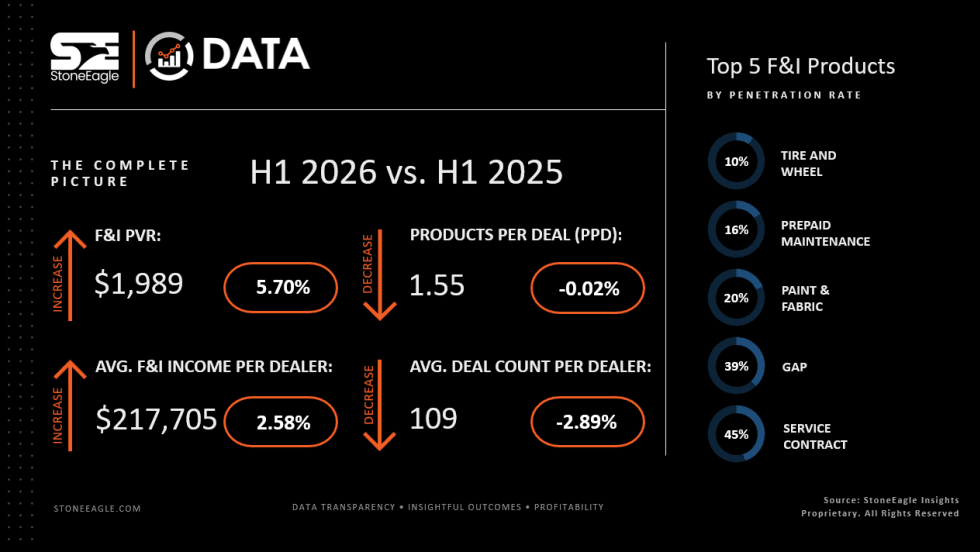
F&I Sales Give Dealers First-Half Lift
Product business shored up total profits to avoid an overall revenue tanking as product penetrations held steady, StoneEagle reported.