



Reynolds and Reynolds Adds New Selling Feature
The Reynolds and Reynolds Company announced it has released a new feature for its Mobile Service Advisor solution that provides a customizable, step-by-step selling process for service advisors. The feature is designed to help dealership service advisors sell more parts and service, while giving customers a more personal and thorough service visit.
Dayton, Ohio—The Reynolds and Reynolds Company announced it has released a new feature for its Mobile Service Advisor solution that provides a customizable, step-by-step selling process for service advisors. The feature is designed to help dealership service advisors sell more parts and service, while giving customers a more personal and thorough service visit.
Market research from Reynolds indicates that 98 percent of service managers surveyed believe building a relationship with new vehicle owners to ensure future service revenue was “extremely” or “very” important.
To help dealerships build these customer relationships, Reynolds has enhanced its Mobile Service Advisor with a new Forced March Process for selling. Mobile Service Advisor is a software application connected via a tablet PC and wireless network that allows service advisors to be mobile while writing repair orders — rather than confined behind a desk or counter. With wireless access to customer and vehicle history, service advisors have access to all of the tools needed to greet the customer, write the repair order and obtain all necessary customer signatures — without ever leaving the vehicle or customer’s side.
Standardizing Retail Processes
Mobile Service Advisor’s Forced March Process feature enables dealerships to create a step-by-step check-in process for advisors to follow from the time they greet a service customer to the time they complete the repair order. Having a standardized process helps reduce the inconsistent write-ups that often cost dealerships money and customer satisfaction.
The Forced March Process can require service advisors to complete selling steps such as: checking for recalls and recommended service, reviewing a customer’s service history and conducting a vehicle inspection or report card review. The Forced March Process feature helps ensure each advisor — new or veteran — consistently follows the process and takes advantage of every opportunity to uncover customer and vehicle needs.
Ray Lunn, controller at Capital Pontiac, implemented the Forced March Process feature in their service department and is pleased with his team’s consistency.
“People get set in their ways and the new Forced March Process helps our dealership promote good habits for customer service,” Lunn said. “The reporting features tell us who is using the tablets and following the appropriate retail processes. It keeps everyone on their toes and gives our customers a consistent dealership visit that is more professional and inviting.”
An important feature of the new step-by-step process is a utilization report that gives service managers details on the consistency with which service advisors are using the Mobile Service Advisor tool. The reports help dealerships encourage adoption and regular use of Mobile Service Advisor to ensure continued success.
“Dealerships have told us what they want is an efficient and profitable service write-up process,” said Jon Strawsburg, Reynolds’ vice president of fixed operations. “With our new tablet PC hardware offerings, service selling tools, and management controls, dealers have the power and tools needed to help them improve profitability and customer satisfaction.
“In fact, Mobile Service Advisor’s effectiveness speaks for itself. Within the last year, dealership service departments already using the product reported a more than 16 percent average increase in parts sales and nearly 8 percent average gain in labor sales per repair order,” he said.
The new Forced March Process further personalizes the dealership experience, while helping advisors better present and sell recommended services to customers. Earlier this year, Reynolds introduced other advanced selling enhancements that included a Vehicle Report Card, multiple electronic signature capture and the new Maintenance Menu Interface that is complete with short video clips explaining various services such as fuel injection cleaning, transmission, coolant and power steering system flushes.
More F&I
Plug Your Profit Leaks
By building in clear processes, your dealership can realize more profits in plugged leaks to maximize sales opportunities.
Managing Expectations
Learn how proactive communication, setting clear expectations, and providing solutions when plans change can strengthen customer trust and improve the overall service experience.

The F&I Manager's Report Card
The best managers take the time and attention to measure the behaviors behind the numbers.

AI: Facilitator, Not Fixer, in F&I
The dealerships that thrive in the years ahead will be those that embrace technology while continuing to invest in the people who make customer interactions count.

Modern Technology Objection Handling
In this video, Trent White shares how to confidently handle technology-based objections by helping customers understand the value of protection, even with modern vehicle technology.

Consistency at Scale: Driving F&I Performance
With 75 rooftops across the Sunshine State, Morgan Auto Group has proven to Floridians that it knows a thing or two about driving performance in a competitive market. But it didn’t start at the top.

Gitty Up on GAP
The foundational finance-and-insurance product hasn’t kept up with the latest conditions for auto dealers. Is the time ripe?

How AI-Powered Coaching Is Transforming F&I Performance
See how AI-powered coaching can turn F&I customer conversations into actionable insights that support compliance, performance and profitability

Sell Value, Build Trust
In this video, Trent White explains why selling on value, not fear, builds lasting customer trust, reduces cancellations, and drives long-term success.
F&I Sales Give Dealers First-Half Lift
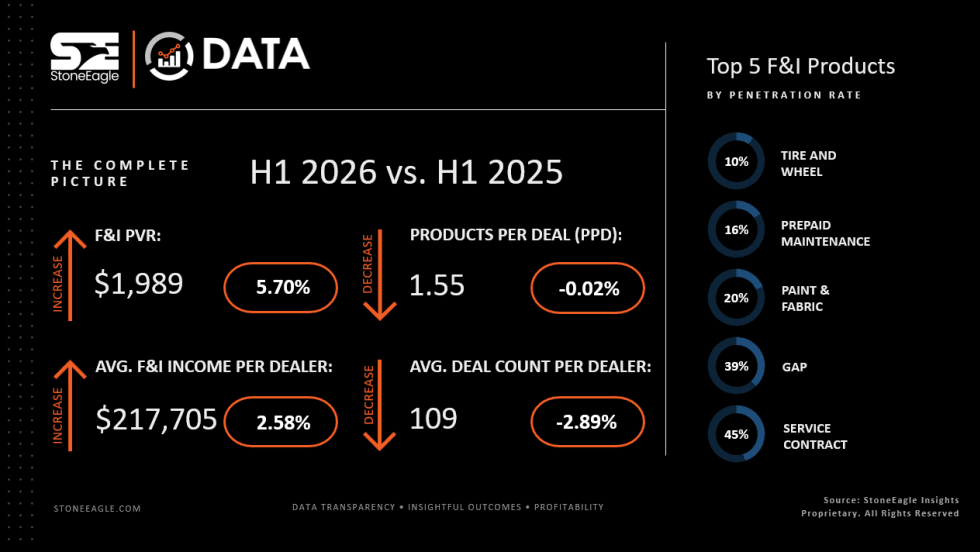
Product business shored up total profits to avoid an overall revenue tanking as product penetrations held steady, StoneEagle reported.