



TransUnion: Delinquency Rates Experience Seasonal Drop in 1Q
The automotive finance industry experienced a drop in the 60-day auto delinquency rate in the first quarter 2009, reflecting a seasonal pattern rather than a reversal of the trends associated with the current lending environment, according to TransUnion's quarterly report on auto lending trends.
CHICAGO — The
automotive finance industry experienced a drop in the 60-day auto delinquency
rate in the first quarter 2009, reflecting a seasonal pattern rather than a
reversal of the trends associated with the current lending environment,
according to TransUnion’s quarterly report on auto lending trends.
The national 60-day auto delinquency rate dropped slightly between the
fourth quarter 2008 and the first quarter 2009 (0.86 percent to 0.83 percent).
However, year-over-year the delinquency rate at the national level increased
27.69 percent in the first quarter 2009.
Auto loan delinquency was highest in Mississippi
at 1.49 percent, followed by Louisiana at 1.40 percent. The lowest auto loan delinquency rates were found in South Dakota (0.34 percent), North Dakota (0.35 percent) and Wyoming (0.44 percent). The largest improvements in delinquency from the previous
quarter were found in South Dakota (45.16
percent decrease from 0.62 percent) and Vermont (33.3 percent decrease from 0.99 percent).
Average auto debt nationally continued to decrease slightly in the first
quarter of 2009 from $12,713 to $12,596. Likewise, year-over-year auto debt
fell by 1.85 percent. The state with the largest auto debt burden was Nevada at $15,080, followed by Texas at $14,748. The lowest average auto
debt was in Nebraska at $10,629. The steepest annual increases in average auto debt as a percentage
occurred in Michigan (+1.49 percent), New Jersey (+1.38 percent) and Rhode
Island (+0.48 percent), while South Dakota
experienced the sharpest drop in annual average auto debt (-4.61 percent), followed by Utah (-3.38 percent).
The drop in the first quarter 60-day auto delinquency rate reflects more
seasonal patterns rather than a reversal of the trends associated with the
current lending environment. As in recent quarters, both the availability of
funding (liquidity crisis) in the market for auto loans and tighter lending
standards have significantly decreased the number of auto loans in the market,
putting continued upward pressure on delinquency rates.
On a state-level basis, 27 states experienced a drop in their
quarter-to-quarter delinquency rates while only South Dakota showed a drop on a
year-over-year basis. It is interesting to note the deteriorating risk
environment has now affected even Alaska,
which at the end of last year showed an extremely low auto delinquency rate of
0.19 percent. In the first quarter of 2008, the northernmost state's delinquency rate increased by 247
percent quarter-to-quarter and 78 percent on a year-over-year basis — the
largest increase for 2009.
"At the end of the 2001 recession, the national auto delinquency rate
increased to a high of just over 1 percent, and then began to edge downward for
the next four or five years," said Peter Turek, TransUnion's automotive
vice president.
He said as the recession ended in November 2001, three of the five riskiest cities in the country were found in Texas: El Paso (5.00
percent), McAllen (2.46 percent) and Laredo (2.09 percent). In the current recession, Laredo still leads in terms of auto delinquency
(3.08 percent), but is followed closely by metropolitan areas within the
state of California such as Visalia (2.33 percent) — reflecting the impact of
the housing market on that state's economy. The least risky metropolitan
area is Corvallis, Oregon, which has an almost zero auto
delinquency rate — a position consistent with what it held during the previous
recession, Turek added.
“Our current forecasting
models indicate that the national 60-day auto delinquency rate will rise to
about 1 percent by year-end, about the same level as that experienced at the
end of our last recession," continued Turek. "However, the overall
economy, weak labor market and lower disposable income levels will continue to
negatively impact the consumer well into 2010."
At the state level, Mississippi is still
anticipated to experience the highest delinquency rate by fourth quarter 2009 (1.94 percent), while South Dakota should prove to have the lowest level of auto delinquency (0.44 percent).
Information for TransUnion’s quarterly analysis is gathered
from approximately 27 million anonymous, individual credit files, providing a
real-life perspective on how U.S. consumers are managing their credit health.
More F&I
Plug Your Profit Leaks
By building in clear processes, your dealership can realize more profits in plugged leaks to maximize sales opportunities.

Managing Expectations
Learn how proactive communication, setting clear expectations, and providing solutions when plans change can strengthen customer trust and improve the overall service experience.

The F&I Manager's Report Card
The best managers take the time and attention to measure the behaviors behind the numbers.

AI: Facilitator, Not Fixer, in F&I
The dealerships that thrive in the years ahead will be those that embrace technology while continuing to invest in the people who make customer interactions count.

Modern Technology Objection Handling
In this video, Trent White shares how to confidently handle technology-based objections by helping customers understand the value of protection, even with modern vehicle technology.

Consistency at Scale: Driving F&I Performance
With 75 rooftops across the Sunshine State, Morgan Auto Group has proven to Floridians that it knows a thing or two about driving performance in a competitive market. But it didn’t start at the top.

Gitty Up on GAP
The foundational finance-and-insurance product hasn’t kept up with the latest conditions for auto dealers. Is the time ripe?

How AI-Powered Coaching Is Transforming F&I Performance
See how AI-powered coaching can turn F&I customer conversations into actionable insights that support compliance, performance and profitability

Sell Value, Build Trust
In this video, Trent White explains why selling on value, not fear, builds lasting customer trust, reduces cancellations, and drives long-term success.
F&I Sales Give Dealers First-Half Lift
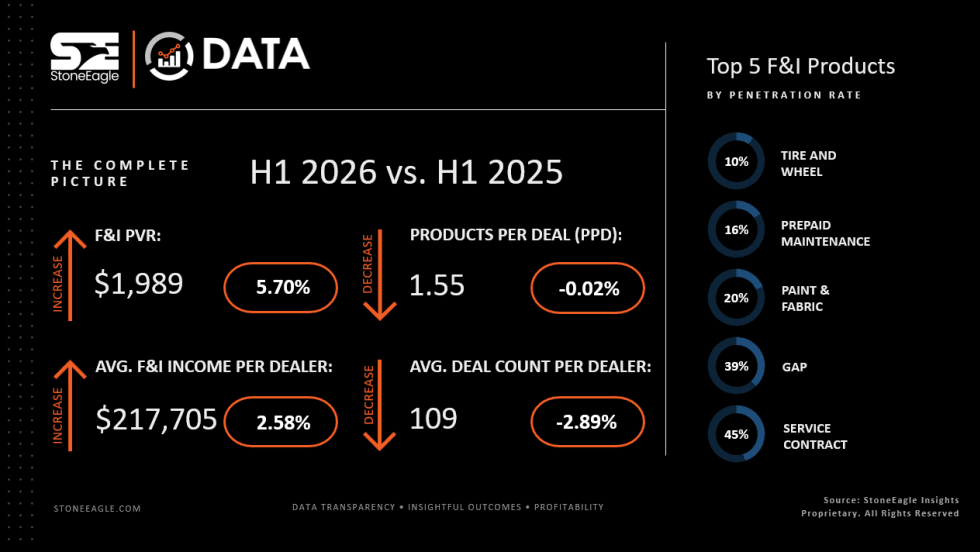
Product business shored up total profits to avoid an overall revenue tanking as product penetrations held steady, StoneEagle reported.