



Wolters Kluwer Predicts Tricky Regulatory Environment in 2009
Experts at compliance and risk management solutions provider Wolters Kluwer Financial Services predict that financial institutions will face a complex regulatory environment in 2009. Successful organizations will not only adjust to a changing regulatory landscape, but demonstrate they are embracing both the letter and the spirit of the law as well, according to the firm.
MINNEAPOLIS –– Experts at compliance and risk management solutions provider Wolters Kluwer Financial Services predict that financial institutions will face a complex regulatory environment in 2009. Successful organizations will not only adjust to a changing regulatory landscape, but demonstrate they are embracing both the letter and the spirit of the law as well, according to the firm.
“The country’s financial and economic crisis is really prompting everyone to look at our current regulatory system and ask, 'What can we do better?'" said David Thetford, securities compliance principal analyst at Wolters Kluwer Financial Services. "The regulatory structure needs to be reviewed from the ground up. We need to identify the goals we are trying to achieve through regulation and what regulatory structure is best to achieve those goals."
Thetford noted that this could encourage and promote a movement toward principles-based regulation, a model that has already received a lot of attention from the Securities and Exchange Commission (SEC) and the Financial Industry Regulatory Authority (FINRA).
Kathy Donovan, manager of government relations for Wolters Kluwer Financial Services’ Insurance Compliance Solutions group, agrees the basic premise of principles-based regulation—doing right by the customer—will likely be paramount in the financial services industry as we enter 2009.
“There continues to be a growing interest in protecting consumers—particularly the senior population,” said Donovan. “Within the insurance industry, we’ve seen many recent examples, including the National Association of Insurance Commissioners’ (NAIC) new model law to prohibit the use of certain senior-specific designations for insurance agents and many state initiatives to place restrictions on Stranger Originated Life Insurance (STOLI).”
Donovan expects that as the 2009 legislative sessions begin in multiple states, insurers will see variations of the NAIC model law and STOLI restrictions, as well as other consumer-focused regulations, introduced.
The issue of state regulation versus federal regulation, and the potential for discrepancies between the two, will also be in focus in the banking industry in coming months.
“I don’t think we’ll see a lot of new regulations right away at the federal level, but I do think we will continue to see substantial change at the state level, given the recent subprime issues,” said Amy Downey, senior compliance consultant at Wolters Kluwer Financial Services. “State banking regulators haven’t traditionally waited for the federal banking regulators to take the initiative in protecting their citizens.”
Downey says many of the emerging regulations at the state level are fair and anti-predatory lending requirements. And while designed to protect the consumer, these regulations can also sometimes unintentionally inhibit lenders. The requirements can be so onerous that the secondary market will not purchase loans that cannot comply with them.
States may be eager to impose new regulations, but that is not always the solution, according to Edward Kramer, executive vice president for regulatory programs at Wolters Kluwer Financial Services.
“Everyone’s instinct when something goes wrong in the financial services industry is to come up with a new regulation,” said Kramer. “But oftentimes, it really is a matter of fixing what you already have.”
Kramer added that mortgage lending has always been based on the ‘three Cs’—credit, collateral and capacity to pay.
“We lost sight of these basic elements,” said Kramer. “And as a result, many regulators are considering more aggressive postures when it comes to monitoring and enforcement practices.”
Such heightened oversight will also apply to new requirements, such as the Fair and Accurate Credit Transactions Act’s Red Flag Rules, that took effect on Nov. 1, said Kevin Byrne, senior compliance consultant for Wolters Kluwer Financial Services.
“Many institutions have taken a wait-and-see approach to compliance with a new requirement in the past,” said Byrne. “They do the minimum work required to comply and wait to see what regulators will say they have to do additionally during an examination. But the Red Flag Rules are all about protecting consumers’ identities. That’s something near and dear to everyone’s heart — a fact regulators will consider.”
Ted Dreyer, senior attorney with Wolters Kluwer Financial Services, added that some institutions may indeed do the bare minimum to comply with the requirements since not all federal regulators have issued examination guidelines yet, and because the Federal Trade Commission pushed its enforcement deadline back six months. But Dreyer stresses that regulators will not accept the excuse that institutions did not fully understand how to comply with the rules.
“While there may not initially be any heavy penalties or large fines, the slaps on the wrists from regulators are going to be hard and hurt very much from a reputational standpoint with customers,” added Dreyer “No institution wants to be known for failing to protect its customers from identity thieves.”
It is also important to understand that the Red Flag Rules don’t just apply to banks, said Kevin Kopp, director of Indirect Lending for Wolters Kluwer Financial Services.
“The Red Flag Rules have hands-down had the most significant impact on the auto finance industry this year in terms of compliance,” Kopp said. “If identity theft and fraud prevention wasn’t a lender or auto dealer’s main focus this year, it should have been.”
And while many institutions view the cost of putting compliance programs in place to address the Red Flag Rules and other requirements as a financial burden, they can often provide a significant return on investment, according to Byrne.
“Protecting your customers’ identities not only benefits them, but it helps the institution avoid a whole host of fraudulent activities and the large monetary losses that accompany them,” Byrne said. “And you can apply that concept to almost any rule or regulation in the financial services industry. The bottom line is that if you are proactively complying with the letter and spirit behind any law, you are protecting your institution from criminal and financial penalties, as well as enhancing your image in the communities you serve. And that’s good for business across the board.”
More F&I

Managing Expectations
Learn how proactive communication, setting clear expectations, and providing solutions when plans change can strengthen customer trust and improve the overall service experience.
Read More →
The F&I Manager's Report Card
The best managers take the time and attention to measure the behaviors behind the numbers.
Read More →
AI: Facilitator, Not Fixer, in F&I
The dealerships that thrive in the years ahead will be those that embrace technology while continuing to invest in the people who make customer interactions count.
Read More →
Modern Technology Objection Handling
In this video, Trent White shares how to confidently handle technology-based objections by helping customers understand the value of protection, even with modern vehicle technology.
Read More →
Consistency at Scale: Driving F&I Performance
With 75 rooftops across the Sunshine State, Morgan Auto Group has proven to Floridians that it knows a thing or two about driving performance in a competitive market. But it didn’t start at the top.
Read More →
Gitty Up on GAP
The foundational finance-and-insurance product hasn’t kept up with the latest conditions for auto dealers. Is the time ripe?
Read More →
How AI-Powered Coaching Is Transforming F&I Performance
See how AI-powered coaching can turn F&I customer conversations into actionable insights that support compliance, performance and profitability
Read More →
Sell Value, Build Trust
In this video, Trent White explains why selling on value, not fear, builds lasting customer trust, reduces cancellations, and drives long-term success.
Read More →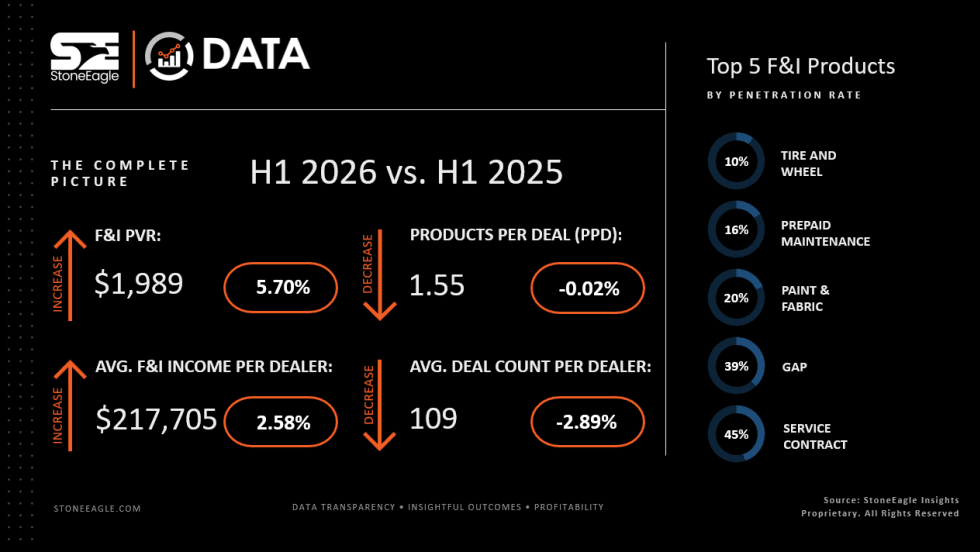
F&I Sales Give Dealers First-Half Lift
Product business shored up total profits to avoid an overall revenue tanking as product penetrations held steady, StoneEagle reported.
Read More →
Targeted Training Drives Results
Today’s technology, instead of threatening F&I managers, can actually make them better, according to an industry veteran who’s watched market setbacks roil the unprepared.
Read More →