



David Wilson: F&I Dealer of the Year
Wilson Automotive Group's principal says good employees equal good business
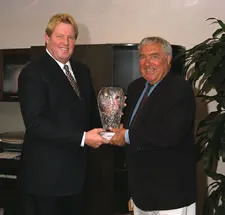
It was happenstance--no less than a catastrophic flood--that first drew David Wilson to the car sales business. As a young man, Wilson worked the second shift at a factory to put himself through college. One day a local dam broke, flooding the factory in water six feet high.
"The next morning I looked in the paper for a job, and this Lincoln-Mercury store was looking for car salesmen," he recalls. "I said, 'I could do that!'"
Car sales not only helped Wilson finance the rest of college, the profession ultimately provided him a career path worthy of F&I's 2004 Dealer of the Year honor. Today, Wilson is owner and president of the Wilson Automotive Group in Orange County, Calif.--the sixth largest privately held auto group in the U.S. Toyota of Orange is the flagship store, but the group has 11 other dealerships in southern California and Arizona. Wilson's company employs more than 1,200 people in six Toyota, two Lexus, and two Honda dealerships, along with an Acura and a Ford dealership.
Customer service and repeat business are key to the company's success. In fact, Toyota of Orange has the highest repeat customer percentage of any Toyota dealership in the U.S., Wilson notes. "I know that for a fact," he says, "because Toyota told me."
But that doesn't mean Wilson focuses his own efforts on customer satisfaction (CSI). Rather, he sees customer loyalty as a natural outgrowth of employee satisfaction. This perspective has fostered a corporate culture where employees are loyal, training is valued, ethical standards aren't compromised, and customers keep returning and referring their friends. In 2003, all 12 dealerships received manufacturers' awards for customer satisfaction.
"If you have happy, well-paid, qualified, trained employees that like their jobs and respect their positions and their employer, then they don't do anything to jeopardize the employer or their position," Wilson says.
And they don't leave the dealership to pursue other job opportunities, either. Customer relationships endure.
"When they have a job that pays 20 percent more than they could get paid somewhere else, they don't dig through the paper when they have their day off to look for a better job, because there aren't any," Wilson says. "And that results in almost no turnover. When you have that kind of continuity, the same customers see the same salesmen, see the same F&I people and the same sales manager every three years..."
The company operates on the "Yellow Pages dentistry" theory, Wilson says. Customer relationships take competitors right out of the equation.
"If you go to the same dentist all the time, you don't look in the Yellow Pages, right?" Wilson explains. "Why do you do that? Well, you know where the place is. You know the receptionist. The receptionist knows your name. The office sends you reminder cards every six months to come in. Even though it's expensive, it hurts and it's not any fun, you keep coming back to the same place. Now, if you go to the same dentist, why wouldn't you go to the same car dealer? It's less expensive than going to the dentist, it doesn't hurt, and we send out reminder cards too."
Low Employee Turnover Promotes Company Stability
Because of the company's emphasis on employee satisfaction, Wilson devotes no time to outside employee recruitment efforts. There's no need to. Whenever any of his dealerships needs a new F&I employee, he taps his sales staff.
"Our only hiring area is sales," Wilson says. "We grow from within. We don't hire general managers; we hire sales people. All of my general managers--all of my partners--have been sales people first, then F&I writers, then sales managers. Some sales managers go back to become F&I directors, and some become new car managers or general sales managers."
Pay plans are tied to CSI scores at the dealerships, using regional averages. "We just want them to be a little better than everybody else, just above the regional average," Wilson says.
Even then, one month below the regional average will not cost an F&I staff person a bonus. Wilson recognizes that isolated customer complaints aren't always reliable.
"Anything can go wrong," he says. "Sometimes people will give you a bad score because they got into an accident on the way home from the dealership and you wouldn't give them a new car. Things happen, and one bad month shouldn't cost people 10 percent or 20 percent of their income."
But when F&I staffers dip below the regional average for two straight months, they do lose their bonus money and get paid straight commission. "They cannot earn a bonus until they are above the regional average again," Wilson says.
With so many long-term employees, the workplace is uncommonly stable. Wilson hasn't advertised to fill a job opening in the past 20 years.
"We have turnover, but the list of people waiting to work for the organization is so long, we don't advertise," Wilson says. "We have that in service and parts too. We even have generations of families working here."
In 2003, the company overmatched employee contributions to the employee 401(k) plan.
"In other words, the company put more into the 401(k) than the employees did, which was in excess of $1 million," Wilson says. "We believe in benefits."
[PAGEBREAK]
It's important to Wilson that his employee benefits outshine those of other companies.
"We have a better pay plan, a better retirement plan, and better insurance plan," he says. "Why? Because I want quality people. When you take care of your employees, the employees take care of the customers. You can't build a big or good business. What you can build is a good organization, and that organization will build the business for you."
The resulting employee loyalty also inspires staff to be protective of the company. Employees police each other without prompting from management. "Once in a while, we get a rogue or a bad employee, and the other employees run him off," Wilson says.
Training Is a Continuing Process
The company's emphasis on professional training also contributes to employee retention. The Wilson Automotive Group doesn't cut corners when budgeting for training. The investment is more than justified.
"You can't spend too much on training, especially when you don't have turnover," says Wilson. "It's so much better to continually train than to retrain people. For the same amount of money you can make a guy better, rather than making a guy standard and then losing him and having to train somebody else."
The company uses Toyota training, the University of Toyota, and its own in-house training department.
F&I trainees have the advantage of drawing upon their car sales experience. Typically, "[they] shadow an experienced F&I person for a couple of weeks," Wilson says. "They know how that customer got there, how the payments were arrived at, and where the deal stands. They understand the sensitivity of an F&I manager blowing a salesperson's deal because they were salespeople for a long time."
Employee training also promotes the use of ethical business practices, Wilson says. Employees are taught to disclose on the contract every item sold in the finance department. Each aftermarket item is also disclosed on the addition and removal order.
"The price and description for whatever they want--whether it's an alarm system, an extended service contract, or GAP insurance--are listed on the addition and removal order. The customer signs that and is given a copy of it. It really is full disclosure."
Wilson stresses the value of ethics in all business dealings. But this philosophy isn't driven solely by legal guidelines and restrictions. Even if a practice is technically legal, it may not be ethical, he says.
"Legally, you can put a 25-year-old working woman with two kids into a car for $500 a month and get it approved," Wilson explains. "But in three months, if she can't make the payments ... It might have been legal, but was it ethical? You're not doing her--or yourself or the lender--any favors."
When employees make ethical decisions, legal compliance is a natural byproduct, he says. The need for disclosure has also prompted Wilson Automotive Group to begin using a menu-based presentation of F&I products.
Wilson notes that the ratio of the company's finance-to-lease penetration is changing. "We used to have 65 percent leases. Now, it's 50/50, which is still way above industry average," he says.
The heavy lease penetration does cut down on the sales of extended service contracts. "Most of our people are on three-year lease programs," Wilson says. "The cars are under warranty the whole time. They never have a problem with a Toyota or Honda. During that period, they know what the payment is. When they come back, if the residual is higher, we give them money back and put them in a new car for about the same payment."
The current ratio is one F&I writer for every six salespeople. "I think an F&I writer can work about 100 deals a month," Wilson says. Any more than that would likely create a logjam.
"Then you're making the customers wait in the customer lounge too long. Or on a day when you get busy, customers have a two- or three-hour wait to get in," Wilson says.
F&I is of major importance to the Wilson Automotive Group. The combination of ethical procedures and highly professional salespeople allows the F&I department to produce 50 percent of the gross profit for Wilson's dealerships.
More F&I

How AI-Powered Coaching Is Transforming F&I Performance
See how AI-powered coaching can turn F&I customer conversations into actionable insights that support compliance, performance and profitability
Read More →
Sell Value, Build Trust
In this video, Trent White explains why selling on value, not fear, builds lasting customer trust, reduces cancellations, and drives long-term success.
Read More →
F&I Sales Give Dealers First-Half Lift
Product business shored up total profits to avoid an overall revenue tanking as product penetrations held steady, StoneEagle reported.
Read More →
Targeted Training Drives Results
Today’s technology, instead of threatening F&I managers, can actually make them better, according to an industry veteran who’s watched market setbacks roil the unprepared.
Read More →
Double the Change, Double the Chance
When an F&I manager gets a customer refusal, it’s a wise move to tweak more than one thing in the product offering.
Read More →
Just Do It
F&I managers need training, but instead of resisting application or expecting perfection, they should improve by simply acting on what they learn.
Read More →
Dealer Lender Preferences Revealed
When lenders provide consistent, fast service, their overall satisfaction scores with dealers greatly improve, according to JD Power research.
Read More →
Leading with Purpose
In this video, Trent White explains how understanding your people’s 'why' is a key leadership responsibility of F&I professionals and how that mindset drives dealership engagement, trust and performance.
Read More →
Integrating Nontraditional F&I Products
The niche presents a strategic advantage for auto dealerships as they move to adapt to fast-changing consumer expectations in today’s market.
Read More →
Trust Is Personal
Technology, no matter how efficient, can’t replace what the human F&I manager can do, which is to bridge the divide between cyberspace and the in-store experience.
Read More →