



Debating the Hybrid Manager
The magazine’s annual conference brought together six of the industry’s top trainers to talk shop, but the age-old battle between sales and F&I dominated the conversation.
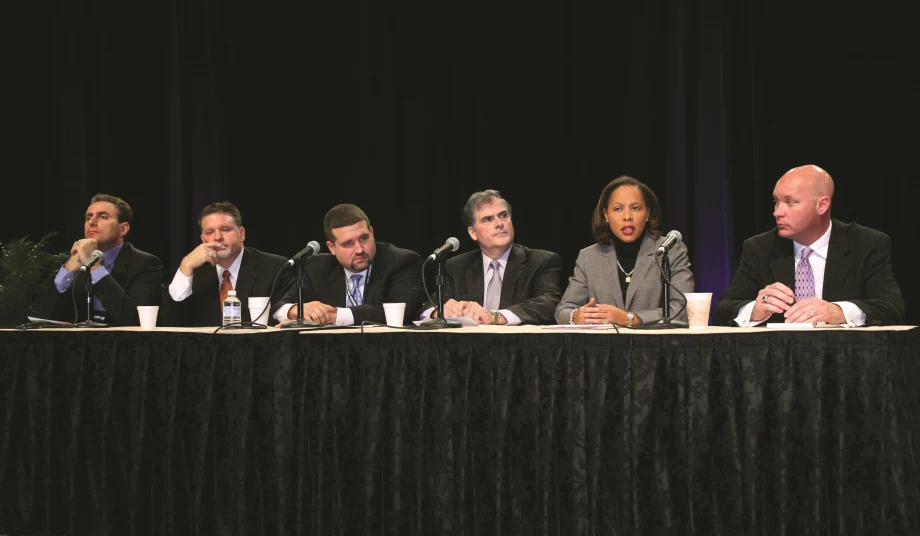
In the heat of the debate are (L–R): Joe Amendola, Bart Carpenter, Luis Garcia, Ron Reahard, Heather Haynes and Tony Dupaquier. Not pictured: moderator Kevin Jacobs.
What was supposed to be an exchange of training philosophies turned into a debate over the one nagging issue that continues to hamper front-end departments: the divide between sales and F&I.
“I feel like this is the same conversation we were having 15 years ago,” said JM&A Group’s Heather Haynes. “We have to get rid of the walls in the dealership.”
Haynes was in to Las Vegas to serve on “The Idea Exchange: Trainers’ Best Practices for Sales and F&I,” a panel led by Alaco Enterprises’ Kevin Jacobs. She was seated alongside fellow training experts Joe Amendola of Resource Automotive Inc.; GSFS Group’s Bart Carpenter; American Financial & Automotive Services (AFAS)’ Tony Dupaquier; Safe-Guard Product’s Luis Garcia; and Reahard & Associates’ Ron Reahard.
The group touched on a range of challenges facing today’s F&I manager, but panelists and even attendees seemed intent on driving the conversation back to the dysfunctional relationship between sales and F&I.
Building Value
Haynes suggested that dealers consider combining the roles of the sales and F&I managers — a suggestion not everyone was on board with. The idea became popular during the downturn, when dealerships were looking to do more with less.
Some panelists attributed the disconnect to a lack of understanding of what each department is trying to accomplish. Others said that the F&I manager holds the key to solving the problem.
“The business manager today has to be engaged with the entire sales team,” said Dupaquier. “The sales team needs to see the value in F&I.”
No panelist seemed ready to call for an industrywide transition to the hybrid manager, but each agreed that today’s market dynamics call for an F&I manager to be active on the showroom floor. Doing so, some panelists said, would help to eliminate some of the bad habits they’ve seen while on the road.
GSFS Group’s Carpenter, for instance, noted that F&I managers have a tendency to stick to “hip-pocket” products like GAP and service contacts. “If a guy trades his car every two years, you’re probably not going to sell him a service contract,” he said. “F&I managers need to step out of their comfort zone, because there are tons of other products available.”
What would break that habit, said Resource’s Amendola, is a needs-discovery interview. From his experience, the interview can lead to a potential increase of about $200 per deal.
Reahard offered his own take. “Some F&I managers sit in their offices trying to create the perfect menu instead of talking to the customer,” he said. “A menu doesn’t sell the product. You do.”
Garcia countered by noting that there are limits to how far the F&I process should migrate onto the showroom floor. But he did agree that today’s F&I manager does have to be active in the showroom. “I don’t want sales selling service contracts, but I don’t want them road-blocking them either,” he said.
Bridging the Gap
For dealers who are not prepared to blend the lines between sales and F&I, panelists suggested a cross-departmental training initiative. They also suggested that dealers seek out a single training provider. This, they added, would create a common language between the departments.
Safe-Guard’s Garcia said he believes the real problem is rooted in the fact that today’s salesperson doesn’t view a job in automotive retail as a career. He added that most salespeople have become transient as a result of the economic downturn.
“When you ask someone why they sell cars, they often say they’ve just lost their job,” Garcia said. “It takes more effort than ever to work with salespeople.”
Reahard added that dealerships also need to get better at investing in their F&I and salespeople, adding that dealers need to get away from the “Got get ’em, Tiger!” training program. “Formal training and coaching is how the F&I foundation gets poured,” he said.
Recruitment also is an issue, noted panelists. Haynes suggested that dealers look from within, putting sales staff on a plan that allows them to rise through the ranks. Panelists also noted that dealers simply have to get more sophisticated with their recruiting efforts.
“Running an ad on Craigslist isn’t cutting it,” Dupaquier said. “We need to go out there and recruit.”
More Auto Finance

Interest Rates Further Squeeze Auto Consumers
Last month’s hike and a potential second increase this month add to a growing list of inflation woes that could continue to dent overall car sales.
Read More →
Mind Your Process
Consistent steps taken in various aspects of the F&I office can make valuable differences over time, similar to an outline for a best-selling book.
Read More →
Top Five Credit Application Fraud Flags
Compliance audits regularly reveal bad habits that can lead to fraud charges and should have been stamped out decades ago.
Read More →
More Auto Loans for the Taking in August
Riskier categories were on the uptick for the month as lenders loosened access in several areas while balancing out the exposure in another, Cox Automotive reported.
Read More →
July Was Hot for Auto Borrowers
Credit proved readily available for many, but most loans left buyers in negative territory, Cox Automotive said.
Read More →
Dealer Lender Preferences Revealed
When lenders provide consistent, fast service, their overall satisfaction scores with dealers greatly improve, according to JD Power research.
Read More →
Auto Refi Savings Surge
Consumers with 84-month auto loan terms who refinanced saved the most on monthly payments, according to a new report by auto refinancing provider Caribou.
Read More →
Subaru Enters Lending Business
The automaker follows other brands in adding captive financing in the U.S., and says the move will strengthen its position here.
Read More →
Positive Equity Reaches Record High
Mainstream vehicle owners who bought a car seven years ago are likely to have positive equity when trading in for a new vehicle, according to second-quarter Edmunds data.
Read More →
Dealerships Are Paying the Price for Extended Car Loans
Growing negative-equity scenarios mean such lengthy terms should be addressed in a forward-looking way to make them work for the dealer and the consumer down the road.
Read More →