



Let’s Not Pave the F&I Cow Path
As the F&I process moves online, we can’t just transport what was designed for the physical world into the virtual world.

As the F&I process moves online, we can’t just transport what was designed for the physical world into the virtual world.
IMAGE: Getty Images
One of the trickier aspects of digital retailing is the F&I process. Let’s face it, the way this process was designed is for face-to-face interaction between an F&I expert and a consumer that may, or may not, fully understand all the products.
As the F&I process moves online, we can’t just transport what was designed for the physical world into the virtual world. Doing so is known as paving the cow path — automating a business process as is, without considering whether that process is efficient or effective. As I see it, the F&I process in the dealership is very different from what the F&I process should be online. Several things will fundamentally have to change.
Keep it Simple
The most successful retail websites all have one thing in common — simplicity. There is no expert sitting next to the consumer explaining what things mean and helping them decide. As an industry, we’re going to have to do one of the most complicated things in the world, which is to make the complex, simple. But how do we take everything we know and simplify it for self-service?
Meet Consumers Where They Are
Digital retailing requires the ability to meet customers where they are, both in a process sense and a physical sense. Not all consumers go through a linear process when they purchase a vehicle online. Most often they switch back and forth between the physical and virtual worlds, so it’s important for salespeople to be flexible and adaptable, using tools appropriate for every scenario such as video calls for a vehicle presentation or to explain a contract.
Interestingly, it appears the lack of pressure in a remote sales process is helping the attachment rate of certain F&I products. With a traditional process, the consumer often feels restrained within the box, which can create pressure and lead to a no. On the other hand, a relaxed, at-home experience where the prospect can ask questions, walk away, and then come back, leads to a better process for the consumer and higher attachment rates for the dealer. I think this is a benefit that has surprised many dealers.
Improve the Needs Analysis
Every F&I manager knows how to do a needs analysis, but as an industry we have not done as well as we could. The tendency is still to leap into selling a product, versus finding out what the customer’s needs are, and from those needs, the products naturally flow.
When the customer is sitting at home, the needs analysis becomes more critical than ever because it is difficult to present 100% of the products, 100% of the time. The 100% rule simply isn’t valid in a digital world. Imagine how overwhelmed you would be if Amazon presented you with 100% of the products, 100% of the time — personalization matters.
With a greater focus on matching the right product to a specific situation, you will build PVR and simultaneously build value in that product to the consumers, which pays dividends further down the line.
Use Data
Ultimately, simplifying the F&I menu will require the use of data in the same way that Amazon and Netflix use consumer data to present options. It’s possible to know many things about a prospect, from their service history to how many miles they drive, where they live, and how many kids they have. Technology can swiftly sort through this data and present F&I products in a “people like you have also bought this…” methodology.
As we make the transition from showroom presentations to online, let’s not pave the F&I cow path. The process will have to change, with an emphasis on simplification and leveraging technology to provide a self-service experience that customers will love.
Scot joined APCO in 2020 as senior vice president of strategy and planning to grow the company in an increasingly digital and competitive auto retail environment, bringing a rich background in the automotive industry and expertise in selling products and services to the retail market. Prior to joining APCO, Scot held leadership positions at Affinitiv Inc., AutoNation, JM Solutions, Reynolds & Reynolds, JD Power and Accenture.
Originally posted on Agent Entrepreneur
More F&I

AI: Facilitator, Not Fixer, in F&I
The dealerships that thrive in the years ahead will be those that embrace technology while continuing to invest in the people who make customer interactions count.
Read More →
Modern Technology Objection Handling
In this video, Trent White shares how to confidently handle technology-based objections by helping customers understand the value of protection, even with modern vehicle technology.
Read More →
Consistency at Scale: Driving F&I Performance
With 75 rooftops across the Sunshine State, Morgan Auto Group has proven to Floridians that it knows a thing or two about driving performance in a competitive market. But it didn’t start at the top.
Read More →
Gitty Up on GAP
The foundational finance-and-insurance product hasn’t kept up with the latest conditions for auto dealers. Is the time ripe?
Read More →
How AI-Powered Coaching Is Transforming F&I Performance
See how AI-powered coaching can turn F&I customer conversations into actionable insights that support compliance, performance and profitability
Read More →
Sell Value, Build Trust
In this video, Trent White explains why selling on value, not fear, builds lasting customer trust, reduces cancellations, and drives long-term success.
Read More →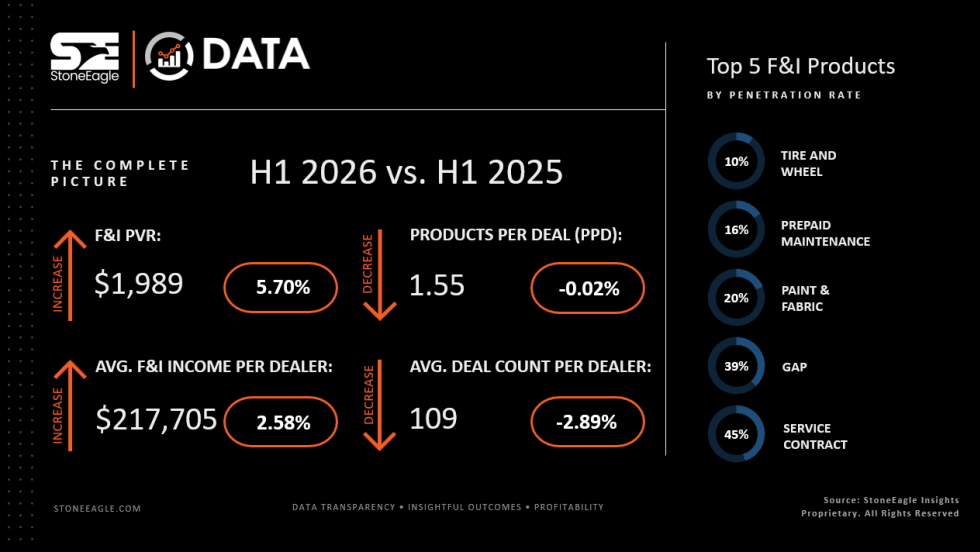
F&I Sales Give Dealers First-Half Lift
Product business shored up total profits to avoid an overall revenue tanking as product penetrations held steady, StoneEagle reported.
Read More →
Targeted Training Drives Results
Today’s technology, instead of threatening F&I managers, can actually make them better, according to an industry veteran who’s watched market setbacks roil the unprepared.
Read More →
Double the Change, Double the Chance
When an F&I manager gets a customer refusal, it’s a wise move to tweak more than one thing in the product offering.
Read More →
Just Do It
F&I managers need training, but instead of resisting application or expecting perfection, they should improve by simply acting on what they learn.
Read More →