



Record, Review, Reward, Repeat
Using video for training can be helpful, but it can also hurt you if not used properly. Check out this six-step guide to effectively employing video for training.
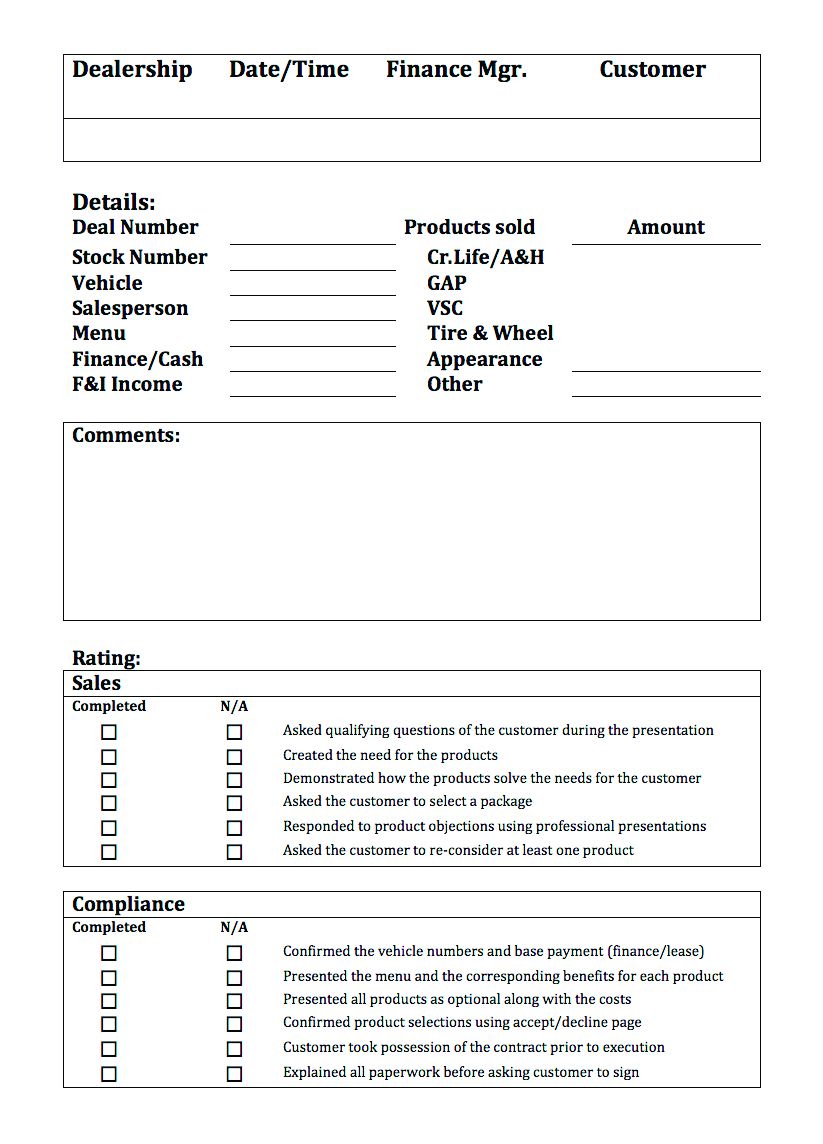
Pictured is the grading sheet Steve Veldkamp employs when using video recordings as a training tool at his clients’ dealerships.
If you have an agent that’s a “techie” like me, he or she has probably proposed the idea of using video cameras as a training tool for your F&I department. I personally started using video in my clients’ stores in 2006, and I’ve come to believe that the camera is the most powerful training tool available.
From this magazine’s annual conference to the 20 Groups you belong to, you’ve probably heard that installing cameras in the F&I office can add $200 in profit per vehicle retailed. Well, I’m here to tell you that, in my experience, all that is true. And the sooner you let your agent or trainer use them as part of their training, the sooner you can realize those gains.
Whatever it was that piqued your interest, it’s important that you make sure you and your agent consider the following six steps to ensure that you get the most out of that video system — and to help avoid a couple of very serious pitfalls.
Step 1: Record Every Transaction
The main reason that numbers usually go up after installing a camera system is that producers who know they’re being watched are more likely to abide by the 300 percent rule: Present 100 percent of the products to 100 percent of the people 100 percent of the time. For that reason alone, it only makes sense to record every single transaction.
Surprisingly — to me, at least — this can be the most difficult step for an agent. I have heard every reason imaginable for a transaction not being recorded: “It stopped working,” “It was a cash deal,” “They’re a previous customer who never buys anything” or “It’s a subprime deal.” That’s why I won’t employ video if I get that kind of pushback from my client, because I’ll spend more time debating which deals to record than actually training.
Picking and choosing transactions to record also creates a compliance issue. See, any time a dealership has one process for one customer and another process for the next, it’s putting itself at risk of a discrimination suit. That’s why I recommend offering some type of incentive for employees who go along with it — or a penalty for those who don’t. Either way, dealer support is crucial to making sure every transaction is captured.
Step 2: Watch the Videos
This was my biggest failure early on. I convinced a dealer client to install cameras at his own expense. I sold him on the same claim that sold me: Adding cameras to the F&I office would boost product sales. Unfortunately, neither of us took the time to explain the purpose to his employees or watch the footage he recorded. After the first month, production was flat and my client’s staff was on the edge of revolt. Needless to say, I lost the account soon after.
That’s why I recommend that agents watch at least four transactions per F&I manager per month. If that’s too much to handle, your provider can probably provide a professional reviewing service. Your agent may also have someone at their agency who can review the recordings. That individual must have rudimentary knowledge of the F&I process to ensure that there is no disconnect between the viewer and what you and your agent are trying to accomplish.
Step 3: Establish a Grading System
This is the most important step. It must reflect everything you want to see accomplished during each transaction. The review sheet that I use includes 12 items that are broken into two categories: sales and compliance.
The grading system also should reflect your store’s training system. For example, I train F&I producers to establish the need for each product before showing how the product solves that need. So my grading system follows what we think makes for the best presentations. And after reviewing the videos, we compile the scores and keep them in a database for performance-tracking purposes.
Step 4: Give Feedback
Producers should see the review sheet after it’s completed by your agent. I always make sure to offer praise before I make any recommendations. I also make sure the dealer and the producer sign off on the feedback sheet. I also will watch the recordings with each producer, as this allows the trainee to see what he or she did right, as well as areas where the F&I manager can improve.
Step 5: Hold Review Meetings
I do this for clients that have more than one producer. At least once a month, I’ll bring all the producers together to watch transactions from the previous month. These recordings should always be highlights, never a blooper real. You want to praise the producers in public and correct them in private.
Remember, the goal of these monthly meetings is to share what’s working with the rest of the organization. It should last no more than an hour, with time allotted for a review of at least five successful transactions.
Step 6: Use the Videos
Use the videos in training. Use them to share new closes. Use them to share compliance initiatives. Video-recording transactions can be a powerful tool for increasing PRU, but you must be committed to it and you must support your agent’s efforts for it to be a success.
Steve Veldkamp is the training director for Great Lakes Companies. He can be reached by e-mail at steve.veldkamp@bobit.com.
More Auto Finance

More Auto Loans for the Taking in August
Riskier categories were on the uptick for the month as lenders loosened access in several areas while balancing out the exposure in another, Cox Automotive reported.
Read More →
July Was Hot for Auto Borrowers
Credit proved readily available for many, but most loans left buyers in negative territory, Cox Automotive said.
Read More →
Dealer Lender Preferences Revealed
When lenders provide consistent, fast service, their overall satisfaction scores with dealers greatly improve, according to JD Power research.
Read More →
Auto Refi Savings Surge
Consumers with 84-month auto loan terms who refinanced saved the most on monthly payments, according to a new report by auto refinancing provider Caribou.
Read More →
Subaru Enters Lending Business
The automaker follows other brands in adding captive financing in the U.S., and says the move will strengthen its position here.
Read More →
Positive Equity Reaches Record High
Mainstream vehicle owners who bought a car seven years ago are likely to have positive equity when trading in for a new vehicle, according to second-quarter Edmunds data.
Read More →
Dealerships Are Paying the Price for Extended Car Loans
Growing negative-equity scenarios mean such lengthy terms should be addressed in a forward-looking way to make them work for the dealer and the consumer down the road.
Read More →
Trade-Ins in Negative Equity Reach New Heights
As such trade-ins rise in frequency, so do monthly loan payment amounts and interest rates, according to second-quarter data compiled by Edmunds.
Read More →
Auto Credit Plentiful
June numbers show lenders are readily granting access, including to risky borrowers, as consumers leverage themselves to take on high prices.
Read More →
Automotive Consumers Sink Further in Debt
Most financing metrics hit records in the second quarter as more buyers locked themselves into long terms and high monthly payments.
Read More →