FI showroom red and grey logo
MenuMENU
SearchSEARCH

AFSA Says TALF Doesn’t Go Far Enough

The Department of the Treasury and the Federal Reserve Board today announced the launch of the Term Asset-Backed Securities Loan Facility (TALF), a component of the Consumer and Business Lending Initiative (CBLI). But although the TALF has the potential to generate up to $1 trillion of lending for businesses and households, one association said it doesn’t go far enough.

by Staff
March 3, 2009
3 min to read


The Department of the Treasury and the Federal Reserve Board today announced the launch of the Term Asset-Backed Securities Loan Facility (TALF), a component of the Consumer and Business Lending Initiative (CBLI). But although the TALF has the potential to generate up to $1 trillion of lending for businesses and households, one association said it doesn’t go far enough.

While the TALF is intended to revive the ABS markets by generating funding for creditors, the American Financial Services Association said its restrictions will prevent many auto finance companies from participating in the program.

Ad Loading...

“In particular, AFSA believes the TALF program must be expanded to permit eligibility for securities beyond those with an AAA rating,” said Chris Stinebert, president and CEO of the AFSA. “Without additional changes, lenders will continue to face funding challenges – and many potential borrowers may still find themselves unable to buy a car.”

The TALF is designed to catalyze the securitization markets by providing financing to investors to support their purchases of certain AAA-rated asset-backed securities (ABS). However, the AFSA said the TALF needs to be expanded to address floorplan financing.

“Of particular concern is the effect on floorplan financing,” Stinebert said. “Without an expansion of TALF’s eligibility requirements, 50 percent of floorplan ABS will be shut out of the program, creating a domino effect that will impact all lenders and dealers.”

Under today's announcement, the Federal Reserve Bank of New York will lend up to $200 billion to eligible owners of certain AAA-rated ABS backed by newly and recently originated auto loans, credit card loans, student loans, and SBA-guaranteed small business loans.

Issuers and investors in the private sector are expected to begin arranging and marketing new securitizations of recently generated loans, and subscriptions for funding in March will be accepted on March 17, 2009. On March 25, 2009, those new securitizations will be funded by the program, creating new lending capacity for additional future loans.

Ad Loading...

The program will hold monthly fundings through December 2009 or longer if the Federal Reserve Board chooses to extend the facility.

Today the Board also released revised terms and conditions for the facility and a revised set of frequently asked questions. The revisions include a reduction in the interest rates and collateral haircuts for loans secured by asset-backed securities guaranteed by the Small Business Administration or backed by government-guaranteed student loans.

The modifications are warranted by the minimal credit risk on these assets owing to the government guarantees, and, by making the terms of the TALF loans more attractive, they should encourage greater flows of credit to small businesses and students.

The Federal Reserve and Treasury currently anticipate that ABS backed by rental, commercial, and government vehicle fleet leases, and ABS backed by small ticket equipment, heavy equipment, and agricultural equipment loans and leases will be eligible for the April funding of the TALF.

Other types of securities under consideration include private-label residential mortgage-backed securities, collateralized loan and debt obligations, and other ABS not included in the initial rollout such as ABS backed by non-auto floorplan loans and ABS backed by mortgage-servicer advances. As is the case for the current categories of newly originated loans, the TALF will combine public financing with private capital to encourage the private securitization of loans in the asset classes eligible in the expanded program.

Ad Loading...

Additional details of the TALF and the CBLI can be found at www.FinancialStability.gov. Further information on the Federal Reserve's credit and liquidity programs is available at www.federalreserve.gov/monetarypolicy/bst.htm. The Treasury Department also released a new white paper outlining efforts to unlock credit markets.

Topics:F&I

More F&I

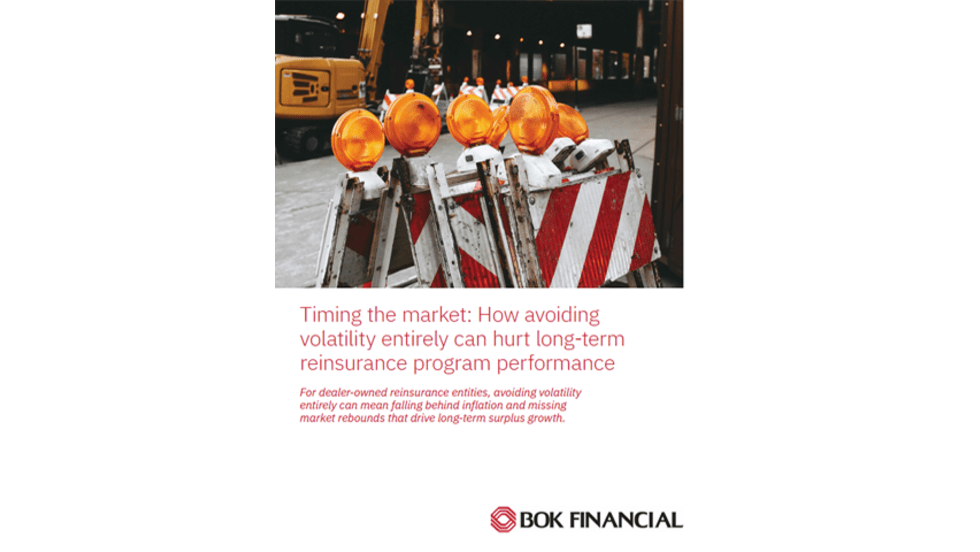
Cover image for a BOK Financial report titled “Timing the market: How avoiding volatility entirely can hurt long-term reinsurance program performance.” The image shows several road construction barricades with flashing amber warning lights lined up in a nighttime work zone. Beneath the image, red text explains that avoiding volatility can mean falling behind inflation and missing market rebounds that drive long-term surplus growth. The BOK Financial logo appears at the bottom right.
SponsoredMay 8, 2026

Timing the Market Can Hurt Long-Term Program Performance

For dealer-owned reinsurance entities, avoiding volatility entirely can mean falling behind inflation and missing market rebounds that drive long term surplus growth. Missing just a handful of strong market days can materially impact cumulative returns—an important reminder for long horizon trust and investment strategies.

Read More →
Ryan Ruff, The 90/10 Rule, Automotive Training Academy, Sales Series
F&IMay 6, 2026

The 90/10 Rule

In this video, Ryan Ruff explains the rule that elite sales professionals use to turn ordinary conversations into unforgettable customer experiences.

Read More →
Photo of essential oil diffuser on desk next to laptop
F&IMay 4, 2026

Your Office Is Talking

What’s the atmosphere saying about you to your customers? You can make minor adjustments and additions that transform your space into one that creates trust with the people on the other side of the desk.

Read More →
Ad Loading...
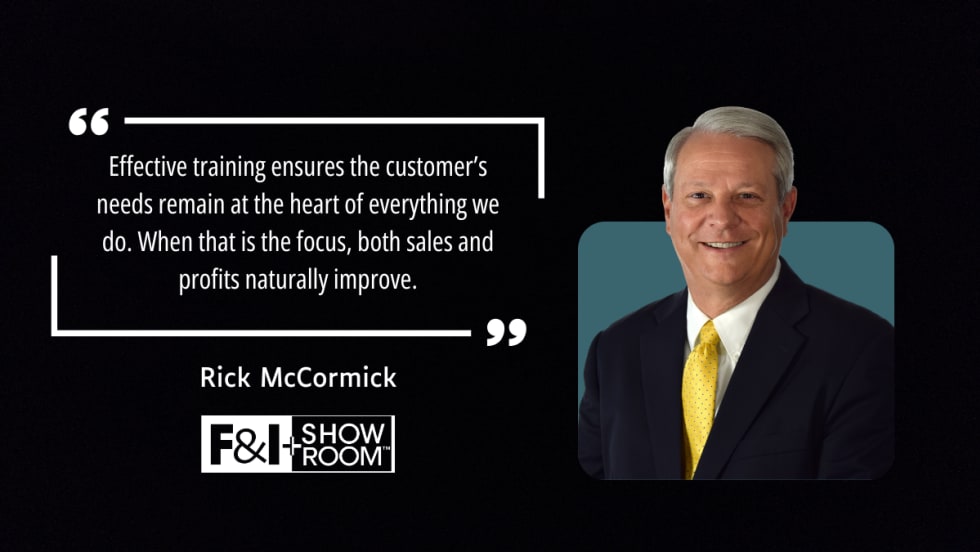
"Effective training ensures the customer’s needs remain at the heart of everything we do. When that is the focus, both sales and profits naturally improve." by Rick McCormick with F&I and Showroom logo and picture of Rick McCormick
F&IMay 1, 2026

F&I Training Fundamentals

How can auto dealerships help F&I managers fulfill their vital role in the most effective ways? Industry expert Rick McCormick shares his insights on the best ways to train these professionals and help them maintain good habits.

Read More →
Photo of car tire and the tread mark it left in snow
F&Iby Hannah MitchellApril 29, 2026

Not Just Any Tire Will Do

More consumers and businesses are opting for all-season options for various reasons as safety, sustainability and convenience push practical change.

Read More →
Photo of robot holding a laptop
F&Iby Hannah MitchellApril 27, 2026

How AI Will Drive the Next Wave of Innovation in Finance & Insurance

It’s time to take the next digital step to free F&I managers to handle the most challenging aspects of customer meetings.

Read More →
Ad Loading...
Photo of notepad and pen next to computer keyboard on desktop
F&IApril 13, 2026

Control in Sales Is an Illusion

Some of it should be given to the customer, but that doesn’t mean the F&I office relinquishes the process. In fact, a different approach both builds trust and boosts sales.

Read More →
Photo of external keyboard on office deak next to window
F&IApril 7, 2026

The Limited Warranty Game

Bringing it in-house benefits the dealership and its customers.

Read More →
Woman in casual clothing sitting at a desk
F&Iby Rick McCormickMarch 31, 2026

Curb The Confusion

Talk to F&I customers like you’d talk to a friend, without industry lingo or sales-like questions, and use hard proof to show, not tell, them about a need.

Read More →
Ad Loading...
Photo of man's hand on laptop computer keyboard with blank screen
F&IMarch 16, 2026

There Is Always one More Product

Helping F&I customers understand complementary offerings is likely to lead to more sales, based on the success of a high-performing practitioner of the philosophy.

Read More →