



August Sales Ride the C4C Wave
After four straight months of declines, retail sales rebounded in August, but not just because of the federal Cash for Clunkers (C4C) program.
After four straight months of declines, retail sales rebounded in August, but not just because of the federal Cash for Clunkers (C4C) program.
According to the U.S. Census Bureau, retail sales rose 2.7 percent in August, well above the 2 percent increase analysts had predicted. Motor vehicle sales, riding the C4C wave, jumped 10.6 percent.
Sales excluding motor vehicles increased 1.1 percent, and sales excluding motor vehicles and gasoline rose 0.6 percent.
“Even excluding the strong growth in motor vehicle sales, which was a result of the successful ‘Cash for Clunkers’ program, this significant increase in consumer spending shows that the Recovery Act and President Obama’s other economic initiatives are succeeding in putting the brakes on the recession,” U.S. Commerce Under Secretary for Economic Affairs Rebecca Blank said. “Accelerated stimulus spending in the second half of this year will create jobs and further stimulate our economic recovery.”
While the C4C program, which launched on July 27, did boost sales in August, some analysts wonder what the impact of the program will be on consumers who took advantage of the program and traditional retail sales.
“Many Americans who traded in their vehicles have become saddled with monthly car payments, which reduces the amount of money they’re able to spend in other areas,” said Rosalind Wells. “As a result, it remains to be seen how the ‘Cash for Clunkers’ program will impact traditional retail sales.”
In a survey conducted shortly after C4C ended on Aug. 24, CNW found that 17 percent of the 1,000 participants of the C4C program had “some” or “serious” doubts about making a new-vehicle purchase. Typically, in a non-C4C environment, buyer’s remorse hits roughly 6 to 9 percent of new-vehicle buyers within a month, according to CNW Purchase Path research.
“The primary reason (for those doubts): They are now facing a $275 to $350 per month car payment that didn’t exist prior to acquiring the car or truck,” wrote CNW’s Art Spinella. “That amount, they say, could negatively impact the total family budget more than expected prior to buying the new vehicle.”
More F&I

AI: Facilitator, Not Fixer, in F&I
The dealerships that thrive in the years ahead will be those that embrace technology while continuing to invest in the people who make customer interactions count.
Read More →
Modern Technology Objection Handling
In this video, Trent White shares how to confidently handle technology-based objections by helping customers understand the value of protection, even with modern vehicle technology.
Read More →
Consistency at Scale: Driving F&I Performance
With 75 rooftops across the Sunshine State, Morgan Auto Group has proven to Floridians that it knows a thing or two about driving performance in a competitive market. But it didn’t start at the top.
Read More →
Gitty Up on GAP
The foundational finance-and-insurance product hasn’t kept up with the latest conditions for auto dealers. Is the time ripe?
Read More →
How AI-Powered Coaching Is Transforming F&I Performance
See how AI-powered coaching can turn F&I customer conversations into actionable insights that support compliance, performance and profitability
Read More →
Sell Value, Build Trust
In this video, Trent White explains why selling on value, not fear, builds lasting customer trust, reduces cancellations, and drives long-term success.
Read More →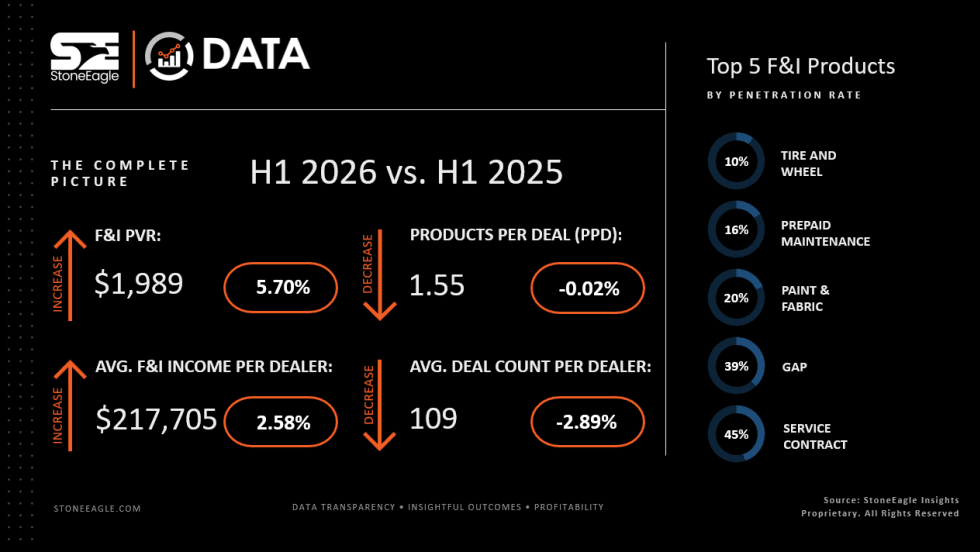
F&I Sales Give Dealers First-Half Lift
Product business shored up total profits to avoid an overall revenue tanking as product penetrations held steady, StoneEagle reported.
Read More →
Targeted Training Drives Results
Today’s technology, instead of threatening F&I managers, can actually make them better, according to an industry veteran who’s watched market setbacks roil the unprepared.
Read More →
Double the Change, Double the Chance
When an F&I manager gets a customer refusal, it’s a wise move to tweak more than one thing in the product offering.
Read More →
Just Do It
F&I managers need training, but instead of resisting application or expecting perfection, they should improve by simply acting on what they learn.
Read More →