



Auto Insurance Premiums Expected to Drop in 2007 for First Time Since 1999
The typical U.S. driver will pay less for auto insurance in 2007 than in 2006, with the average premium expenditure expected to drop by 0.5 percent, reported the Insurance Information Institute (I.I.I.)
NEW YORK — The typical U.S. driver will pay less for auto insurance in 2007 than in 2006, with the average premium expenditure expected to drop by 0.5 percent, reported the Insurance Information Institute (I.I.I.)
The average annual cost for auto insurance premiums nationwide for 2007 is estimated at $847 per policy, the first decrease since 1999. This translates into a $4 per policy savings as compared to the $851 the typical U.S. driver paid in 2006. And while $4 may not sound like much for an individual policy, it translates into hundreds of millions of dollars in total consumer savings when spread across the U.S. The trend in the auto market stands in stark contrast to the health insurance industry, where premium rates for employer-sponsored policies has risen 87 percent over the past six years (2000-2006), according to a survey by the Kaiser Family Foundation and the Health Research and Educational Trust
“Competitive marketplaces, safer cars, aggressive fraud-fighting and innovative underwriting are joining forces in 2007 to drive down the price of an essential financial product,” said Robert Hartwig, exectutive vice president and chief economist of the I.I.I. “This is great news for drivers who were battered this year by higher fuel prices and rising auto repair costs.”
Hartwig said that savings would vary by driver, depending on his or her accident experience, and by state, with the greatest savings in states with the most competitive markets and lower savings in states where stringent regulations can counteract market forces.
Drivers pay more for auto insurance in states with significant urban populations, greater traffic density and a higher cost-of-living. Tort liability and other auto laws as well as each state’s auto body repair labor costs, liability coverage requirements and theft rates also have an impact on auto insurance prices.
The I.I.I. attributed the auto insurance price reductions to declining claim frequency (down anywhere from 3 to 5 percent in 2006 as compared to 2005), coupled with very modest increases in claims severity, with the average cost per claim, a figure that includes the price of medical care and property damage, rising only 2 to 4 percent in 2006 as compared to 2005.
In addition to fewer accidents, many industry analysts believe that fraud-fighting successes have contributed to a decrease in bogus bodily injury claims.
Safer vehicles and roads, as well as graduated licensing programs for teens, are other factors driving the downward trend in auto insurance premium costs. The changing demographics of the U.S. population, with millions of baby boomers born between 1946 and 1964 now all in what insurers calculate to be their safest driving years, are also contributing to these cost reductions.
“The I.I.I. is finding that the nation’s overall insurance rating system—how a company assesses the risk a particular driver represents—has on the whole become much fairer and more equitable through innovations in underwriting technology,” Dr. Hartwig said. By looking at a potential policyholder’s credit score, in conjunction with criteria such as their driving record and driving habits, insurers are able to match with greater precision than ever before the premium they charge in the context of the potential claims they may have to pay a policyholder, he noted.
Moreover, drivers’ auto insurance premiums are also affected by the amount of coverage they purchase. Every state insists on some level of coverage for its registered drivers. Yet the National Association of Insurance Commissioners (NAIC) estimated in 2004, for instance, that 23 percent of insured drivers did not purchase comprehensive coverage, and 28 percent opted against buying collision coverage. Drivers who buy neither comprehensive nor collision coverage have lower auto insurance premium rates while choosing to self-insure themselves for theft and other losses.
With an auto insurance market that is favorable to consumers, there are additional ways to save money, according to the I.I.I.
Raise your deductible. Higher deductibles on your car could produce savings of 15 to 30 percent or more.
Compare insurance costs before buying a car. Your premium is based in part on the car’s sticker price, the cost to repair it, its overall safety record and the likelihood of theft. Many insurers offer discounts for features that reduce the risk of injury or theft. These include air bags, anti-lock breaks, daytime running lights and anti-theft devices. Cars that are favorite targets for thieves cost more to insure. Information that can help you decide what car to buy is available from the Insurance Institute for Highway Safety ( http://www.iihs.org ).
Reduce coverage on older cars. Consider dropping collision and/or comprehensive coverage on older cars. It may not be cost-effective to continue to buy these coverages on cars worth less than 10 times the amount you would pay for the coverage.
Maintain good credit. Increasingly, insurers are using credit-based insurance scores to determine auto coverage premiums. This is because people with good credit tend to file fewer claims. All else being equal, a person with a good insurance score—credit information used by an insurer to predict claims—may pay much less for insurance than someone with a poor score.
Shop around. Prices vary from company to company, so it pays to shop around. Get at least three price quotes. You can call companies directly or access information on the Internet. Your state insurance department may also provide comparisons of prices charged by major insurers.
More F&I

AI: Facilitator, Not Fixer, in F&I
The dealerships that thrive in the years ahead will be those that embrace technology while continuing to invest in the people who make customer interactions count.
Read More →
Modern Technology Objection Handling
In this video, Trent White shares how to confidently handle technology-based objections by helping customers understand the value of protection, even with modern vehicle technology.
Read More →
Consistency at Scale: Driving F&I Performance
With 75 rooftops across the Sunshine State, Morgan Auto Group has proven to Floridians that it knows a thing or two about driving performance in a competitive market. But it didn’t start at the top.
Read More →
Gitty Up on GAP
The foundational finance-and-insurance product hasn’t kept up with the latest conditions for auto dealers. Is the time ripe?
Read More →
How AI-Powered Coaching Is Transforming F&I Performance
See how AI-powered coaching can turn F&I customer conversations into actionable insights that support compliance, performance and profitability
Read More →
Sell Value, Build Trust
In this video, Trent White explains why selling on value, not fear, builds lasting customer trust, reduces cancellations, and drives long-term success.
Read More →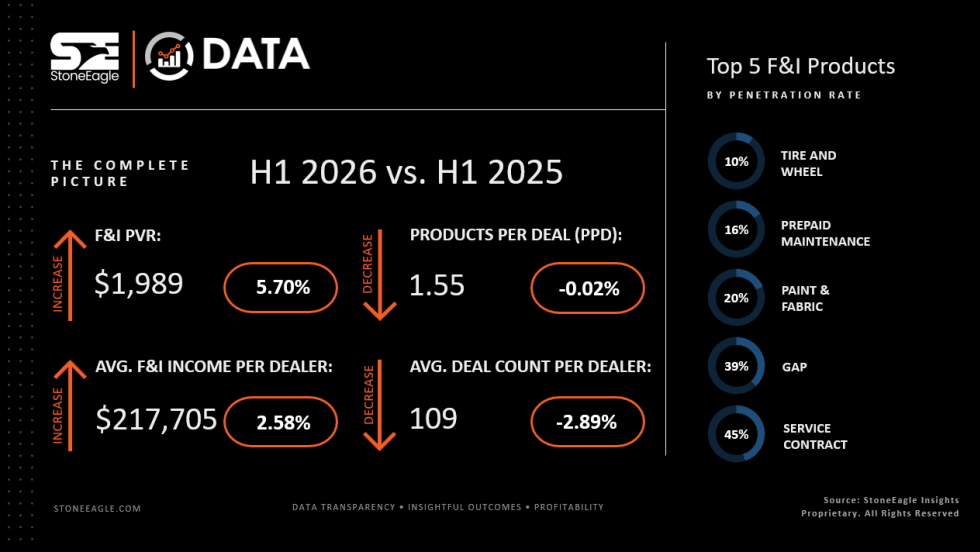
F&I Sales Give Dealers First-Half Lift
Product business shored up total profits to avoid an overall revenue tanking as product penetrations held steady, StoneEagle reported.
Read More →
Targeted Training Drives Results
Today’s technology, instead of threatening F&I managers, can actually make them better, according to an industry veteran who’s watched market setbacks roil the unprepared.
Read More →
Double the Change, Double the Chance
When an F&I manager gets a customer refusal, it’s a wise move to tweak more than one thing in the product offering.
Read More →
Just Do It
F&I managers need training, but instead of resisting application or expecting perfection, they should improve by simply acting on what they learn.
Read More →