



Auto Insurance Satisfaction Spotty
J.D. Power survey finds repair times have improved but premiums are up. There’s also room for improvement on communication during the process.


In a positive turn of events, average repair cycle times have fallen by one day year-over-year to 22 days.
Pexels/Mikhail Nilov
Auto repair costs claims through insurance have spiked in the past two years, sparking a jump in premiums.
J.D. Power research found that the average repair cost is up 26% and the resulting insurance premium bump 15%.
In a survey of nearly 10,000 auto insurance policy holders on claims satisfaction, 48% said their premiums had increased in the previous 12 months, almost half of the increases tied to claims. Claims-related premium increases bring a 100-point decline in satisfaction scores, an effect that almost doubles among baby boomers and older consumers, J.D. Power said.
Meanwhile, in a positive turn of events, average repair cycle times have fallen by one day year-over-year to 22 days.
There’s room for improvement on communication, though. The study found that digital claims steps are received unevenly across various parts of the process and across generations. Some are highly satisfied with moving through the process via insurer mobile applications, but they represent only 13% of consumers, said J.D. Power, which emphasized that good communication during claims processing is key to satisfaction.
“… 80% of auto insurance customers who have poor claims experiences have already left or say they plan to leave that carrier,” said Mark Garrett, director of global insurance intelligence. “That makes this year’s significant improvement in repair cycle times very good news for insurers and their customers. However, premium increases have created a new challenge for insurers as trust is eroding and affecting the way customers view their claims.”
More F&I

AI: Facilitator, Not Fixer, in F&I
The dealerships that thrive in the years ahead will be those that embrace technology while continuing to invest in the people who make customer interactions count.
Read More →
Modern Technology Objection Handling
In this video, Trent White shares how to confidently handle technology-based objections by helping customers understand the value of protection, even with modern vehicle technology.
Read More →
Consistency at Scale: Driving F&I Performance
With 75 rooftops across the Sunshine State, Morgan Auto Group has proven to Floridians that it knows a thing or two about driving performance in a competitive market. But it didn’t start at the top.
Read More →
Gitty Up on GAP
The foundational finance-and-insurance product hasn’t kept up with the latest conditions for auto dealers. Is the time ripe?
Read More →
How AI-Powered Coaching Is Transforming F&I Performance
See how AI-powered coaching can turn F&I customer conversations into actionable insights that support compliance, performance and profitability
Read More →
Sell Value, Build Trust
In this video, Trent White explains why selling on value, not fear, builds lasting customer trust, reduces cancellations, and drives long-term success.
Read More →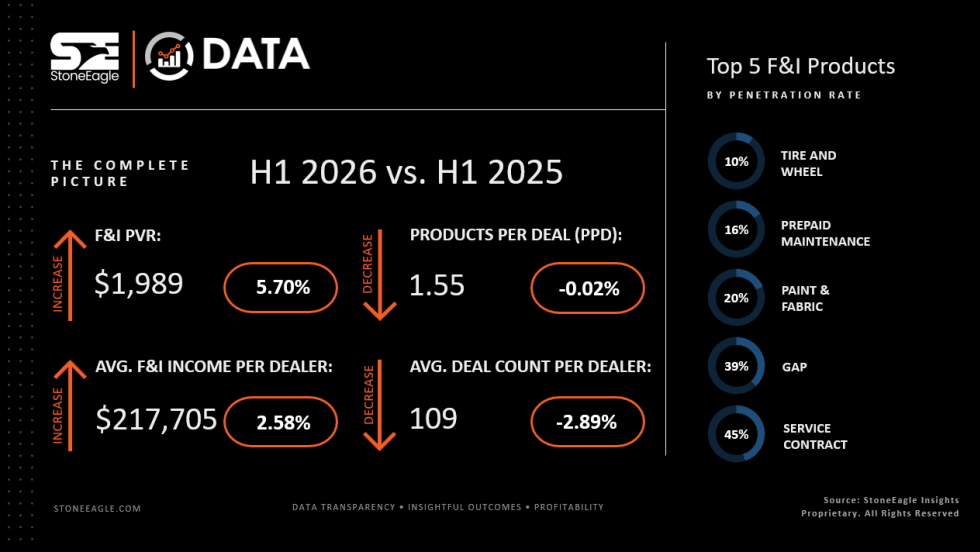
F&I Sales Give Dealers First-Half Lift
Product business shored up total profits to avoid an overall revenue tanking as product penetrations held steady, StoneEagle reported.
Read More →
Targeted Training Drives Results
Today’s technology, instead of threatening F&I managers, can actually make them better, according to an industry veteran who’s watched market setbacks roil the unprepared.
Read More →
Double the Change, Double the Chance
When an F&I manager gets a customer refusal, it’s a wise move to tweak more than one thing in the product offering.
Read More →
Just Do It
F&I managers need training, but instead of resisting application or expecting perfection, they should improve by simply acting on what they learn.
Read More →