



California DMV Accuses Tesla of Exaggerating Hands-free Driving Software Capabilities
The California Department of Motor Vehicles has asked for an administrative hearing that could result in penalties.

Tesla
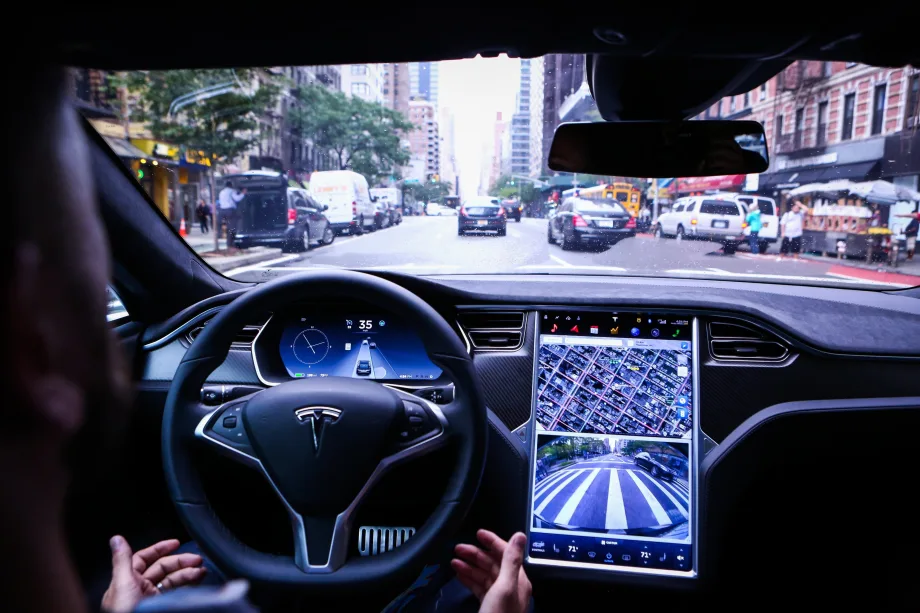
The California Department of Motor Vehicles has accused Tesla of exaggerating the capabilities of its hands-free driving software. The agency has asked for an administrative hearing that could result in penalties.
Tesla offers three levels of automation on its vehicles. Each level offers different capabilities, but none give consumers a true autonomous vehicle.
Autopilot comes standard equipment on every Tesla vehicle. It includes a smart cruise control that matches the car’s speed to the speed of surrounding traffic and a lane-centering function to keep the car in the center of its lane.
Enhanced Autopilot, a $6,000 option on all Tesla vehicles, which offers the same features as Autopilot but adds the ability to navigate highway on- and off-ramps and highway interchanges without driver input, and to suggest lane changes. This level also includes a self-parking system and a “summon” function that lets owners call the car to them from across a parking lot.
Full Self-Driving costs consumers $12,000. This system lets the car read and react to traffic lights and stop signs with the driver’s “active supervision.” Owners can use this system today but must agree to a series of waivers to activate it. Tesla reports the system is still in “beta testing.”
The California DMV claims Tesla “made or disseminated statements that are untrue or misleading, and not based on facts.” By naming the products “autopilot” and “full self-driving,” the DMV alleges Tesla suggests the systems operate autonomously.
But SAE requires active driver supervision with autonomous capabilities such as those offered by Tesla. The automaker has since added a disclaimer stating “the currently enabled features require active driver supervision and do not make the vehicle autonomous.”
A collective group of automotive safety groups have asked the auto industry to agree on standardized names for autonomous systems to avoid confusion.
Tesla has offered up information that explains how Full Self-Driving is “not capable of recognizing or responding to static objects and road debris, emergency vehicles, construction zones, large uncontrolled intersections with multiple incoming ways, occlusions, adverse weather, complicated or adversarial vehicles in the driving path, and unmapped roads.”
California DMV maintains this disclaimer is not enough.
If the DMV prevails in its lawsuit, it could revoke the company’s licenses to make or sell its cars in California.
But in a KMB.com article, a DMV spokesperson hinted the agency wouldn’t take things that far. Instead, will require Tesla to advertise to consumers and better educate Tesla drivers about the capabilities of its ‘Autopilot’ and ‘Full Self-Driving’ features.”
Originally posted on Auto Dealer Today
More Compliance

Variations on a Theme – Lease Packing
Dealers must be careful they don’t run afoul of the law when it comes to such deceptive practices, as there are many cases pointing to the potential bad ends of such deals.
Read More →
Your 10-Point Compliance Checklist
Identify areas of concern and opportunities for training by updating, installing and enforcing a compliance checklist that requires specific actions for sales, F&I and accounting.
Read More →
A Continuing Antediluvian Dealer Fraud: Payment Packing
The longtime illegal practice, which can take many forms, can get a dealer and its employees in deep trouble. It’s a good idea to determine if anyone in your stores is doing it and to weed it out if so.
Read More →
Line 1 Is Not a Junk Drawer
Rolling products into the cash price — even if the bank told you to — misrepresents the vehicle’s value and runs afoul of four federal laws.
Read More →
Dueling Banjos in the Car Biz
Reports and accounts at variance show auto dealers’ trust profiles have risen in many consumers’ minds but that there remains a need for greater transparency by some.
Read More →
NADA and the Miracle on 34th Street
Automotive dealers should follow the National Automobile Dealers Association's consumer-friendly guidelines in order to minimize their legal risks.
Read More →
Another Look at a Recent Data Breach
Get caught up on the most pressing legal and regulatory matters facing dealers and F&I professionals, including data security, shotgun purchases, and inconsistent payment quotes.
Read More →

The Best Thing a Dealer Can Do to Avoid Legal Problems
Citing the issue is a strategy borrowed from the legal field itself.
Read More →