



'Can Car Dealers Keep the Profits Rolling?' asks Business Week
With heavy advertising and good old-fashioned salesmanship, savvy car dealers went all out in December to finish the year with strong sales, according to Business Week magazine.
The reason for the extra effort: Jan. 2 marked the end of the zero percent financing deals that Detroit carmakers offered up in mid-September to get buyers, who had been spooked by the impending recession and the Sept. 11 terrorist attacks on the United States, back into the showroom.
"It's the best sales incentive program I've ever seen," Rene Isip, who runs four dealerships
in Dallas for Charlotte-based Sonic Automotive Inc., told the magazine.
Islip better have made the most of it. Even though new programs are being announced -- General Motors Co.'s $2,002 discount, for example -- deals as sweet as free financing are unlikely to come around again for a long time, according to Business Week. And no one has benefited as much from Detroit's generous promotions as have the nation's auto dealers.
While the combination of big incentives and a weakening economy decimated profits at the Big Three automakers, the reverse has been true
for large U.S. dealer chains. The incentive-fueled sales boom turned 2001 into one of their best years ever as buyers poured in to take
advantage of lower prices.
Even Wall Street applauded the dealers' good
fortune: Shares of the biggest chains -- market leader AutoNation, followed by UnitedAuto Group, then Group 1 Automotive -- doubled or
tripled last year.
With the stumbling economy, rising unemployment, and the end of the incentives all expected to slow new car sales in 2002, the question now is whether dealers' fortunes will stall out, too.
Dealers are hoping to make up much of the difference with stronger used-car sales, where they book better margins. Used-car sales are likely to grow by just 100,000 vehicles next year, to 12.7 million, according to Paul Taylor, chief economist for the National Automobile Dealers Association (NADA).
Fat margins may be a thing of the past, according to Business Week. Thanks mostly to trade-ins from the zero percent financing, used-car prices tumbled six percent in 2001, squeezing profits, the magazine reported.
More F&I

Managing Expectations
Learn how proactive communication, setting clear expectations, and providing solutions when plans change can strengthen customer trust and improve the overall service experience.
Read More →
The F&I Manager's Report Card
The best managers take the time and attention to measure the behaviors behind the numbers.
Read More →
AI: Facilitator, Not Fixer, in F&I
The dealerships that thrive in the years ahead will be those that embrace technology while continuing to invest in the people who make customer interactions count.
Read More →
Modern Technology Objection Handling
In this video, Trent White shares how to confidently handle technology-based objections by helping customers understand the value of protection, even with modern vehicle technology.
Read More →
Consistency at Scale: Driving F&I Performance
With 75 rooftops across the Sunshine State, Morgan Auto Group has proven to Floridians that it knows a thing or two about driving performance in a competitive market. But it didn’t start at the top.
Read More →
Gitty Up on GAP
The foundational finance-and-insurance product hasn’t kept up with the latest conditions for auto dealers. Is the time ripe?
Read More →
How AI-Powered Coaching Is Transforming F&I Performance
See how AI-powered coaching can turn F&I customer conversations into actionable insights that support compliance, performance and profitability
Read More →
Sell Value, Build Trust
In this video, Trent White explains why selling on value, not fear, builds lasting customer trust, reduces cancellations, and drives long-term success.
Read More →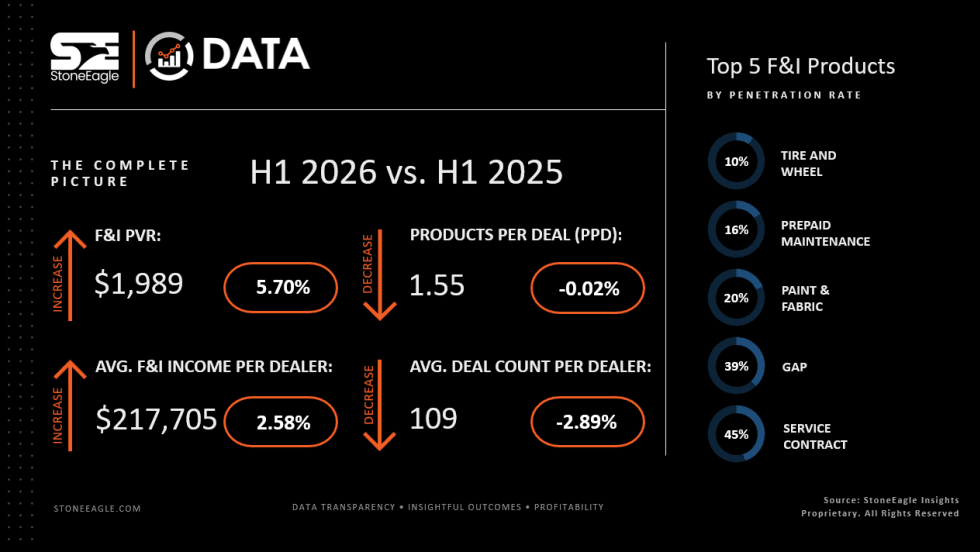
F&I Sales Give Dealers First-Half Lift
Product business shored up total profits to avoid an overall revenue tanking as product penetrations held steady, StoneEagle reported.
Read More →
Targeted Training Drives Results
Today’s technology, instead of threatening F&I managers, can actually make them better, according to an industry veteran who’s watched market setbacks roil the unprepared.
Read More →