



CFPB’s Cordray Commends Honda’s New Markup Policy
At the CFPB’s semi-annual report to Congress Wednesday, the bureau’s director praised Honda Finance for setting limitations on dealers’ ability to mark up interest rates on auto loans. But he also fielded questions about whether the bureau is overstepping its jurisdiction.

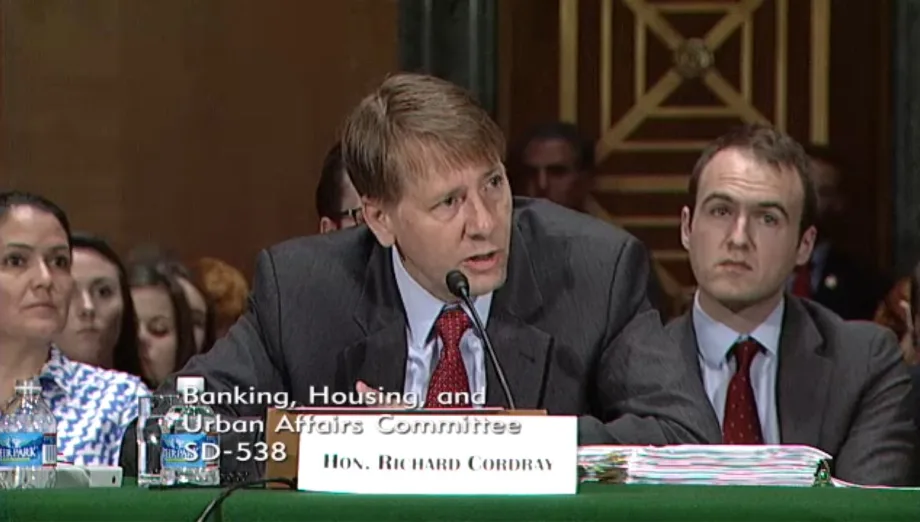
WASHINGTON, D.C. — Concerns about the Consumer Financial Protection Bureau (CFPB)’s expanded authority over the auto finance industry and its lack of accountability were at the forefront of discussions during the bureau’s semi-annual report to Congress on Wednesday.
In his opening remarks at the hearing, U.S. Senator Richard Shelby (R-Ala.), chairman of the U.S. Senate Committee on Banking, Housing, and Urban Affairs, noted that the CFPB’s moves to broaden its authority over the auto finance industry — including the passage of a new rule that gave it supervisory powers over any nonbank auto finance company that makes, acquires or refinances 10,000 or more loan or leases in a year — “have not been without controversy.”
“Many would say that some of them go beyond what Congress envisioned in [Dodd-Frank Wall Street Reform and Consumer Protection Act],” Shelby said. “For instance, the bureau’s regulation of auto lending now involves over 30 nonbank lenders not previously subject to its supervision. This move has been called into question given the specific exemption for auto dealers in Dodd-Frank.”
The CFPB’s alleged insistence on skirting the dealer exemption in Dodd-Frank came to a head earlier in the week, when the National Automobile Dealers Association (NADA) filed a Freedom of Information Act request demanding that the CFPB make public an internal memo that allegedly said limiting dealers’ ability to mark up interest rates on retail installment sales contracts was “one of the goals” of the agency.
The memo was acquired by American Banker, which also broke the news that the bureau was planning to cite three captive finance companies — American Honda Finance Corp., Toyota Motor Credit Corp. and Nissan Motor Acceptance Corp. — for allegedly allowing their dealer partners to charge higher interest rates on auto loans to minority buyers. On July 14, a day before CFPB Director Richard Cordray appeared before Congress, the bureau and the Department of Justice reached a $24 million settlement with Honda Finance. The captive announced it will cap dealer markups at 1.25% above the buy rate for auto loans with terms of five years or less, and 1% for auto loans with longer terms.
“… It’s to Honda’s credit — we would commend them — that they are reaching steps to constrain the discretionary markup which we think has led to discrimination for consumers,” Cordray told the Senate Banking Committee.
The director added that the bureau has been very careful to observe the “illogical” line drawn by Congress, giving the regulator authority over auto lenders but not dealers. “We feel that that means that the law has spoken clearly; that we have a responsibility to address any sort of issues of discrimination or violations of the law by lenders, but not by dealers,” he said.
Despite the near-constant discussion of auto lending by the bureau and its critics, auto loans did not merit much attention in the CFPB’s first ever monthly “complaint snapshot,” published today. The report is designed to highlight key trends from consumer complaints submitted to the bureau, which cover credit cards, mortgages, bank accounts, private student loans, vehicle and other consumer loans, credit reporting, money transfers, debt collection and payday loans.
Consumer loans did show the greatest percentage increase from 2014 to 2015 — rising from 660 complaints to 1,020 — but it was unclear how many of those complaints were related to auto loans. Consumer loan complaints totaled 24,767 from 2013 to 2015, while products like debt collection and mortgages racked up 163,084 and 183,451 complaints, respectively.
Equifax and Experian topped the bureau’s list of most complained about companies, with nearly all of those complaints related to credit reporting. Complaints related to “other” products — which presumably include auto loans — made up only a small portion of the complaints received about Bank of America, Wells Fargo, JP Morgan Chase, Citibank and Capital One, all of which made the bureau’s list of Top 10 most complained-about companies.
During the hearing Wednesday, Cordray pointed to consumer relief as one of the primary elements of the bureau’s mission. Since its creation four years ago, the bureau’s activities have resulted in more than $10.1 billion in relief for more than 17 million consumers.
“I come from a strong automotive state,” said the Ohio-born regulator. “The last thing I want is to do things that hamstring important markets like auto lending, mortgage lending and the like.”
More Auto Finance

Interest Rates Further Squeeze Auto Consumers
Last month’s hike and a potential second increase this month add to a growing list of inflation woes that could continue to dent overall car sales.
Read More →
Mind Your Process
Consistent steps taken in various aspects of the F&I office can make valuable differences over time, similar to an outline for a best-selling book.
Read More →
Top Five Credit Application Fraud Flags
Compliance audits regularly reveal bad habits that can lead to fraud charges and should have been stamped out decades ago.
Read More →
More Auto Loans for the Taking in August
Riskier categories were on the uptick for the month as lenders loosened access in several areas while balancing out the exposure in another, Cox Automotive reported.
Read More →
July Was Hot for Auto Borrowers
Credit proved readily available for many, but most loans left buyers in negative territory, Cox Automotive said.
Read More →
Dealer Lender Preferences Revealed
When lenders provide consistent, fast service, their overall satisfaction scores with dealers greatly improve, according to JD Power research.
Read More →
Auto Refi Savings Surge
Consumers with 84-month auto loan terms who refinanced saved the most on monthly payments, according to a new report by auto refinancing provider Caribou.
Read More →
Subaru Enters Lending Business
The automaker follows other brands in adding captive financing in the U.S., and says the move will strengthen its position here.
Read More →
Positive Equity Reaches Record High
Mainstream vehicle owners who bought a car seven years ago are likely to have positive equity when trading in for a new vehicle, according to second-quarter Edmunds data.
Read More →
Dealerships Are Paying the Price for Extended Car Loans
Growing negative-equity scenarios mean such lengthy terms should be addressed in a forward-looking way to make them work for the dealer and the consumer down the road.
Read More →