



Fuel Economy Reigns Supreme in NADA Shopper Preference Study
New-vehicle buyers ranked fuel economy as their top consideration in the NADAguides.com's newest shopper preference study. Vehicle design, brand perception, safety and ownership costs rounded out the Top 5 considerations.
McLEAN, Va. – New-car and -truck buyers ranked fuel economy, ownership costs, brand perception, safety and vehicle design as the five most important attributes considered when shopping for a vehicle, according to a recent survey by NADAguides.com. Factors were scored on a scale of zero to 100, with a higher score indicating greater importance.
Both new-car and -truck shoppers ranked Fuel Economy as the most important factor. Car buyers placed a greater emphasis on fuel economy compared to truck buyers with scores of 89 and 84, respectively.
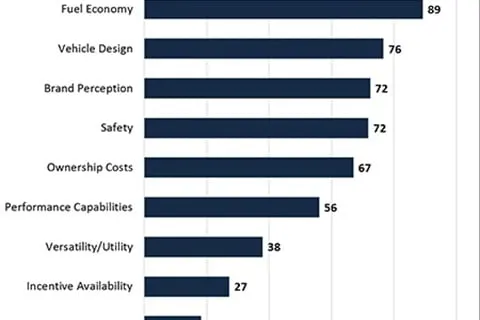
Car buyers gave Vehicle Design a score of 76, making it the second most important factor considered behind fuel economy.
“The fact that car shoppers ranked vehicle design so highly is a reflection of the ongoing parity we’ve seen in the areas of quality, dependability and efficiency among the brands,” said Jonathan Banks, executive automotive analyst for the NADA Used Car Guide. “As we’ve seen from the success of Hyundai and Kia over the past few years, inspirational design can change how consumers view a brand and act as a catalyst to increase new-vehicle sales.”
Banks added that the re-styles of the 2013 Honda Civic and 2014 Chevrolet Malibu, just one year after major revisions, were examples of how “manufacturers are keenly aware of the pronounced role of design in shaping the sales success of a brand.”
With scores ranging from 67 to 72, brand perception, safety and ownership costs rounded out the Top 5 most important factors considered by new-car shoppers.
Performance capabilities received a moderate score of 56, a second place ranking for luxury car respondents, just behind vehicle design.
Car respondents ranked versatility/utility, incentive availability and advanced technologies as the three least important factors.
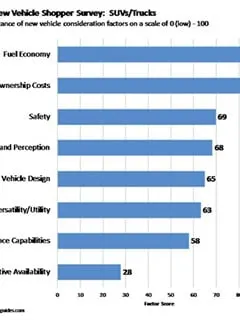
For SUV and truck buyers, ownership cost was the second most important purchase attribute with a score of 83, just one point behind fuel economy.
“The close proximity of these two factors resulted from the broad composition of SUV and truck respondents, which was comprised of consumers shopping for pickup trucks and SUVs of all sizes,” Banks said.
“Shoppers of small SUVs ranked fuel economy as their top concern and ownership costs as third, while shoppers for mid-size and large trucks ranked ownership costs as their top concern and fuel economy third,” Banks continued. “Results indicate that larger truck shoppers want to maximize fuel economy, but they also understand that the added size required to support their household and recreational needs will result in higher gasoline costs. To compensate for this, buyers will look to reduce maintenance expenses and purchase dependable trucks with solid used value retention.”
Truck shoppers, similar to car shoppers, rated safety and brand perception as the third and fourth most important purchase considerations with rankings of 69 and 68, respectively. Vehicle design and versatility/utility followed closely behind with respective scores of 65 and 63.
Brand preference ranked fourth for truck shoppers overall, but was the No. 1 most important attribute for pickup shoppers who are loyal to specific brands in the pickup truck segment.
With an average score of 58, performance capabilities was ranked seventh by truck shoppers, but pickup truck shoppers ranked performance fourth. Luxury truck shoppers, just like luxury car shoppers, ranked performance as the second most important purchase factor.
Incentive availability received a score of 27, making it the least important purchase factor considered by truck buyers.
Through its Car Research Center, NADAguides.com provides tools that allow consumers to research new and used cars by comparing prices, fuel economy, warranty and other important purchase factors for multiple new or used vehicles side-by-side.
More F&I

Modern Technology Objection Handling
In this video, Trent White shares how to confidently handle technology-based objections by helping customers understand the value of protection, even with modern vehicle technology.
Read More →
Consistency at Scale: Driving F&I Performance
With 75 rooftops across the Sunshine State, Morgan Auto Group has proven to Floridians that it knows a thing or two about driving performance in a competitive market. But it didn’t start at the top.
Read More →
Gitty Up on GAP
The foundational finance-and-insurance product hasn’t kept up with the latest conditions for auto dealers. Is the time ripe?
Read More →
How AI-Powered Coaching Is Transforming F&I Performance
See how AI-powered coaching can turn F&I customer conversations into actionable insights that support compliance, performance and profitability
Read More →
Sell Value, Build Trust
In this video, Trent White explains why selling on value, not fear, builds lasting customer trust, reduces cancellations, and drives long-term success.
Read More →
F&I Sales Give Dealers First-Half Lift
Product business shored up total profits to avoid an overall revenue tanking as product penetrations held steady, StoneEagle reported.
Read More →
Targeted Training Drives Results
Today’s technology, instead of threatening F&I managers, can actually make them better, according to an industry veteran who’s watched market setbacks roil the unprepared.
Read More →
Double the Change, Double the Chance
When an F&I manager gets a customer refusal, it’s a wise move to tweak more than one thing in the product offering.
Read More →
Just Do It
F&I managers need training, but instead of resisting application or expecting perfection, they should improve by simply acting on what they learn.
Read More →
Dealer Lender Preferences Revealed
When lenders provide consistent, fast service, their overall satisfaction scores with dealers greatly improve, according to JD Power research.
Read More →