General Motors announced Monday that Chris Liddell was appointed as the company’s vice chairman and chief financial officer. Liddell was most recently CFO for Microsoft Corp., a post he held since May 2005.
by Staff
December 22, 2009
2 min to read
DETROIT – General Motors announced Monday that Chris Liddell was appointed as the company’s vice chairman and chief financial officer. Liddell was most recently CFO for Microsoft Corp., a post he held since May 2005.
"Chris brings a depth and experience to this job that was unmatched in our search for a new financial leader," said Ed Whitacre, GM chairman and CEO. "Chris will lead our financial and accounting operations on a global basis and will report directly to me. We're also looking to his experience and insights in corporate strategy as a member of the senior leadership team in helping our restructuring efforts."
Ad Loading...
Liddell will start with GM in 2010. While at Microsoft, Liddell was responsible for leading Microsoft Corp.'s worldwide finance organization, which included overseeing acquisitions, corporate strategy, treasury activities, tax planning, accounting and reporting, internal audit, and investor relations. He is leaving Microsoft on December 31 of this year.
Before joining Microsoft, Liddell was CFO at International Paper Co., the world's largest forest products company, with similar responsibilities. Prior to that, he was chief executive officer of Carter Holt Harvey Ltd., then New Zealand's second-largest listed company. He also has worked as an investment banker as managing director and joint CEO for CS First Boston NZ Ltd.
Liddell, 51, holds an engineering degree with honors from the University of Auckland, New Zealand, and a Master of Philosophy degree from Oxford University in England. He has served as director of the New Zealand Rugby Union and governor of the New Zealand Sports Foundation. He is a distinguished alumnus of the University of Auckland. Liddell was a member of the Securities and Exchange Commission's Advisory Committee on Improvements to Financial Reporting.
The increasingly important profit center continued making gains in the first quarter, according to StoneEagle data, ancillary products proving more popular as consumers hold onto their buys longer.
For dealer-owned reinsurance entities, avoiding volatility entirely can mean falling behind inflation and missing market rebounds that drive long term surplus growth. Missing just a handful of strong market days can materially impact cumulative returns—an important reminder for long horizon trust and investment strategies.
What’s the atmosphere saying about you to your customers? You can make minor adjustments and additions that transform your space into one that creates trust with the people on the other side of the desk.
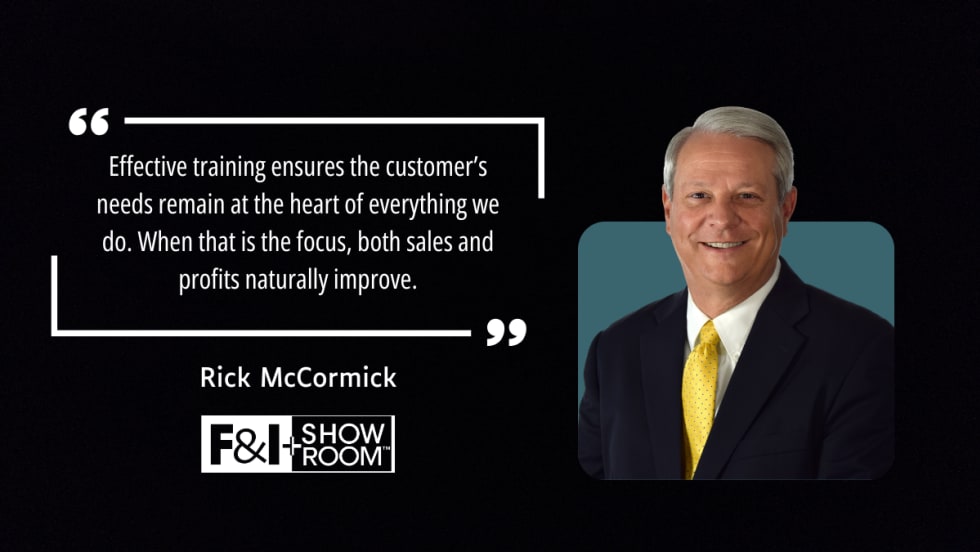
How can auto dealerships help F&I managers fulfill their vital role in the most effective ways? Industry expert Rick McCormick shares his insights on the best ways to train these professionals and help them maintain good habits.
Some of it should be given to the customer, but that doesn’t mean the F&I office relinquishes the process. In fact, a different approach both builds trust and boosts sales.
Talk to F&I customers like you’d talk to a friend, without industry lingo or sales-like questions, and use hard proof to show, not tell, them about a need.