



Industry Recovery Regains Traction in March
Lured by incentives, new-vehicle buyers are returning to dealer showrooms in March after recall news and bad weather kept them away in February. The surge in buyers could lead to a 25 percent sales increase over the same period last year, estimates J.D. Power and Associates, which gathers real-time transaction data from more than 8,900 retail franchise points across the United States.
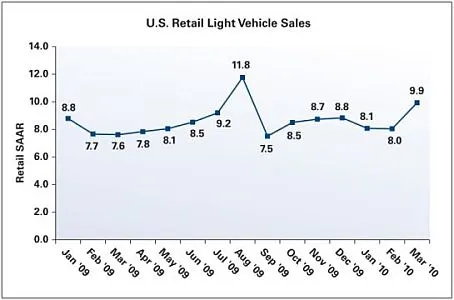
U.S. Retail SAAR from January 2009 to March 2010 (in millions of units)
WESTLAKE VILLAGE, Calif. – Lured by incentives, new-vehicle buyers are returning to dealer showrooms in March after recall news and bad weather kept them away in February. The surge in buyers could lead to a 25 percent sales increase over the same period last year, estimates J.D. Power and Associates, which gathers real-time transaction data from more than 8,900 retail franchise points across the United States.
March new-vehicle retail sales are expected to come in at 883,300 units, representing a seasonally adjusted annualized rate (SAAR) of 9.9 million units. This reflects a retail SAAR increase of nearly 2 million units compared to February 2010. Compared with March 2009, retail sales are projected to increase by 2.3 million units.
"New-vehicle retail sales increased robustly during the first half of March, and are expected to remain strong throughout the remainder of the month — setting the industry recovery back on track," said Jeff Schuster, executive director of global forecasting at J.D. Power and Associates. "March sales could outperform projections if the pace does not level off as expected for the remainder of the month. However, there is some risk that the incentives offered by Toyota could spark an incentive war among several automakers. While this may lead to a temporary increase in sales momentum, it could also potentially slow the pace of long-term recovery."
North American production also continues to increase, with volume in February 2010 reaching 922,000 units, up 57 percent from February 2009. For the first quarter of 2010, production is on target to reach 2.8 million units, an increase of 70 percent from the year-ago period. Production volume for 2010 overall is expected to increase by 25 percent to 10.6 million from 8.5 million in 2009.
At the beginning of March, vehicle inventory was at a 67-day supply, compared with 101 days in March 2009.
Capacity utilization in North America has improved from 2009 due to the recovery in production levels, as well as reductions in capacity, and is forecasted to reach 61 percent in 2010, compared with 47 percent in 2009.
"Since 2006, more than 1.2 million units of excess capacity have been cut from North American production levels," said Schuster. "Capacity is now at 17.9 million units, which is still well above current and near-term production levels of 10.6 million units, suggesting that additional production cuts may be necessary as a new, leaner industry takes shape."
Despite ongoing issues with unemployment, consumer spending has been stronger than expected during the first two months of the year and the automotive market is continuing to improve. J.D. Power and Associates' 2010 forecast remains at 11.7 million units for total sales and 9.6 million units for retail sales.
"Due to improving economic conditions, downside risk appears to be subsiding," said Schuster. "However, the market remains very dynamic, and it will be critical for sales momentum to be sustained as the market heads into the spring selling season."
More F&I

AI: Facilitator, Not Fixer, in F&I
The dealerships that thrive in the years ahead will be those that embrace technology while continuing to invest in the people who make customer interactions count.
Read More →
Modern Technology Objection Handling
In this video, Trent White shares how to confidently handle technology-based objections by helping customers understand the value of protection, even with modern vehicle technology.
Read More →
Consistency at Scale: Driving F&I Performance
With 75 rooftops across the Sunshine State, Morgan Auto Group has proven to Floridians that it knows a thing or two about driving performance in a competitive market. But it didn’t start at the top.
Read More →
Gitty Up on GAP
The foundational finance-and-insurance product hasn’t kept up with the latest conditions for auto dealers. Is the time ripe?
Read More →
How AI-Powered Coaching Is Transforming F&I Performance
See how AI-powered coaching can turn F&I customer conversations into actionable insights that support compliance, performance and profitability
Read More →
Sell Value, Build Trust
In this video, Trent White explains why selling on value, not fear, builds lasting customer trust, reduces cancellations, and drives long-term success.
Read More →
F&I Sales Give Dealers First-Half Lift
Product business shored up total profits to avoid an overall revenue tanking as product penetrations held steady, StoneEagle reported.
Read More →
Targeted Training Drives Results
Today’s technology, instead of threatening F&I managers, can actually make them better, according to an industry veteran who’s watched market setbacks roil the unprepared.
Read More →
Double the Change, Double the Chance
When an F&I manager gets a customer refusal, it’s a wise move to tweak more than one thing in the product offering.
Read More →
Just Do It
F&I managers need training, but instead of resisting application or expecting perfection, they should improve by simply acting on what they learn.
Read More →