



J.D. Power/LMC: Record Incentive Spending Keeps April Sales on Pace With a Year Ago
April retail sales are expected to reach 1.17 million thanks to record incentive spending. However, average days to turn continues to rise, with nearly 30% of vehicles sold so far in 2017 having sat on dealer lots more than 90 days.
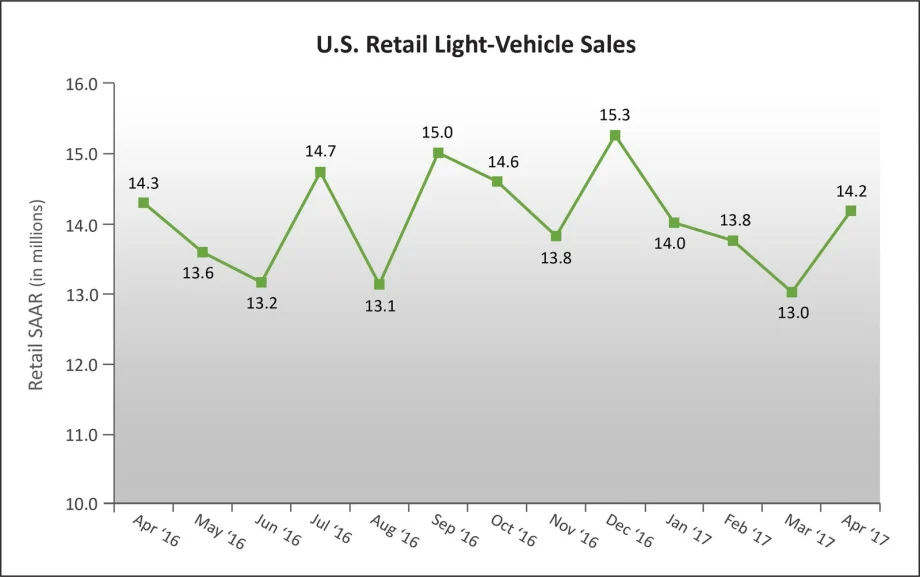
Source: Power Information Network® (PIN) from J.D. Power
DETROIT — New-vehicle retail sales are expected to remain on pace with last year, but incentive spending is at record levels through April, according to a forecast developed jointly by J.D. Power and LMC Automotive.
April retail sales are expected to reach 1,169,700 units, a 1.3% increase compared to a year ago on a selling day adjusted basis. Year to date, retail sales in 2017 are up 0.3% compared to the same period a year ago.
“While industry retail sales pace remains high, it is being powered by elevated levels of incentive spending which pose a serious threat to the long-term health of the industry,” said Deirdre Borrego, senior vice president of automotive data and analytics at J.D. Power. “The total value of incentives used to sell new vehicles has increased by $1.9 billion through the first four months of the year.”
Total incentive spending in the marketplace stands at $16.4 billion through April, up 13% from last year. On a per-unit basis, spending for the average new vehicle through April was $3,814, up $460 from a year ago, according to the two firms. On trucks and SUVs, spending was $3,740 per unit, up $578. On cars, spending was $3,938 per unit, up $308.
Despite record incentive levels, average days to turn continues to rise. Nearly 30% of vehicles sold in 2017 sat on dealer lots for more than 90 days, up from 27% last year. “With flat retail demand and inventory at record levels, manufacturers will continue to face a difficult choice between maintaining elevated incentives or making production cuts,” Borrego said.
The average new-vehicle retail transaction price through April reached a record $31,380, surpassing the previous monthly high of $31,228 set in April 2016, according to the firms. Average incentive spending per unit through April 16 is $3,499, a record for the month and surpassing the previous high of $3,393 set in April 2009.
Additionally, trucks account for 61.8% of new-vehicle retail sales so far in April — the highest level ever for the month of April and the 10th consecutive month above 60%.
The firms also noted that days to turn reached 70 in the first 13 days of April, the highest level for any month since July 2009 (80), according to the firms.
Fleet sales are expected to total 306,400 units in April, up 3.8% from April 2016 on a selling day adjusted basis. Fleet volume is expected to account for 20.8% of total light-vehicle sales, a slight increase from 20.4% in April 2016.
“Retail auto sales are performing as expected but non-retail sales have been slightly lower, which is the primary reason for total sales being down 1.4% year to date. But this is no time to hit the panic button,” said Jeff Schuster, senior vice president of forecasting at LMC Automotive. “There’s a lot of runway left in the year and many variables. Economic and policy factors remain important in setting direction for the auto sector in the near term, however, given the year-to-date performance, risk assessment is looking at internal factors like used-car pricing, lease penetration and the interplay between vehicle inventory and incentives.”
As the outlook for 2017 is realigned based on current factors, LMC is reducing its forecast by 40,000 units to 17.5 million total light-vehicle sales in 2017. That’s a decline of 0.1% from 2016. The forecast for retail light-vehicle sales remains at 14.2 million units, representing 0.2% increase from 2016.
More Auto Finance

Interest Rates Further Squeeze Auto Consumers
Last month’s hike and a potential second increase this month add to a growing list of inflation woes that could continue to dent overall car sales.
Read More →
Mind Your Process
Consistent steps taken in various aspects of the F&I office can make valuable differences over time, similar to an outline for a best-selling book.
Read More →
Top Five Credit Application Fraud Flags
Compliance audits regularly reveal bad habits that can lead to fraud charges and should have been stamped out decades ago.
Read More →
More Auto Loans for the Taking in August
Riskier categories were on the uptick for the month as lenders loosened access in several areas while balancing out the exposure in another, Cox Automotive reported.
Read More →
July Was Hot for Auto Borrowers
Credit proved readily available for many, but most loans left buyers in negative territory, Cox Automotive said.
Read More →
Dealer Lender Preferences Revealed
When lenders provide consistent, fast service, their overall satisfaction scores with dealers greatly improve, according to JD Power research.
Read More →
Auto Refi Savings Surge
Consumers with 84-month auto loan terms who refinanced saved the most on monthly payments, according to a new report by auto refinancing provider Caribou.
Read More →
Subaru Enters Lending Business
The automaker follows other brands in adding captive financing in the U.S., and says the move will strengthen its position here.
Read More →
Positive Equity Reaches Record High
Mainstream vehicle owners who bought a car seven years ago are likely to have positive equity when trading in for a new vehicle, according to second-quarter Edmunds data.
Read More →
Dealerships Are Paying the Price for Extended Car Loans
Growing negative-equity scenarios mean such lengthy terms should be addressed in a forward-looking way to make them work for the dealer and the consumer down the road.
Read More →