



KBB Puts September's SAAR at 17.5 Million
Kelley Blue Book said replacement demand driven by hurricanes Harvey and Sandy is already being felt in some areas. The firm predicts that will continue into October and potentially November as vehicle insurance payouts are received.
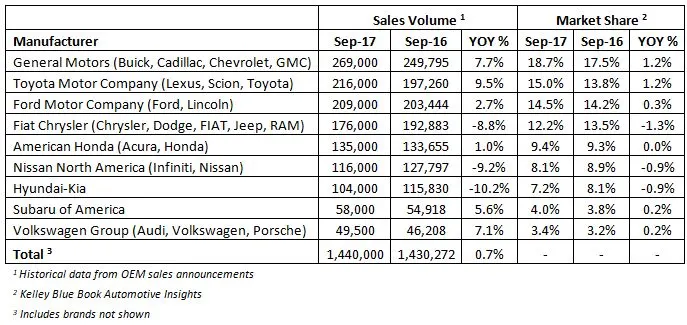
IRVINE, Calif. — September new-vehicle sales, including fleet, are expected to rise 0.7% from a year ago to 1.44 million units, resulting in an estimated seasonally adjusted annual rate of 17.5 million, according to Kelley Blue Book.
The firm noted that most consumers are likely to shop used. However, with used prices trending upward recently, some used buyers may opt to purchase new. Additionally, many automakers are offering hurricane relief incentives of up to $1,000. In these areas, car segments are likely to be shopped more, as these vehicles are the most affordable and in plentiful supply. Nationally, demand is still shifting steadily toward SUVs.
“September will be another opportunity for the first sales increase of the year, as we project slight growth for the industry,” said Kelley Blue Book analyst Tim Fleming. “While major hurricanes devastated parts of Texas and Florida in the past month, this is driving replacement demand for those drivers with vehicles destroyed. This demand has already started in some areas, but will continue into October and potentially November, as vehicle insurance payouts are received.”
At 1.44 million, however, sales would be down 2.6% from August. But at 17.5 million, the SAAR would be up from August’s 16 million-unit reading.
Additionally, retail sales are expected to account for 85.5% of volume in September, up from 85.4% in September 2016.
And after a record sales year in 2016 and seven consecutive annual increases, Kelley Blue Book’s forecast for 2017 calls for sales in the range of 16.8 million and 17.3 million units, a 1% to 4% decrease from last year.
By brand, Kelley Blue Book anticipates another month of mixed new-car sales results fro manufacturers. Toyota, for instance, could have the best month of all automakers with projected growth of 9.5%, which would be the manufacturer’s most significant year-over-year increase since December 2015.
“Sales of the RAV4 crossover are surging, as it has become the top-selling model outside of pickup trucks, and this month looks strong for the vehicle as well,” the firm noted in its report. “Meanwhile, the redesigned Camry is growing in availability and could offer a nice sales lift for Toyota.”
Hyundai-Kia, however, is possible looking at severe declines in sales and losing one point of market share. “The automakers’ SUVs are posting sales gains, including the Hyundai Tucson. But Hyundai-Kia’s lineup still leans heavily on cars, which are struggling,” the firm noted. “Some nameplates like the Kia Soul and Forte could have a good month, but Kelley Blue Book expects the brands’ cars could fall by 15% overall.
“Half of these sales declines are attributed to fleet and rental reductions versus last year.”
Compact SUVs are still the No. 1 segment and are expected to gain market share in September 2017. Aside from the Toyota RAV4, which the firm believes could top 40,000 sales for the third consecutive month, several redesigned products are helping to drive segment growth, including the Chevrolet Equinox, Subaru Crosstrek, and GMC Terrain — all of which could see sales increases upwards of 40%, according to Kelley Blue Book.
“Year to date, sales in the compact SUV segment are up just 2%, but this represents significant volume given the annual sales total could reach three million units,” the firm noted.
Mid-size SUVs are another category on the rise, with growing headlined by the redesigned Chevrolet Traverse and the all-new Volkswagen Atlas. A 5% increase in sales is expected for this segment in September, Kelley Blue Book predicts.
More Auto Finance

Interest Rates Further Squeeze Auto Consumers
Last month’s hike and a potential second increase this month add to a growing list of inflation woes that could continue to dent overall car sales.
Read More →
Mind Your Process
Consistent steps taken in various aspects of the F&I office can make valuable differences over time, similar to an outline for a best-selling book.
Read More →
Top Five Credit Application Fraud Flags
Compliance audits regularly reveal bad habits that can lead to fraud charges and should have been stamped out decades ago.
Read More →
More Auto Loans for the Taking in August
Riskier categories were on the uptick for the month as lenders loosened access in several areas while balancing out the exposure in another, Cox Automotive reported.
Read More →
July Was Hot for Auto Borrowers
Credit proved readily available for many, but most loans left buyers in negative territory, Cox Automotive said.
Read More →
Dealer Lender Preferences Revealed
When lenders provide consistent, fast service, their overall satisfaction scores with dealers greatly improve, according to JD Power research.
Read More →
Auto Refi Savings Surge
Consumers with 84-month auto loan terms who refinanced saved the most on monthly payments, according to a new report by auto refinancing provider Caribou.
Read More →
Subaru Enters Lending Business
The automaker follows other brands in adding captive financing in the U.S., and says the move will strengthen its position here.
Read More →
Positive Equity Reaches Record High
Mainstream vehicle owners who bought a car seven years ago are likely to have positive equity when trading in for a new vehicle, according to second-quarter Edmunds data.
Read More →
Dealerships Are Paying the Price for Extended Car Loans
Growing negative-equity scenarios mean such lengthy terms should be addressed in a forward-looking way to make them work for the dealer and the consumer down the road.
Read More →