



Light Vehicle Sales Rebounding in Late February, JD Power and LMC Report
Early returns for the month of February show sales of light vehicles rebounding after being hampered by severe weather disruptions in much of the United States.
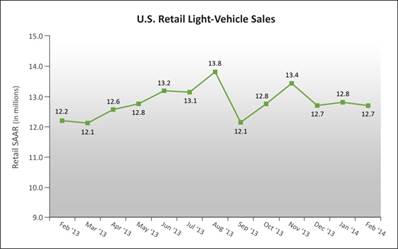
WESTLAKE VILLAGE, Calif. — Preliminary returns from February showed that retail light-vehicle sales were on the upswing after suffering through severe weather conditions in much of the United States in January and the first week of the month, J.D. Power and LMC Automotive reported last week.
J.D. Power said it expects the sales pace to increase toward the end of the month, as vehicle buyers who delayed their purchase due to severe weather return to market. The firm said the President’s Day holiday weekend and other promotional events should also provide a sales boost.
February’s new-vehicle retail sales are forecasted to reach 972,400 units — a 5% increase from February 2013 — with the seasonally adjusted annualized rate (SAAR) for retail sales projected to reach 12.7 million.
“Although severe weather impacted sales in early February, the negative effect should be somewhat mitigated since the majority of vehicle sales occur in the second half of the month,” said John Humphrey, senior vice president of the global automotive practice at J.D. Power.
Humphrey also noted that the underlying health of the industry remains strong, as seen through a continuation of record average transaction prices.
“The industry is on track to reach its highest ever average transaction price for the month of February, with prices exceeding $29,000,” Humphrey said. “This beats the previous record from February 2013 by more than $400.”
J.D. Power also expects consumer spending on new vehicles — the sum of retail sales multiplied by transaction price — to exceed $28.3 billion in February, also the highest for the month and an increase of nearly $1.7 billion from February 2013.
J.D. Power and LMC Automotive U.S. Sales and SAAR Comparisons
February 20141 | January 2014 | February 2013 | |
New-Vehicle Retail Sales | 972,400 units (5% higher than February 2013) | 825,610 units | 928,130 units |
Total Vehicle Sales | 1,226,000 units (3% higher than February 2013) | 1,010,713 units | 1,191,934 units |
Retail SAAR | 12.7 million units | 12.8 million units | 12.2 million units |
Total SAAR | 15.7 million units | 15.2 million units | 15.3 million units |
1Figures cited for February 2014 are forecasted based on the first 13 selling days of the month.
Total light-vehicle sales in February 2014 are projected to reach 1.2 million units, a 3% increase from February 2013. Fleet sales should account for less than 21% of total new-vehicle sales, which is below the February average of more than 22% from the previous two years. Fleet sales for the full year are forecasted to account for 17.8% of total sales, slightly higher than 2013.
Despite the initial slow start to the year, LMC Automotive’s forecast for total light-vehicle sales in 2014 remains at 16.2 million units, with retail light-vehicle sales of 13.3 million units.
“With the likelihood of fleet sales holding below 18% and modest retail sales increases, the absolute rate of growth could be lower than initially expected,” said Jeff Schuster, senior vice president of forecasting at LMC Automotive. “The auto industry needs to be prepared for slower but stable growth and increased competitive intensity, which will put pressure on the successful execution of launches this year.”
Vehicle production in North America in January — hampered by inclement weather in the southeastern United States — came in at 1.3 million units, flat from January 2013 but a 250,000-unit increase from December.
A slower-than-expected sales pace in January, combined with excess production in the fourth quarter of 2013, built a substantial increase in inventory from a days-supply perspective. Inventory started February at an 88-day supply, an increase of 24 days from the start of January. The supply level for Detroit Three increased to 109 days, with an additional 92,000 units parked on dealer lots and storage locations. All other manufacturers, with the exception of Subaru, also had an increase in inventory for the month.
“While inventory levels are excessive at this point, demand during the spring selling season will help resolve the situation,” said Bill Rinna, senior manager of forecasting at LMC Automotive. “However, if inventory is not cleared out by June, production levels in the second half of the year are at risk.”
Given the current environment and risk, LMC Automotive has reduced its 2014 North American production forecast by nearly 100,000 units to 16.5 million units, a 2.5% increase from 2013. This is still the highest total in the region since 2000.
More Auto Finance

Top Five Credit Application Fraud Flags
Compliance audits regularly reveal bad habits that can lead to fraud charges and should have been stamped out decades ago.
Read More →
More Auto Loans for the Taking in August
Riskier categories were on the uptick for the month as lenders loosened access in several areas while balancing out the exposure in another, Cox Automotive reported.
Read More →
July Was Hot for Auto Borrowers
Credit proved readily available for many, but most loans left buyers in negative territory, Cox Automotive said.
Read More →
Dealer Lender Preferences Revealed
When lenders provide consistent, fast service, their overall satisfaction scores with dealers greatly improve, according to JD Power research.
Read More →
Auto Refi Savings Surge
Consumers with 84-month auto loan terms who refinanced saved the most on monthly payments, according to a new report by auto refinancing provider Caribou.
Read More →
Subaru Enters Lending Business
The automaker follows other brands in adding captive financing in the U.S., and says the move will strengthen its position here.
Read More →
Positive Equity Reaches Record High
Mainstream vehicle owners who bought a car seven years ago are likely to have positive equity when trading in for a new vehicle, according to second-quarter Edmunds data.
Read More →
Dealerships Are Paying the Price for Extended Car Loans
Growing negative-equity scenarios mean such lengthy terms should be addressed in a forward-looking way to make them work for the dealer and the consumer down the road.
Read More →
Trade-Ins in Negative Equity Reach New Heights
As such trade-ins rise in frequency, so do monthly loan payment amounts and interest rates, according to second-quarter data compiled by Edmunds.
Read More →
Auto Credit Plentiful
June numbers show lenders are readily granting access, including to risky borrowers, as consumers leverage themselves to take on high prices.
Read More →