



Toyota Still Leads Buyer Loyalty, but Loses Ground
Edmunds.com reports that Toyota loyalty faded slightly in the first quarter of 2010, but the Japanese automaker still remains the strongest in the auto industry.
SANTA MONICA, Calif. — Edmunds.com reports that Toyota loyalty faded slightly in the first quarter of 2010, but the Japanese automaker still remains the strongest in the auto industry.
During the first quarter, nearly 58 percent of Toyota trade-ins resulted in the purchase of a new Toyota vehicle, down four percent from the first quarter of last year. At the other end of the spectrum, Mercury owners had the lowest loyalty among all major brands, with only 14 percent of Mercury trade-ins resulting in the purchase of another Mercury vehicle.
Toyota, Ford, Hyundai, Honda, Subaru, Nissan and Mercedes-Benz are the only brands that had a loyalty rate of 50 percent or higher, according to Edmunds.com’s study. (Edmunds.com only included brands that sell more than 10,000 vehicles per quarter.)
Year-over-year, Mercedes-Benz gained the most ground in retaining customers, followed by BMW and Nissan.
Here are some other trade-in trends:
• Among domestic brands, Ford had the highest owner loyalty and second highest industrywide. Nearly 56 percent of Ford trade-ins resulted in the purchase of a new Ford, up nearly 10 percent from the first quarter of 2009. Chevrolet was second at 45 percent and Dodge came in third at 38 percent.
• Among the imports, Hyundai came in second after Toyota. Nearly 56 percent of Hyundai trade-ins resulted in the purchase of another Hyundai, while Honda was next at 51 percent. At the other end of the spectrum, just over 14 percent of Infinitis were traded in for new Infinitis.
• Among luxury brands, Mercedes-Benz had the highest owner loyalty: 50 percent of Mercedes-Benz trade-ins resulted in the purchase of a new Mercedes-Benz. Lexus was second at 46 percent followed by Acura at 34 percent. Infiniti had the lowest loyalty among luxury brands; just over 14 percent of Infinitis were traded in for new Infinitis.
Trade-In Loyalty | |||
Make | Q1 2010 | Q1 2009 | Q1 2010 vs. Q1 2009 |
Toyota | 57.6% | 60.1% | -4.2% |
Ford | 56.1% | 51.2% | 9.5% |
Hyundai | 55.8% | 63.8% | -12.5% |
Honda | 55.2% | 51.7% | 6.8% |
Subaru | 51.8% | 48.4% | 7.1% |
Nissan | 50.7% | 41.0% | 23.7% |
Mercedes-Benz | 50.0% | 38.0% | 31.3% |
Kia | 46.6% | 53.9% | -13.4% |
Lexus | 46.1% | 38.1% | 21.1% |
Chevrolet | 45.3% | 49.6% | -8.6% |
Dodge | 37.6% | 43.8% | -14.2% |
GMC | 36.0% | 37.1% | -2.9% |
Acura | 35.4% | 36.5% | -3.1% |
Jeep | 32.6% | 38.7% | -15.9% |
Volkswagen | 32.4% | 40.2% | -19.5% |
BMW | 32.3% | 24.6% | 31.4% |
Audi | 30.1% | 40.5% | -25.7% |
Cadillac | 29.9% | 37.3% | -19.8% |
Volvo | 27.2% | 31.3% | -13.1% |
Buick | 25.7% | 29.9% | -14.0% |
Lincoln | 24.9% | 27.3% | -9.0% |
Mazda | 22.7% | 27.0% | -15.8% |
Mitsubishi | 20.7% | 22.7% | -8.9% |
Chrysler | 17.3% | 27.7% | -37.5% |
Infiniti | 14.1% | 17.7% | -20.5% |
Mercury | 14.0% | 21.0% | -33.2% |
“Some automakers offer owner loyalty programs that are rather compelling, such as Toyota’s recent offer of two years’ worth of free maintenance for current owners who buy new Toyotas,” commented Michelle Krebs, Senior Analyst for Edmunds.com. “However, today automakers like Ford, Honda and Chevy are generating loyalty by delivering on or above customer expectations – without having to pay for special marketing programs.”
More F&I
Plug Your Profit Leaks
By building in clear processes, your dealership can realize more profits in plugged leaks to maximize sales opportunities.
Managing Expectations
Learn how proactive communication, setting clear expectations, and providing solutions when plans change can strengthen customer trust and improve the overall service experience.

The F&I Manager's Report Card
The best managers take the time and attention to measure the behaviors behind the numbers.

AI: Facilitator, Not Fixer, in F&I
The dealerships that thrive in the years ahead will be those that embrace technology while continuing to invest in the people who make customer interactions count.
Modern Technology Objection Handling
In this video, Trent White shares how to confidently handle technology-based objections by helping customers understand the value of protection, even with modern vehicle technology.
Consistency at Scale: Driving F&I Performance
With 75 rooftops across the Sunshine State, Morgan Auto Group has proven to Floridians that it knows a thing or two about driving performance in a competitive market. But it didn’t start at the top.

Gitty Up on GAP
The foundational finance-and-insurance product hasn’t kept up with the latest conditions for auto dealers. Is the time ripe?
How AI-Powered Coaching Is Transforming F&I Performance
See how AI-powered coaching can turn F&I customer conversations into actionable insights that support compliance, performance and profitability

Sell Value, Build Trust
In this video, Trent White explains why selling on value, not fear, builds lasting customer trust, reduces cancellations, and drives long-term success.
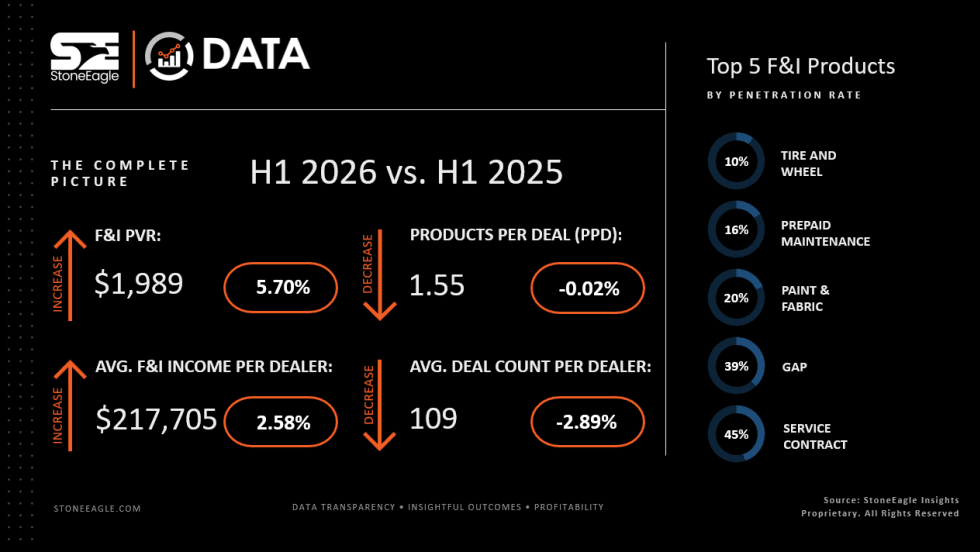
F&I Sales Give Dealers First-Half Lift
Product business shored up total profits to avoid an overall revenue tanking as product penetrations held steady, StoneEagle reported.